Kirjojen hintavertailu – 12 859 828 kirjaa ja 27 kauppaa
Kirjailija
John Davis
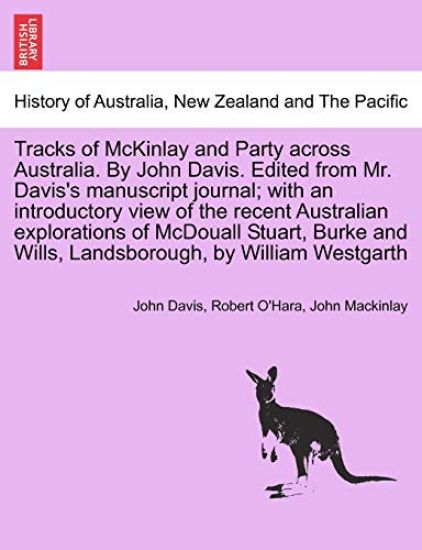
Kirjat ja teokset yhdessä paikassa: 148 kirjaa, julkaisuja vuosilta 1978–2026, suosituimpiin kuuluu Tracks of McKinlay and Party Across Australia. by John Davis. Edited from Mr. Davis's Manuscript Journal; With an Introductory View of the Recent Australian Explorations of McDouall Stuart, Burke and Wills, Landsborough, by William Westgarth. Vertaile teosten hintoja ja tarkista saatavuus suomalaisista kirjakaupoista.
This book is dedicated to an amazing airplane, the SR-71 Blackbird. Here you can see the innovative construction of the plane, the equipment and payloads. Also the missions and the efforts of Soviet Union to shot down and put hand on a Blackbird. The SR-71 Blackbird broke many records in the history of aviation. Here you can also read true stories from the pilots who flew with this plane, an amazing adventure. The book contains full colour photos in good quali
The 18th century was a wealth of knowledge, exploration and rapidly growing technology and expanding record-keeping made possible by advances in the printing press. In its determination to preserve the century of revolution, Gale initiated a revolution of its own: digitization of epic proportions to preserve these invaluable works in the largest archive of its kind. Now for the first time these high-quality digital copies of original 18th century manuscripts are available in print, making them highly accessible to libraries, undergraduate students, and independent scholars. Western literary study flows out of eighteenth-century works by Alexander Pope, Daniel Defoe, Henry Fielding, Frances Burney, Denis Diderot, Johann Gottfried Herder, Johann Wolfgang von Goethe, and others. Experience the birth of the modern novel, or compare the development of language using dictionaries and grammar discourses. ++++The below data was compiled from various identification fields in the bibliographic record of this title. This data is provided as an additional tool in helping to insure edition identification: ++++Library of CongressW012834Errata statement, p. 71]. New-York: Furman and Loudon's Type, 1800. 70, 2]p.; 14 cm
Tracks of McKinlay and Party Across Australia is an unchanged, high-quality reprint of the original edition of 1863. Hansebooks is editor of the literature on different topic areas such as research and science, travel and expeditions, cooking and nutrition, medicine, and other genres. As a publisher we focus on the preservation of historical literature. Many works of historical writers and scientists are available today as antiques only. Hansebooks newly publishes these books and contributes to the preservation of literature which has become rare and historical knowledge for the future.
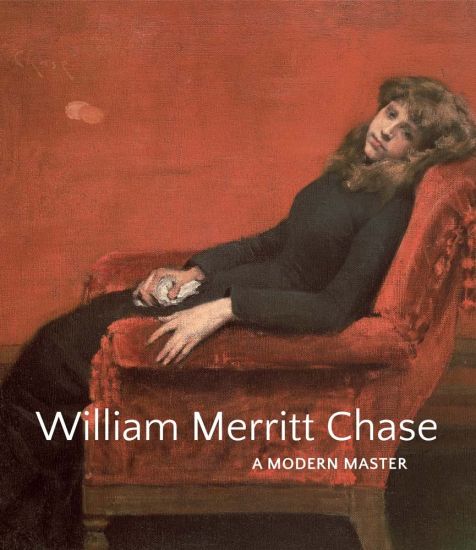
A landmark retrospective that examines William Merritt Chase and his lasting contribution to the history of modern art The history of modern art owes a great debt to William Merritt Chase (1849–1916), one of America’s influential artists and educators. Chase was a leading member of the international artistic avant-garde and was best known for his mastery of a wide range of subjects in oil and pastel, including figures, landscapes, urban park scenes, interiors, and portraits. As a teacher and founder of the Shinnecock Summer School of Art and the New York School of Art, Chase mentored a new generation of modernists, including Edward Hopper, Georgia O’Keeffe, and Joseph Stella. A century after his death, the breadth and richness of Chase’s career are celebrated in this beautifully illustrated publication. Five essays by prominent scholars of American art offer new insights into Chase’s multi-faceted artistic practice and his position in the international cultural climate at the turn of the 20th century. Published in association with The Phillips CollectionExhibition Schedule:The Phillips Collection, Washington, D. C. (06/04/16–09/11/16)Museum of Fine Arts, Boston (10/09/16–01/16/17)Ca’Pesaro-Galleria Internazionale d’Arte Moderna, Venice (02/11/17–05/28/17)
The publications of the Hakluyt Society (founded in 1846) made available edited (and sometimes translated) early accounts of exploration. The first series, which ran from 1847 to 1899, consists of 100 books containing published or previously unpublished works by authors from Christopher Columbus to Sir Francis Drake, and covering voyages to the New World, to China and Japan, to Russia and to Africa and India. John Davis (c.1543–1605) was an eminent explorer and navigator who published two highly influential guides to practical navigation in 1594 and 1595 and invented an improved version of a navigational instrument known as the Davis quadrant. This book, first published in 1880, includes these two guides, The Seaman's Secret and The Worlds' Hydrographical Description, together with accounts of the three voyages John Davis undertook in search of the North-West Passage between 1585 and 1587.
The book presents a detailed description of all known astrolabes and quadrants made in England in the Middle Age, placing these instruments within their historical context. It analyses the socio-cultural and intellectual situation in England in the Early Middle Ages, which allowed astronomical instrument manufacture to develop and flourish in the fourteenth century. With additional consideration of the political situation in England and northern Europe during this period, including the Black Death and the beginning of the 100 Years War, the text also develops a series of interlocked hypotheses regarding the instruments' makers, owners and commissioners, revealing the influence of English instruments in continental Europe. The tools used to make these instruments are also described: these are largely undated and unsigned, but by reverse-engineering their designs and studying their metallurgy for the first time it is possible to assign likely dates of manufacture. Including seven specialized appendices and an extensive bibliography, the book is a detailed and copiously illustrated catalogue of all surviving Medieval English astrolabes and quadrants placed in their historical, social, and technical context.
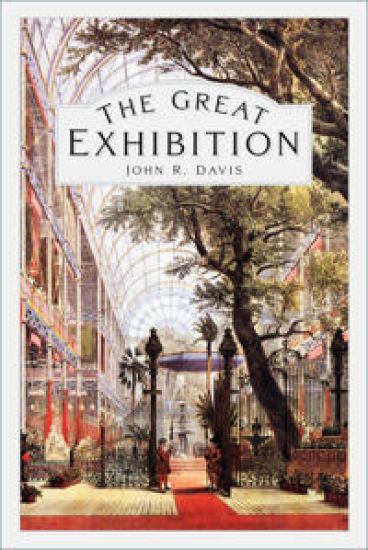
The Great Exhibition of 1851 was the world's first international exposition of manufactured goods, inventions, works of art and artefacts from many cultures. A showcase of British manufacturing supremacy, an educational extravaganza, a lesson to foreigners and a deep source of public fascination, the Exhibition was closely connected with Queen Victoria's consort, Prince Albert, who put much effort into having it sited in Hyde Park against stiff opposition. Protesters feared the disappearance of the park under tons of bricks and mortar, but when the great structure was eventually chosen and built, it silenced dissenters and became the most famous new building in the world. Designed by Joseph Paxton, it was a vast cathedral of glass, prefabricated off-site. Measuring 1851 feet in length and covering 26 acres, the building was viewed by its detractors as a "giant cucumber frame" and by Punch magazine as the "Crystal Palace" — a name which stuck. The Great Exhibition ran from May to October 1851 and in that time the 100,000 exhibits were seen by over six million people who came to celebrate Britain's industrial ascendancy and a renewed confidence in the possibilities of peaceful social progress. Financially, the Exhibition was a greater success than anyone dared hope, and the profit was invested in the advancement of education in art, industry and science at a new "Albertopolis" in London — containing eventually the South Kensington museums, the Albert Hall, Royal College of Music and Imperial College of Science and Technology. This volume provides an accessible history of the way the Exhibition was organized and took place. It also delves into its wider significance and the historical debates surrounding it. New insight is provided into the event's part in the Victorian construction of the modern world and in particular to its relevance to the millennium and the new "Great Exhibition" at Greenwich.
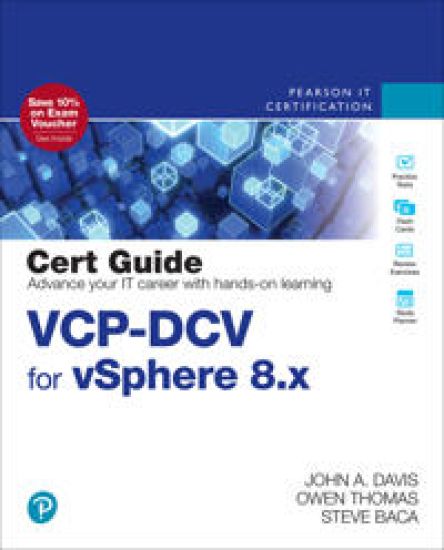
Learn, prepare, and practice for VCP-DCV for vSphere 8.x Professional exam success with this Cert Guide from Pearson IT Certification, a leader in IT Certification learning. VCP-DCV for vSphere 8.x Cert Guide from Pearson IT Certification helps you prepare to succeed on the VCP-DCV for vSphere 8.x Professional exam by directly addressing the exam's objectives as stated by VMware®. Leading instructors and experts John Davis and Steve Baca share preparation hints and test-taking tips, helping you identify areas of weakness and improve both your conceptual knowledge and hands-on skills. This complete study package includes Complete coverage of the exam objectives and a test-preparation routine designed to help you pass the examsDo I Know This Already? quizzes, which allow you to decide how much time you need to spend on each sectionChapter-ending Key Topic tables, which help you drill on key concepts you must know thoroughlyThe powerful Pearson Test Prep Practice Test software, complete with hundreds of well-reviewed, exam-realistic questions, customization options, and detailed performance reportsAn online, interactive Flash Cards application to help you drill on Key Terms by chapterA final preparation chapter, which guides you through tools and resources to help you craft your review and test-taking strategiesStudy plan suggestions and templates to help you organize and optimize your study time Well regarded for its level of detail, study plans, assessment features, and challenging review questions and exercises, this study guide helps you master the concepts and techniques that ensure your exam success. This study guide helps you master all the topics on the VMware vSphere 8.x Professional exam, including: Describing vSphere architecture, requirements, and featuresImplementing, configuring, and managing vSphere storageConfiguring secured access and networking in a vSphere environmentMonitoring, managing, and optimizing the services and resources in a vSphere environmentProvisioning, migrating, and supporting virtual machines in a vSphere environment