Kirjojen hintavertailu – 12 903 725 kirjaa ja 27 kauppaa

Kirjailija

John Dirk Walecka

Kirjat ja teokset yhdessä paikassa: 36 kirjaa, julkaisuja vuosilta 2000–2023, suosituimpiin kuuluu Introduction To Electricity And Magnetism. Vertaile teosten hintoja ja tarkista saatavuus suomalaisista kirjakaupoista.

36 kirjaa

Kirjojen julkaisuvuodet: 2000–2023.

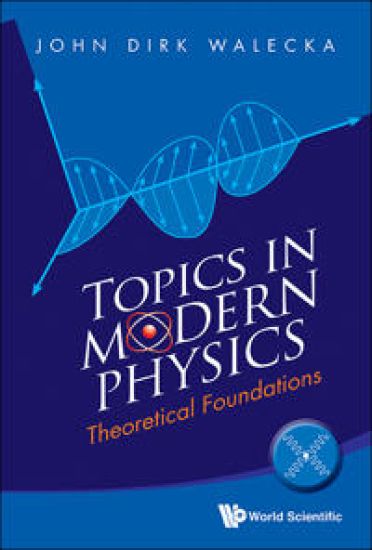
Topics In Modern Physics: Theoretical Foundations

Topics In Modern Physics: Theoretical Foundations

John Dirk Walecka

World Scientific Publishing Co Pte Ltd
2013
nidottu
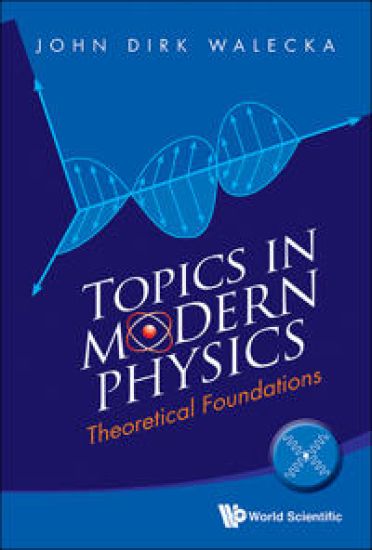
While the two previous books entitled Introduction to Modern Physics: Theoretical Foundations and Advanced Modern Physics: Theoretical Foundations exposed the reader to the foundations and frontiers of today's physics, the goal of this third volume is to cover in some detail several topics omitted in the essentially linear progression of the first two. This book is divided into three parts. Part 1 is on quantum mechanics. Analytic solutions to the Schrödinger equation are developed for some basic systems. The analysis is then formalized, concluding with a set of postulates for the theory. Part 2 is on applications of quantum mechanics: approximation methods for bound states, scattering theory, time-dependent perturbation theory, and electromagnetic radiation and quantum electrodynamics. Part 3 covers some selected topics in relativistic quantum field theory: discrete symmetries, the Heisenberg picture, and the Feynman rules for quantum chromodynamics. The three volumes in this series taken together provide a clear, logical, self-contained, and comprehensive base from which the very best students can learn modern physics. When finished, readers should have an elementary working knowledge in the principal areas of theoretical physics of the twentieth century.
Topics In Modern Physics: Theoretical Foundations

Topics In Modern Physics: Theoretical Foundations

John Dirk Walecka

World Scientific Publishing Co Pte Ltd
2013
sidottu
While the two previous books entitled Introduction to Modern Physics: Theoretical Foundations and Advanced Modern Physics: Theoretical Foundations exposed the reader to the foundations and frontiers of today's physics, the goal of this third volume is to cover in some detail several topics omitted in the essentially linear progression of the first two. This book is divided into three parts. Part 1 is on quantum mechanics. Analytic solutions to the Schrödinger equation are developed for some basic systems. The analysis is then formalized, concluding with a set of postulates for the theory. Part 2 is on applications of quantum mechanics: approximation methods for bound states, scattering theory, time-dependent perturbation theory, and electromagnetic radiation and quantum electrodynamics. Part 3 covers some selected topics in relativistic quantum field theory: discrete symmetries, the Heisenberg picture, and the Feynman rules for quantum chromodynamics. The three volumes in this series taken together provide a clear, logical, self-contained, and comprehensive base from which the very best students can learn modern physics. When finished, readers should have an elementary working knowledge in the principal areas of theoretical physics of the twentieth century.
Introduction To Statistical Mechanics

Introduction To Statistical Mechanics

John Dirk Walecka

World Scientific Publishing Co Pte Ltd
2011
sidottu
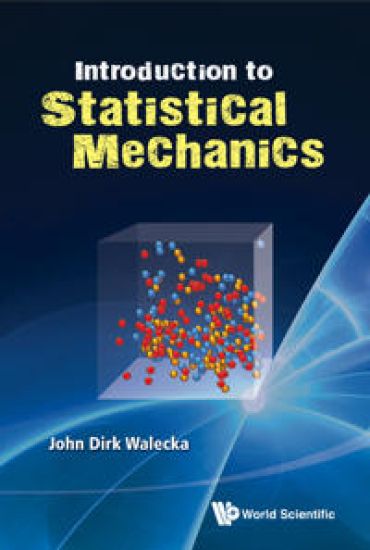
The science of statistical mechanics is concerned with defining the thermodynamic properties of a macroscopic sample in terms of the properties of the microscopic systems of which it is composed. The aim of this book is to provide a clear, logical, and self-contained treatment of equilibrium statistical mechanics starting from Boltzmann's two statistical assumptions, and to present a wide variety of applications to diverse physical assemblies. The coverage is enhanced and extended through an extensive set of accessible problems. An appendix provides an introduction to non-equilibrium statistical mechanics through the Boltzmann equation and its extensions. The book assumes introductory courses in classical and quantum mechanics, as well as familiarity with multi-variable calculus and the essentials of complex analysis. Some knowledge of thermodynamics is assumed, although the book starts with an appropriate review of that topic. The targeted audience is first-year graduate students, and advanced undergraduates, in physics, chemistry, and the related physical sciences. The goal of this text is to help the reader obtain a clear working knowledge of the very useful and powerful methods of equilibrium statistical mechanics and to enhance the understanding and appreciation of the more advanced texts.
Introduction To Statistical Mechanics

Introduction To Statistical Mechanics

John Dirk Walecka

World Scientific Publishing Co Pte Ltd
2011
nidottu
The science of statistical mechanics is concerned with defining the thermodynamic properties of a macroscopic sample in terms of the properties of the microscopic systems of which it is composed. The aim of this book is to provide a clear, logical, and self-contained treatment of equilibrium statistical mechanics starting from Boltzmann's two statistical assumptions, and to present a wide variety of applications to diverse physical assemblies. The coverage is enhanced and extended through an extensive set of accessible problems. An appendix provides an introduction to non-equilibrium statistical mechanics through the Boltzmann equation and its extensions. The book assumes introductory courses in classical and quantum mechanics, as well as familiarity with multi-variable calculus and the essentials of complex analysis. Some knowledge of thermodynamics is assumed, although the book starts with an appropriate review of that topic. The targeted audience is first-year graduate students, and advanced undergraduates, in physics, chemistry, and the related physical sciences. The goal of this text is to help the reader obtain a clear working knowledge of the very useful and powerful methods of equilibrium statistical mechanics and to enhance the understanding and appreciation of the more advanced texts.
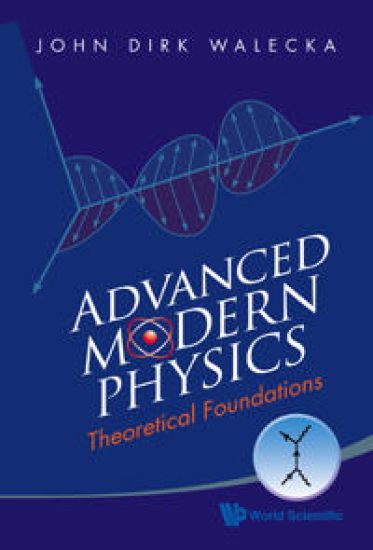
Advanced Modern Physics: Theoretical Foundations

Advanced Modern Physics: Theoretical Foundations

John Dirk Walecka

World Scientific Publishing Co Pte Ltd
2010
sidottu
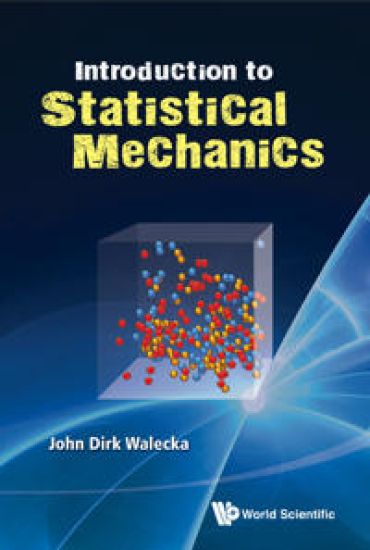
Our understanding of the physical world was revolutionized in the twentieth century — the era of “modern physics”. This book, aimed at the very best students, extends the coverage of the theoretical groundwork of today's physics presented in the previous volume: Introduction to Modern Physics: Theoretical Foundations (Vol. I). Typically, students have to wade through several courses to see many of these topics. The goal is to give them some idea of where they are going, and how things fit together, as they go along. The present book focuses on the following topics: reformulation of quantum mechanics, angular momentum, scattering theory, lagrangian field theory, symmetries, Feynman rules, quantum electrodynamics, including higher-order contributions, path integrals, and canonical transformations for quantum systems. Many problems are included that enhance and extend the coverage. The book assumes a mastery of the material in Vol. I, and the continued development of mathematical skills, including multivariable calculus and linear algebra. Several appendices provide important details, and any additional required mathematics. The reader should then find the text, together with the appendices and problems, to be self-contained. The aim is to cover the framework of modern theoretical physics in sufficient depth that things “make sense” to students, and, when finished, the reader should have an elementary working knowledge in the principal areas of theoretical physics of the twentieth century.
Advanced Modern Physics: Theoretical Foundations

Advanced Modern Physics: Theoretical Foundations

John Dirk Walecka

World Scientific Publishing Co Pte Ltd
2010
nidottu
Our understanding of the physical world was revolutionized in the twentieth century — the era of “modern physics”. This book, aimed at the very best students, extends the coverage of the theoretical groundwork of today's physics presented in the previous volume: Introduction to Modern Physics: Theoretical Foundations (Vol. I). Typically, students have to wade through several courses to see many of these topics. The goal is to give them some idea of where they are going, and how things fit together, as they go along. The present book focuses on the following topics: reformulation of quantum mechanics, angular momentum, scattering theory, lagrangian field theory, symmetries, Feynman rules, quantum electrodynamics, including higher-order contributions, path integrals, and canonical transformations for quantum systems. Many problems are included that enhance and extend the coverage. The book assumes a mastery of the material in Vol. I, and the continued development of mathematical skills, including multivariable calculus and linear algebra. Several appendices provide important details, and any additional required mathematics. The reader should then find the text, together with the appendices and problems, to be self-contained. The aim is to cover the framework of modern theoretical physics in sufficient depth that things “make sense” to students, and, when finished, the reader should have an elementary working knowledge in the principal areas of theoretical physics of the twentieth century.
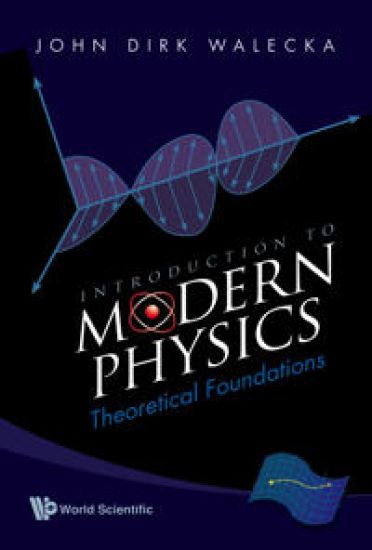
Introduction To Modern Physics: Theoretical Foundations

Introduction To Modern Physics: Theoretical Foundations

John Dirk Walecka

World Scientific Publishing Co Pte Ltd
2008
nidottu
Our understanding of the physical world was revolutionized in the twentieth century — the era of “modern physics''. This book, aimed at the very best students, presents the foundations and frontiers of today's physics. It focuses on the following topics: quantum mechanics; applications in atomic, nuclear, particle, and condensed-matter physics; special relativity; relativistic quantum mechanics, including the Dirac equation and Feynman diagrams; quantum fields; and general relativity. The aim is to cover these topics in sufficient depth such that things “make sense'' to students and they can achieve an elementary working knowledge of them. Many problems are included, a great number of which take dedicated readers just as far as they want to go in modern physics. Although the book is designed so that one can, in principle, read and follow the text without doing any of the problems, the reader is urged to attempt as many of them as possible. Several appendices help bring the reader up to speed on any additional required mathematics. With very few exceptions, the reader should then find the text, together with the appendices and problems, to be self-contained.
Introduction To Modern Physics: Theoretical Foundations

Introduction To Modern Physics: Theoretical Foundations

John Dirk Walecka

World Scientific Publishing Co Pte Ltd
2008
sidottu
Our understanding of the physical world was revolutionized in the twentieth century — the era of “modern physics''. This book, aimed at the very best students, presents the foundations and frontiers of today's physics. It focuses on the following topics: quantum mechanics; applications in atomic, nuclear, particle, and condensed-matter physics; special relativity; relativistic quantum mechanics, including the Dirac equation and Feynman diagrams; quantum fields; and general relativity. The aim is to cover these topics in sufficient depth such that things “make sense'' to students and they can achieve an elementary working knowledge of them. Many problems are included, a great number of which take dedicated readers just as far as they want to go in modern physics. Although the book is designed so that one can, in principle, read and follow the text without doing any of the problems, the reader is urged to attempt as many of them as possible. Several appendices help bring the reader up to speed on any additional required mathematics. With very few exceptions, the reader should then find the text, together with the appendices and problems, to be self-contained.
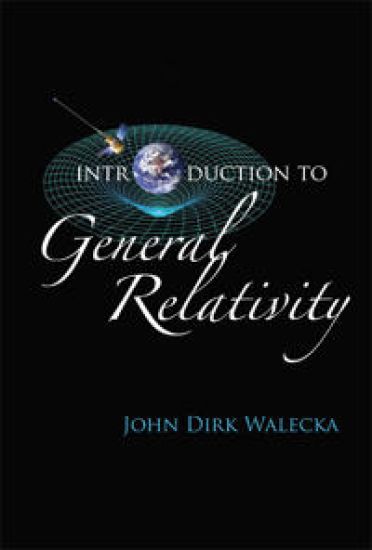
Introduction To General Relativity

Introduction To General Relativity

John Dirk Walecka

World Scientific Publishing Co Pte Ltd
2007
nidottu
A working knowledge of Einstein's theory of general relativity is an essential tool for every physicist today. This self-contained book is an introductory text on the subject aimed at first-year graduate students, or advanced undergraduates, in physics that assumes only a basic understanding of classical Lagrangian mechanics. The mechanics problem of a point mass constrained to move without friction on a two-dimensional surface of arbitrary shape serves as a paradigm for the development of the mathematics and physics of general relativity. After reviewing special relativity, the basic principles of general relativity are presented, and the most important applications are discussed. The final special topics section guides the reader through a few important areas of current research. This book will allow the reader to approach the more advanced texts and monographs, as well as the continual influx of fascinating new experimental results, with a deeper understanding and sense of appreciation.
Introduction To General Relativity

Introduction To General Relativity

John Dirk Walecka

World Scientific Publishing Co Pte Ltd
2007
sidottu
A working knowledge of Einstein's theory of general relativity is an essential tool for every physicist today. This self-contained book is an introductory text on the subject aimed at first-year graduate students, or advanced undergraduates, in physics that assumes only a basic understanding of classical Lagrangian mechanics. The mechanics problem of a point mass constrained to move without friction on a two-dimensional surface of arbitrary shape serves as a paradigm for the development of the mathematics and physics of general relativity. After reviewing special relativity, the basic principles of general relativity are presented, and the most important applications are discussed. The final special topics section guides the reader through a few important areas of current research. This book will allow the reader to approach the more advanced texts and monographs, as well as the continual influx of fascinating new experimental results, with a deeper understanding and sense of appreciation.
Theoretical Nuclear And Subnuclear Physics

Theoretical Nuclear And Subnuclear Physics

John Dirk Walecka

World Scientific Publishing Co Pte Ltd
2004
sidottu
This book is a revised and updated version of the most comprehensive text on nuclear and subnuclear physics, first published in 1995. It maintains the original goal of providing a clear, logical, in-depth, and unifying treatment of modern nuclear theory, ranging from the nonrelativistic many-body problem to the standard model of the strong, electromagnetic, and weak interactions. In addition, new chapters on the theoretical and experimental advances made in nuclear and subnuclear physics in the past decade have been incorporated. Four key topics are emphasized: basic nuclear structure, the relativistic nuclear many-body problem, strong-coupling QCD, and electroweak interactions with nuclei. New chapters have been added on the many-particle shell model, effective field theory, density functional theory, heavy-ion reactions and quark-gluon plasma, neutrinos, and electron scattering. This book is designed to provide graduate students with a basic understanding of modern nuclear and hadronic physics needed to explore the frontiers of the field. Researchers will benefit from the updates on developments and the bibliography.
Theoretical Nuclear And Subnuclear Physics

Theoretical Nuclear And Subnuclear Physics

John Dirk Walecka

World Scientific Publishing Co Pte Ltd
2004
nidottu
This book is a revised and updated version of the most comprehensive text on nuclear and subnuclear physics, first published in 1995. It maintains the original goal of providing a clear, logical, in-depth, and unifying treatment of modern nuclear theory, ranging from the nonrelativistic many-body problem to the standard model of the strong, electromagnetic, and weak interactions. In addition, new chapters on the theoretical and experimental advances made in nuclear and subnuclear physics in the past decade have been incorporated. Four key topics are emphasized: basic nuclear structure, the relativistic nuclear many-body problem, strong-coupling QCD, and electroweak interactions with nuclei. New chapters have been added on the many-particle shell model, effective field theory, density functional theory, heavy-ion reactions and quark-gluon plasma, neutrinos, and electron scattering. This book is designed to provide graduate students with a basic understanding of modern nuclear and hadronic physics needed to explore the frontiers of the field. Researchers will benefit from the updates on developments and the bibliography.
Theoretical Mechanics of Particles

Theoretical Mechanics of Particles

B. Roth; John Dirk Walecka

Dover Publications Inc.
2004
nidottu

Halvin toimitettuna 30,40 €

This two-part text fills what has often been a void in the first-year graduate physics curriculum. Through its examination of particles and continua, it supplies a lucid and self-contained account of classical mechanics -- which in turn provides a natural framework for introducing many of the advanced mathematical concepts in physics. The text opens with Newton's laws of motion and systematically develops the dynamics of classical particles, with chapters on basic principles, rotating coordinate systems, lagrangian formalism, small oscillations, dynamics of rigid bodies, and hamiltonian formalism, including a brief discussion of the transition to quantum mechanics. This part of the book also considers examples of the limiting behavior of many particles, facilitating the eventual transition to a continuous medium. The second part deals with classical continua, including chapters on string membranes, sound waves, surface waves on nonviscous fluids, heat conduction, viscous fluids, and elastic media. Each of these self-contained chapters provides the relevant physical background and develops the appropriate mathematical techniques, and problems of varying difficulty appear throughout the text.
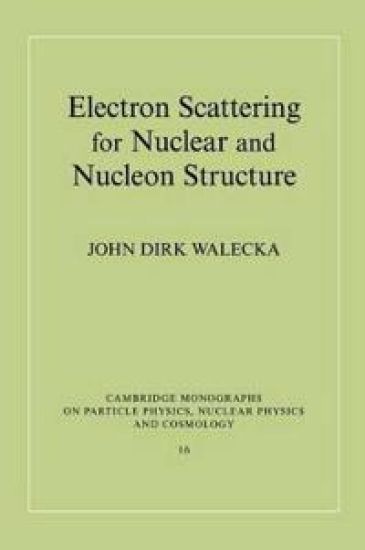
Electron Scattering for Nuclear and Nucleon Structure

Electron Scattering for Nuclear and Nucleon Structure

John Dirk Walecka

Cambridge University Press
2001
sidottu
The scattering of high-energy electrons from nuclear and nucleon targets provides a microscope for examining the structure of these tiny objects. The best evidence we have on what nuclei and nucleons actually look like comes from electron scattering. This book examines the motivation for electron scattering and develops the theoretical analysis of the process. It discusses our current theoretical understanding of the underlying structure of nuclei and nucleons at appropriate levels of resolution and sophistication, and summarizes present experimental electron scattering capabilities. Only a working knowledge of quantum mechanics and special relativity is assumed, making this a suitable textbook for graduate and advanced undergraduate courses. It will also provide a valuable summary and reference for researchers already working in electron scattering and other areas of nuclear/particle physics.
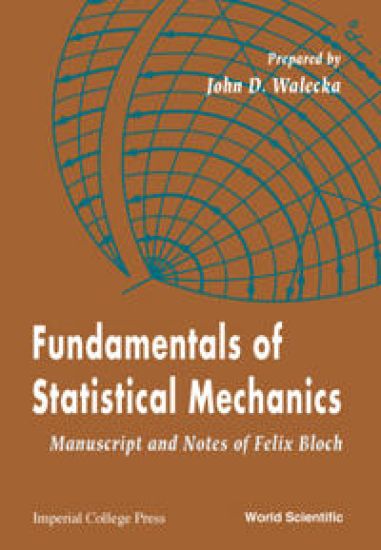
Fundamentals Of Statistical Mechanics: Manuscript And Notes Of Felix Bloch

Fundamentals Of Statistical Mechanics: Manuscript And Notes Of Felix Bloch

John Dirk Walecka

World Scientific Publishing Co Pte Ltd
2000
sidottu
The 1952 Nobel physics laureate Felix Bloch (1905-83) was one of the titans of twentieth-century physics. He laid the fundamentals for the theory of solids and has been called the “father of solid-state physics.” His numerous, valuable contributions include the theory of magnetism, measurement of the magnetic moment of the neutron, nuclear magnetic resonance, and the infrared problem in quantum electrodynamics. Statistical mechanics is a crucial subject which explores the understanding of the physical behaviour of many-body systems that create the world around us. Bloch's first-year graduate course at Stanford University was the highlight for several generations of students. Upon his retirement, he worked on a book based on the course. Unfortunately, at the time of his death, the writing was incomplete. This book has been prepared by Professor John Dirk Walecka from Bloch's unfinished masterpiece. It also includes three sets of Bloch's handwritten lecture notes (dating from 1949, 1969 and 1976), and details of lecture notes taken in 1976 by Brian Serot, who gave an invaluable opinion of the course from a student's perspective. All of Bloch's problem sets, some dating back to 1933, have been included. The book is accessible to anyone in the physical sciences at the advanced undergraduate level or the first-year graduate level.
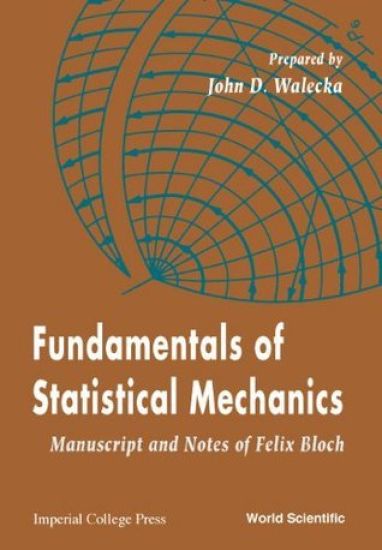
Fundamentals Of Statistical Mechanics: Manuscript And Notes Of Felix Bloch

Fundamentals Of Statistical Mechanics: Manuscript And Notes Of Felix Bloch

John Dirk Walecka

World Scientific Publishing Co Pte Ltd
2000
nidottu
The 1952 Nobel physics laureate Felix Bloch (1905-83) was one of the titans of twentieth-century physics. He laid the fundamentals for the theory of solids and has been called the “father of solid-state physics.” His numerous, valuable contributions include the theory of magnetism, measurement of the magnetic moment of the neutron, nuclear magnetic resonance, and the infrared problem in quantum electrodynamics. Statistical mechanics is a crucial subject which explores the understanding of the physical behaviour of many-body systems that create the world around us. Bloch's first-year graduate course at Stanford University was the highlight for several generations of students. Upon his retirement, he worked on a book based on the course. Unfortunately, at the time of his death, the writing was incomplete. This book has been prepared by Professor John Dirk Walecka from Bloch's unfinished masterpiece. It also includes three sets of Bloch's handwritten lecture notes (dating from 1949, 1969 and 1976), and details of lecture notes taken in 1976 by Brian Serot, who gave an invaluable opinion of the course from a student's perspective. All of Bloch's problem sets, some dating back to 1933, have been included. The book is accessible to anyone in the physical sciences at the advanced undergraduate level or the first-year graduate level.