Kirjojen hintavertailu – 12 859 818 kirjaa ja 27 kauppaa
Kirjailija
John Donne
Kirjat ja teokset yhdessä paikassa: 188 kirjaa, julkaisuja vuosilta 1952–2026, suosituimpiin kuuluu Bread and Wine. Vertaile teosten hintoja ja tarkista saatavuus suomalaisista kirjakaupoista.
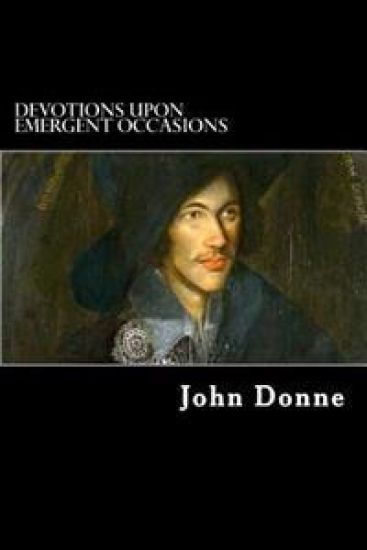
Devotions Upon Emergent Occasions by John Donne text is offered here together with Death's Duel. Devotions upon Emergent Occasions, or in full Devotions Upon Emergent Occasions, and severall steps in my Sicknes, is a prose work by the English metaphysical poet and cleric in the Church of England John Donne, published in 1624. It covers death, rebirth and the Elizabethan concept of sickness as a visit from God, reflecting internal sinfulness. The Devotions were written in December 1623 as Donne recovered from a serious but unknown illness - believed to be relapsing fever or typhus. Having come close to death, he described the illness he had suffered from and his thoughts throughout his recovery with "near super-human speed and concentration". 1] Registered by 9 January, and published soon after, the Devotions is one of only seven works attributed to John Donne which were printed during his lifetime. The Devotions is divided into 23 parts, each consisting of 3 sub-sections, called the 'meditation', the "expostulation' and a prayer. The 23 sections are chronologically ordered, each covering his thoughts and reflections on a single day of the illness. Famously, the 17th devotion, Meditation XVII, includes the phrases "No man is an Iland" (often modernised as "No man is an island") and "...for whom the bell tolls". The work as a whole is considered similar to 17th-century devotional writing generally, and particularly to Donne's Holy Sonnets. Some academics have also identified political strands running through the work, from a polemic Arminian denunciation of Puritanism to advice to the young Prince Charles. Donne was born in 1572 to a wealthy ironmonger and a warden of the Worshipful Company of Ironmongers, and his wife Elizabeth. 2] After his father's death when he was four, John Donne was trained as a gentleman scholar; his family used the money his father had made to hire tutors who taught him grammar, rhetoric, mathematics, history and foreign languages. Elizabeth remarried to a wealthy doctor, ensuring the family remained comfortable; as a result, despite being the son of an ironmonger and portraying himself in his early poetry as an outsider, Donne refused to accept that he was anything other than a gentleman. 3] After study at Hart Hall, Oxford, Donne's private education saw him study at Lincoln's Inn, one of the Inns of Court, where he occupied his time with history, poetry, theology and "Humane learning and languages". 4] It was at Lincoln's Inn that John Donne first began writing poetry, looking upon it as "a life-sign or minor irritation" rather than something that defined him. In November 1623, Donne fell seriously ill. London was the scene of a 'spotted' or relapsing fever, which hit its victims unexpectedly and left them conscious but physically helpless. 6] What disease Donne suffered from is not known. Writers have suggested typhus as a likely culprit, but Donne's writings on the subject reference multiple diseases. Clara Lander, writing in Studies in English Literature 1500-1900, suggests that the typhus may have exacerbated the enteritis Donne had suffered from since childhood. 7] Donne was of the opinion - as were many others of the age - that illness reflected a state of internal sinfulness, and constituted a visit from God. 8] Despite being ordered to rest, he insisted that a pen and paper be given to him, and he wrote down his impressions of the disease. 9] After his recovery, in December, these became Devotions upon Emergent Occasions, one of his few published prose works, 10] and also one of only seven printed works of which he acknowledged authorship. 11] Written with "near super-human speed and concentration", 1] the work was registered with the Stationers' Company by 9 January 1624. 1] It was published that year, and again in 1634 and 1638. 12] The full, albeit rarely used, title is Devotions Upon Emergent Occasions, and severall steps in my Sicknes.
This volume-presented in the original spelling, with all its inconsistencies-reproduces the text of Poems by J. D. With Elegies on the Authors Death, published in 1633, two years after Donne's death. Very little of Donne's poetry had been published during his lifetime but it was much prized and many manuscript copies survive from the period, although only one is in the author's hand. This first edition of Poems by J. D. remains a monument and-unusually for posthumous publications of this kind-very little of the contents was not Donne's work, only two poems having been incorrectly attributed.
This selection of John Donne's most powerful prose shows that the man remembered predominantly for his poetry was also a preacher, and a prose writer of extraordinary power. In it, he explores the metaphysical collision between poetry and religion, suicide and duty, the secular and the spiritual that characterized his times. Edited with an introduction and notes by Neil Rhodes.
Originally published in 1923, this book contains an edition of John Donne's Devotions, which were first printed in 1624. Donne wrote these passionate and 'unadorned' meditations during a severe sickness that he feared was life-threatening, and the text consequently provides an intimate portrait of Donne that is lacking from many of his other writings. A brief biography of Donne and a bibliographical note are also provided. This book will be of value to anyone with an interest in the life and spirituality of John Donne or in his contributions to seventeenth-century religious thought.
The nineteen poems that comprise John Donne's Holy Sonnets are works of anxiety and spiritual crisis. Most of the sonnets are thought to have been written between 1609 and 1611 but were not published until two decades later-two years after Donne's death. The Holy Sonnets explore the poet's fear and trembling when faced with the realisation of his mortality and self-described unworthiness as a recipient of God's grace and mercy. Donne's poems navigate through his doubts in search of a divine comfort and assurance in the hope of salvation and eternal life. With an introduction by poet John Daniel Thieme.
Biathanatos is a controversial work by the renowned English poet and cleric, John Donne. First published in 1648, the book is a treatise on the subject of suicide, arguing that it is not inherently sinful and that there may be circumstances where it is justifiable. Donne's argument is based on his interpretation of Christian theology and his belief that suicide is not explicitly condemned in the Bible. The book is divided into several sections, each of which explores different aspects of the topic. In the first section, Donne presents his thesis and sets out to refute the arguments of those who believe that suicide is always a sin. He argues that suicide can be an act of bravery, and that it is not necessarily a sign of mental illness or weakness. The second section of the book examines the historical and cultural attitudes towards suicide, from the ancient Greeks and Romans to the early modern period. Donne draws on a wide range of sources to show that suicide has been viewed differently in different times and places, and that it is not always regarded as a sin. In the third section, Donne considers the moral and ethical implications of suicide. He argues that there are circumstances where suicide may be the most moral choice, such as when a person is facing unbearable suffering or is in danger of committing a greater sin. He also explores the idea that suicide can be a form of martyrdom, and that it may be a way of expressing one's faith or political beliefs. The final section of the book is a series of reflections on death and the afterlife. Donne explores the idea that death is not necessarily something to be feared, and that it can be a release from the suffering and pain of life. He also considers the possibility of an afterlife, and the idea that suicide may not necessarily lead to damnation. Biathanatos is a complex and challenging work that raises important questions about the nature of sin, morality, and the value of human life. It is a fascinating insight into the mind of one of England's greatest poets and thinkers, and a testament to Donne's intellectual courage and originality. This Is A New Release Of The Original 1648 Edition. This scarce antiquarian book is a facsimile reprint of the old original and may contain some imperfections such as library marks and notations. Because we believe this work is culturally important, we have made it available as part of our commitment for protecting, preserving, and promoting the world's literature in affordable, high quality, modern editions, that are true to their original work.
The Poems Of John Donne V1 is a collection of poetry by the renowned English poet John Donne. This volume includes a wide range of Donne's work, including his famous love poems, religious sonnets, and satirical pieces. Donne's poetry is known for its complex themes, intricate metaphors, and clever wordplay, and this collection showcases the full range of his poetic talents. The book is a must-read for fans of classic English poetry, and it provides a fascinating glimpse into the mind of one of the most influential poets of the Renaissance era. This Is A New Release Of The Original 1901 Edition. This scarce antiquarian book is a facsimile reprint of the old original and may contain some imperfections such as library marks and notations. Because we believe this work is culturally important, we have made it available as part of our commitment for protecting, preserving, and promoting the world's literature in affordable, high quality, modern editions, that are true to their original work.
John Donne's poems on heavenly and earthly love, delight and despair, beauty and betrayal, are rightly regarded as one of the glories of European civilisation, something every school child (and child of every age) should know
Originally published in 1921 as part of the Cambridge Plain Texts series, this volume contains two sermons by John Donne, delivered in 1621 and 1625, on the theme of death and resurrection. A short editorial introduction is also included. This book will be of value to anyone with an interest in Donne and his religious writings.
John Donne (24 January 1572 - 31 March 1631) was an English poet, satirist, lawyer and a cleric in the Church of England. He is considered the pre-eminent representative of the metaphysical poets. This book contains two of his most famous works - "Devotions upon Emergent Occasions" and "Death's Duel". Devotions upon Emergent Occasions is a 1624 prose work by John Donne, who dedicated it to the future King Charles I. It is a series of reflections that were written as Donne recovered from a serious illness, believed to be either typhus or relapsing fever. (Donne does not clearly identify the disease in his text.) He describes this as a "preternatural birth, in returning to life, from this sickness". The work consists of twenty-three parts ('devotions') describing each stage of the sickness. Each part is further divided into a Meditation, an Expostulation, and a Prayer.