Kirjojen hintavertailu – 12 903 725 kirjaa ja 27 kauppaa
Kirjailija
John Duncan
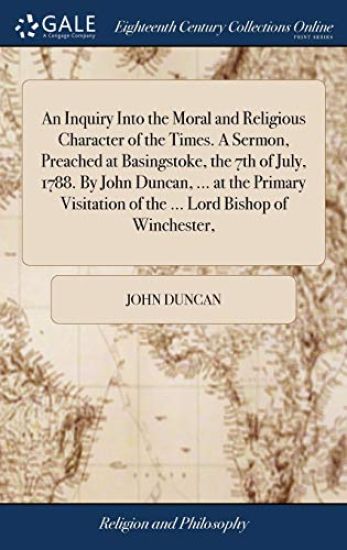
Kirjat ja teokset yhdessä paikassa: 59 kirjaa, julkaisuja vuosilta 2003–2026, suosituimpiin kuuluu An Inquiry Into the Moral and Religious Character of the Times. a Sermon, Preached at Basingstoke, the 7th of July, 1788. by John Duncan, ... at the Primary Visitation of the ... Lord Bishop of Winchester, .... Vertaile teosten hintoja ja tarkista saatavuus suomalaisista kirjakaupoista.
The 18th century was a wealth of knowledge, exploration and rapidly growing technology and expanding record-keeping made possible by advances in the printing press. In its determination to preserve the century of revolution, Gale initiated a revolution of its own: digitization of epic proportions to preserve these invaluable works in the largest archive of its kind. Now for the first time these high-quality digital copies of original 18th century manuscripts are available in print, making them highly accessible to libraries, undergraduate students, and independent scholars. The Age of Enlightenment profoundly enriched religious and philosophical understanding and continues to influence present-day thinking. Works collected here include masterpieces by David Hume, Immanuel Kant, and Jean-Jacques Rousseau, as well as religious sermons and moral debates on the issues of the day, such as the slave trade. The Age of Reason saw conflict between Protestantism and Catholicism transformed into one between faith and logic -- a debate that continues in the twenty-first century.++++The below data was compiled from various identification fields in the bibliographic record of this title. This data is provided as an additional tool in helping to insure edition identification: ++++Bodleian Library (Oxford)T148177With a half-title and a final advertisement leaf. London: printed by H. Goldney, for T. Cadell, 1788. 6],28, 2]p.; 8
The big questions of our lives bring fierce debates. Right and wrong. Freedom and responsibility. Women and men. Democracy and justice. Ambition and fulfilment. Where do answers lie in a mind that produces the many sides and needs of humanity? In The Animal and the Thinker, pioneering neuroscientist John Duncan lays out the principles, strengths and weaknesses of two sides of ourselves. One side follows the principles of instinctive animal behaviour. It is elaborate, sophisticated, conflicted yet essential - without it, our life would have no meaning. On the other side is our rational brain. It generates an infinite world of new ideas, but often, its need for focus generates sterile social beliefs and destructive culture wars. Our rational side is brilliant, but often, it is wrong. For thousands of years, writers, thinkers and philosophers have seen human life as a war between Dr Jekyll and Mr Hyde. Duncan shows that there is no war. To bring humanity and reality to the great, conflicted questions of our lives, we need the dance between these two essential sides of ourselves.
This book argues that, although secular and religious perspectives on disasters have often conflicted, today there are grounds for believing that the world’s major faiths have much to contribute to the processes of post-disaster recovery and future disaster risk reduction (DRR). It seeks to demonstrate how contemporary dialogues between theologians, disaster scholars and policymakers are defining new ways of working together. These explore how the resources of religious communities, e.g. buildings, human resources and finance, may be used to foster successful policies of DRR, particularly in the aftermath of earthquakes and volcanic eruptions. Musing on the relationships between religion and disasters has occurred for millennia and has affected many societies worldwide. In societies where the world’s major religions – Buddhism, Christianity, Hinduism, Islam, Judaism and Shinto – have been and remain dominant, attempting to find supernatural explanations for disasters has occurred throughout history and there have been many theologies seeking to explain why people suffer losses. It is argued that developments both within these traditions of faith and in how disasters are understood by the hazard research community of researchers and planners have allowed a new modus vivendi to emerge which emphasises both a recognition of religious worldviews by academic writers and disaster planners on the one hand, and a desire by people of faith and their leaders to be more fully committed to the goals of DRR. The book will appeal to those who are interested in the interface between disasters and theology across the principal religions of the world. This includes researchers and students in geology, geography, theology and religious studies. It will also be useful for specialist academic audience and the educated general reader.
Why are we so often in conflict—arguing with ourselves and with others, uncertain over who we are and what we need from our lives? In The Animal and The Thinker, the world-leading, pioneering neuroscientist John Duncan explains that each of us is not just one person – we are two. On one side are our animal instincts, built on the sophisticated needs of human life through evolution, but struggling to navigate the complexity of modern life. On the other side is our rational brain which calculates and cogitates, but is often helpless in the face of bigger questions of meaning and purpose. Dovetailing these two competing sides of ourselves, Duncan draws on a lifetime’s pioneering work to attack puzzles that have concerned thinkers, writers and philosophers through human history. Right and wrong. Freedom and responsibility. Women and men. Democracy and justice. Ambition and fulfilment. Understanding how these two sides of ourselves interact offers revealing and often surprising answers to some of the great questions of our lives. Discover a new perspective on human behaviour, and learn how we can better understand ourselves, our struggles, and our search for meaning.