Kirjojen hintavertailu – 12 859 824 kirjaa ja 27 kauppaa
Kirjailija
John Duns Scotus
Kirjat ja teokset yhdessä paikassa: 19 kirjaa, julkaisuja vuosilta 1987–2025, suosituimpiin kuuluu John Duns Scotus and the Principle Omne Quod Movetur AB Alio Movetur. Vertaile teosten hintoja ja tarkista saatavuus suomalaisista kirjakaupoista.
""John Duns Scotus and the Principle Omne Quod Movetur Ab Alio Movetur"" by Roy R. Effler is a scholarly book that explores the philosophical ideas of John Duns Scotus, a medieval philosopher and theologian. The book focuses on Scotus' concept of the principle of causality, which states that everything that is moved is moved by another. This principle is known as Omne Quod Movetur Ab Alio Movetur, and it is a central idea in Scotus' philosophy. Effler's book examines Scotus' views on causality and how they relate to his larger philosophical system. The author explores Scotus' ideas about the nature of God, the human soul, and the relationship between faith and reason. Effler also discusses Scotus' influence on later philosophers, including Descartes and Leibniz. Overall, ""John Duns Scotus and the Principle Omne Quod Movetur Ab Alio Movetur"" is a comprehensive and detailed study of one of the most important thinkers of the medieval period. It will be of interest to scholars of medieval philosophy, theology, and intellectual history, as well as anyone interested in exploring the philosophical ideas that have shaped our understanding of the world. This scarce antiquarian book is a facsimile reprint of the old original and may contain some imperfections such as library marks and notations. Because we believe this work is culturally important, we have made it available as part of our commitment for protecting, preserving, and promoting the world's literature in affordable, high quality, modern editions, that are true to their original work.
This work is the first English translation of Scotus's commentary on Aristotle's Quaestiones super Praedicamenta. Although there are numerous Latin commentaries on Aristotle's Categories, Scotus's Questions is one of the few commentaries on the Categories written in the thirteenth century covering all of Aristotle's text, including the often neglected post-praedicamenta, and the only complete Latin commentary available in English. Moreover, unlike many of the commentaries, Scotus's text is one of the last commentaries to be written before the nominalist reduction of the categories to substance and quality. The question format allows Scotus a great deal of liberty to discuss the categories in detail, as well as matters that are only remotely raised by the text. Altogether, the forty-four questions cover the following subjects: questions 1–4 are prolegomena to the work itself and raise the question of its subject matter as well as whether there can be a science of the categories; questions 5–8 deal with equivocals, univocals, and denominatives; questions 9–11 discuss Aristotle's two rules regarding predication and the sufficiency of the categories; questions 12–36 discuss the four main categories treated by Aristotle, namely, substance, quantity, relation, and quality; and the remaining eight questions discuss the post- praedicamenta.
In On Being and Cognition, the first complete translation into English of a pivotal text in the history of philosophy and theology, Scotus addresses fundamental issues concerning the limits of human knowledge and the nature of cognition by developing his doctrine of the univocity of being, refuting skepticism and analyzing the way the intellect and the object cooperate in generating actual knowledge in the case of abstractive cognition. Throughout the work Scotus is in discussion with important theologians of his time, such as Thomas Aquinas, Henry of Ghent, and Godfrey of Fontaines. Anyone interested in the pertinent philosophical problems will find in this book the highly sophisticated and subtle answers of a giant in the history of thought.
Duns Scotus (c. 1265–1308) is one of a handful of figures in the history of philosophy whose significance is truly di”fficult to overestimate. Despite an academic career that lasted barely two decades, and numerous writings left in various states of incompletion at his death, his thought has been profoundly influential in the history of western philosophy. The Questions on Aristotle’s ‘Perihermenias’ is an early work, probably written at Oxford in the closing decade of the thirteenth century. The questions, which have come down to us in two sets (‘Opus I’ and ‘Opus II’), most likely originated from Scotus’s classroom lectures on Aristotle’s text, a work now known by its Latin name, De interpretatione. The Perihemenias was understood in the medieval university as a work of dialectic or logic, although the text itself deals with subjects we would nowadays consider to belong to the intersection of metaphysics and the philosophy of language: the semantics of time, existence, modality, and quantification. At its heart is the important and still philosophically relevant question of how we can talk about things which no longer exist, or which do not yet exist. The topics covered include reference and signification; existence and essence; truth and its relation to things. What is the relationship between existence in reality and existence in the understanding? Does the meaning of a name depend on the existence of the objects falling under it? Is the present time all that exists? If a proposition about the future can be true now, what now makes it true? The English translation includes an extensive commentary explaining and elaborating on some of the more di”cult ideas Scotus develops in the work, placing them in the context of the teaching of logic andmetaphysics in late-thirteenth century Europe.
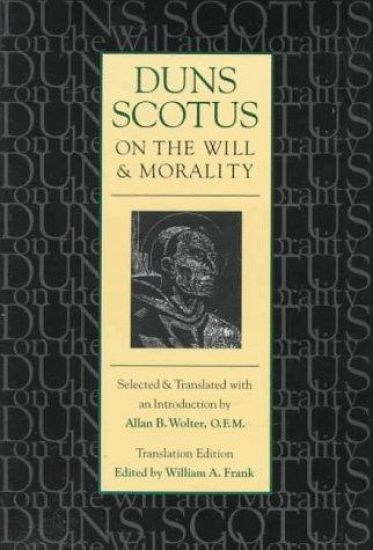
Since the original publication of Duns Scotus on the Will and Morality in 1986, there has been a remarkable growth of interest in the thought of this early fourteenth-century Franciscan master. Allan B. Wolter's critically acclaimed book inspired much of the inquiry, and today it remains the standard source on Scotus' moral philosophy. This new edition of the book retains the introduction and English translations of the original thirty-four selections of texts from Scotus' writings on the will and morality. In addition to a substantially expanded bibliography, the volume includes a preface written by William A. Frank.
Covers topics such as Concerning Metaphysics, Man's Knowledge of God, The Existence of God, The Unicity of God, Concerning Human Knowledge, and The Spirituality and Immortality of the Human Soul.