Kirjojen hintavertailu – 12 859 818 kirjaa ja 27 kauppaa

Kirjailija

John Erik Fossum

Kirjat ja teokset yhdessä paikassa: 7 kirjaa, julkaisuja vuosilta 1997–2026, suosituimpiin kuuluu Norway’s EU Experience and Lessons for the UK. Vertaile teosten hintoja ja tarkista saatavuus suomalaisista kirjakaupoista.

7 kirjaa

Kirjojen julkaisuvuodet: 1997–2026.

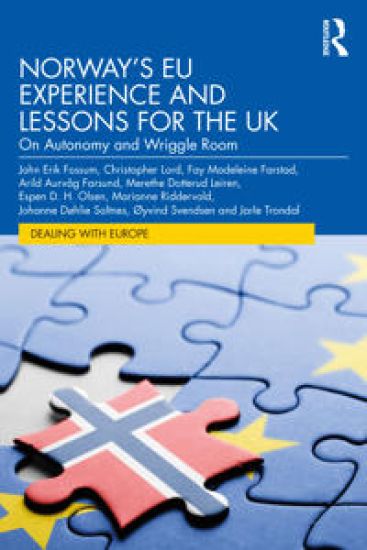
Norway’s EU Experience and Lessons for the UK

Norway’s EU Experience and Lessons for the UK

John Erik Fossum; Christopher Lord; Fay Madeleine Farstad; Arild Aurvåg Farsund; Merethe Dotterud Leiren; Espen D. H. Olsen; Marianne Riddervold; Johanne Døhlie Saltnes; Øyvind Svendsen; Jarle Trondal

TAYLOR FRANCIS LTD
2023
nidottu
This book examines Norway’s affiliation to the EU and systematically assesses the potential suitability of this arrangement for the UK as a viable EU affiliation post-Brexit. Framing the book within the framework of the broader European context, the authors ask how much autonomy and room to manoeuvre tightly integrated non-member states have under this arrangement. They present an in-depth assessment of Norway’s close EU affiliation and provide insight into what this may reveal to us about the post-Brexit European political order. The book’s analytical framework centred on autonomy under complex interdependence has relevance well beyond the confines of the Norway case. This includes the UK, not least since the EU–UK Trade and Cooperation Agreement (TCA) leaves considerable uncertainty. It contains transitory elements; there will be implementation reviews, and there may be many more bilateral and multilateral agreements before the trade relationship is fully defined. This book will be of key interest to scholars and students of European Union politics, Norwegian politics, British politics, European integration, and, more broadly, to European studies and international relations.
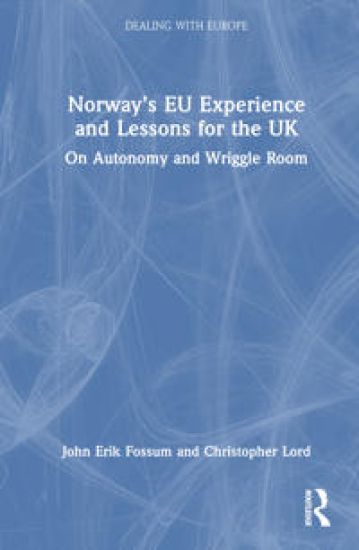
Norway’s EU Experience and Lessons for the UK

Norway’s EU Experience and Lessons for the UK

John Erik Fossum; Christopher Lord; Fay Madeleine Farstad; Arild Aurvåg Farsund; Merethe Dotterud Leiren; Espen D. H. Olsen; Marianne Riddervold; Johanne Døhlie Saltnes; Øyvind Svendsen; Jarle Trondal

TAYLOR FRANCIS LTD
2023
sidottu
This book examines Norway’s affiliation to the EU and systematically assesses the potential suitability of this arrangement for the UK as a viable EU affiliation post-Brexit. Framing the book within the framework of the broader European context, the authors ask how much autonomy and room to manoeuvre tightly integrated non-member states have under this arrangement. They present an in-depth assessment of Norway’s close EU affiliation and provide insight into what this may reveal to us about the post-Brexit European political order. The book’s analytical framework centred on autonomy under complex interdependence has relevance well beyond the confines of the Norway case. This includes the UK, not least since the EU–UK Trade and Cooperation Agreement (TCA) leaves considerable uncertainty. It contains transitory elements; there will be implementation reviews, and there may be many more bilateral and multilateral agreements before the trade relationship is fully defined. This book will be of key interest to scholars and students of European Union politics, Norwegian politics, British politics, European integration, and, more broadly, to European studies and international relations.
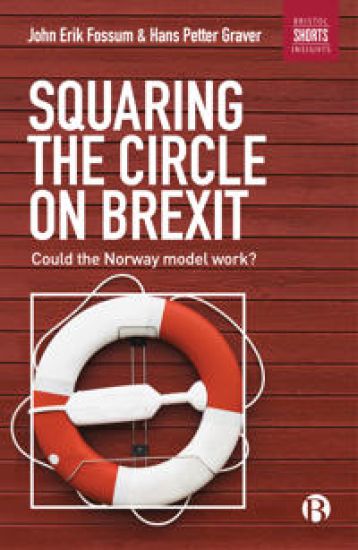
Squaring the Circle on Brexit

Squaring the Circle on Brexit

John Erik Fossum; Hans Petter Graver

Bristol University Press
2018
nidottu
This important book provides the first systematic assessment of the so-called Norway Model, suggested as an off-the-shelf option for the UK to ‘square the circle’ after Brexit. Two preeminent Norwegian scholars of politics and law offer a comprehensive first-hand account of Norway’s relationship with the EU and how this affects the country’s legal and political system, setting out what Britain can learn from Norway’s experience and how transferable these lessons are. Their analysis also explores what impact the UK’s presence is likely to have on existing members of the European Economic Area (EEA) discussing both the opportunities and the challenges. The book will be a valuable resource for anyone interested in the future of the UK’s relationship with Europe.
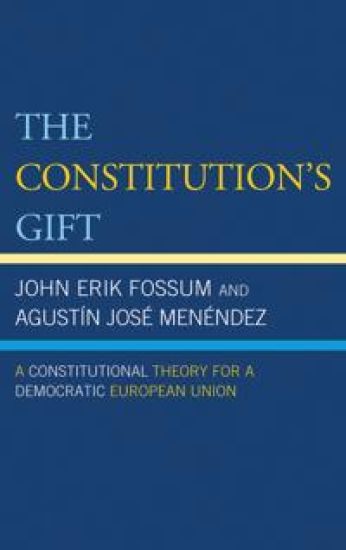
The Constitution's Gift

The Constitution's Gift

John Erik Fossum; Agustín José Menéndez

Rowman Littlefield Publishers
2011
sidottu
This authoritative study considers all aspects of the European Union's distinctive constitution since its inception. A unique political animal, the EU has given rise to important constitutional conundrums and paradoxes that John Erik Fossum and Agustín José Menéndez explore in detail. The authors consider the process of forging the EU's constitution and the set of fundamental norms that define the institutional structure, the decision-making procedures, and the foundations of the Union's democratic legitimacy. Their analysis illuminates the distinctive features of the EU's pluralist constitutional construct but also the interesting parallels to the Canadian constitutional experience and provides the tools to understand the Union's development, especially during the Laeken (2001–2005) and Lisbon (2007–2009) processes of constitutional reform. The authors' original theory of constitutional synthesis captures the distinctive traits of the European Union as a polity. It explains why and how the European Communities were established as the first constitutional union of constitutional states wherein integration would be steered by law, not power politics or imperialism. Similarly, it presents the European Union as one of the few examples of a polity that has transcended the paradigm of the nation-state (and perhaps even that of the state). Locating the substance and process of Lisbon in its proper constitutional context, Fossum and Menéndez explain why this should be seen as a new beginning of the Union's constitutional season, not its end. Offering the first history of European constitutional law that is both theoretically informed and normatively grounded, their book will be essential reading for all readers interested in the process and theory of European integration.
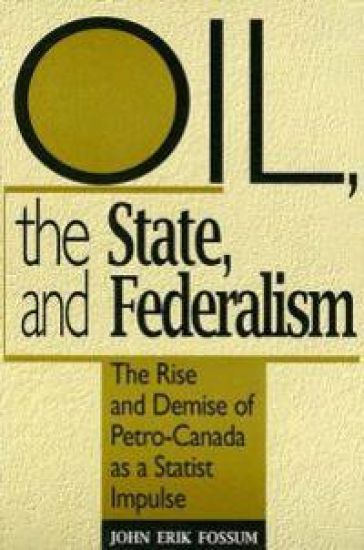
Oil, the State, and Federalism

Oil, the State, and Federalism

John Erik Fossum

University of Toronto Press
1997
pokkari
The creation and privatization of Petro-Canada provides an important lesson in state intervention and Canadian public policy. John Erik Fossum explores the reasons for the federal government's intervention in the energy industry between 1973 and 1984 and shows how its initial objectives failed, culminating in the privatization of Petro-Canada in 1990. In other countries, state oil policy unfolded along state-industry lines of conflict. Fossum shows us how in Canada the conflict was deflected to focus on the jurisdictional and constitutional concerns of governmental actors. The dismantling of state intervention was associated with a reverse deflection and reduced conflict in both the state-industry and intergovernmental arenas. Oil, the State, and Federalism is a sophisticated analysis of statist and federalist theories of Canadian public policy-making that will spark debate among political scientists, analysts, and policy-makers.
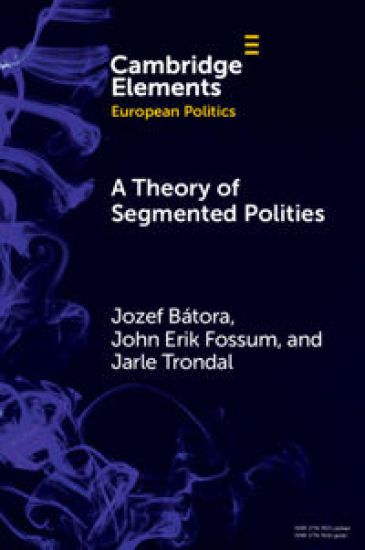
A Theory of Segmented Polities

A Theory of Segmented Polities

Jozef Bátora; John Erik Fossum; Jarle Trondal

Cambridge University Press
2026
pokkari
This Element introduces the theory of segmented polity to address the misfit between dominant state-centric political theories and the hybrid realities of contemporary governance. Segmented polities are contested, partial, and constrained but nonetheless develop autonomous policymaking capacities and distinct social constituencies. The EU exemplifies this form, blending supranational and intergovernmental traits within a statist political order. Grounded in organization theory and institutionalism, the Element provides empirical analysis of the internal market and security segments showing how segmented polities operate across functional domains and generate bounded epistemic communities. While enabling policy efficiency, they also exhibit democratic deficits. The Element presents segmented polities as evolutionary responses to governance complexity and outlines implications for political science, international relations, European integration theory, and democracy studies, and proposes a research agenda focused on longitudinal, actor-based, and comparative studies of polity segmentation beyond the EU. This title is also available as Open Access on Cambridge Core.
A Theory of Segmented Polities

A Theory of Segmented Polities

Jozef Bátora; John Erik Fossum; Jarle Trondal

Cambridge University Press
2026
sidottu
This Element introduces the theory of segmented polity to address the misfit between dominant state-centric political theories and the hybrid realities of contemporary governance. Segmented polities are contested, partial, and constrained but nonetheless develop autonomous policymaking capacities and distinct social constituencies. The EU exemplifies this form, blending supranational and intergovernmental traits within a statist political order. Grounded in organization theory and institutionalism, the Element provides empirical analysis of the internal market and security segments showing how segmented polities operate across functional domains and generate bounded epistemic communities. While enabling policy efficiency, they also exhibit democratic deficits. The Element presents segmented polities as evolutionary responses to governance complexity and outlines implications for political science, international relations, European integration theory, and democracy studies, and proposes a research agenda focused on longitudinal, actor-based, and comparative studies of polity segmentation beyond the EU. This title is also available as Open Access on Cambridge Core.