Kirjojen hintavertailu – 12 903 733 kirjaa ja 27 kauppaa

Kirjailija

John F. Haught

Kirjat ja teokset yhdessä paikassa: 23 kirjaa, julkaisuja vuosilta 2004–2022, suosituimpiin kuuluu God After Darwin. Vertaile teosten hintoja ja tarkista saatavuus suomalaisista kirjakaupoista.

Nimi esiintyy myös muodoissa: John F Haught

23 kirjaa

Kirjojen julkaisuvuodet: 2004–2022.

God after Einstein

God after Einstein

John F. Haught

YALE UNIVERSITY PRESS
2022
sidottu
A leading theologian presents a hopeful account of the universe after Einstein, exploring it as a meaningful drama of awakening“This book is a deep and provocative piece of theology that proposes we engage with the universe as a kind of narrative of awakening and unfolding, as well as an important and useful approach for thinking about theology with respect to modern cosmology.”—Matthew Stanley, New York University Before the early twentieth century, scientists and theologians knew almost nothing about time’s enormity and the corresponding immensity of space. But now, after Einstein, cosmology offers theology a whole new way of looking at the ageless questions about matter, time, God, cosmic purpose, and the significance of our lives. The universe need not be thought of as simply an endless reshuffling of lifeless and mindless atoms in a pointless series of moments. Rather, the universe is a temporal drama of awakening whose meaning can be revealed only gradually by looking, in a spirit of anticipation and hope, toward the horizon of the cosmic future. In conversation with Einstein’s ideas and opinions, John F. Haught develops here a new cosmological understanding of the meaning of God, time, eternity, mystery, life, thought, freedom, and faith. In doing so, he offers readers a new way of understanding the relationship of science to theology.
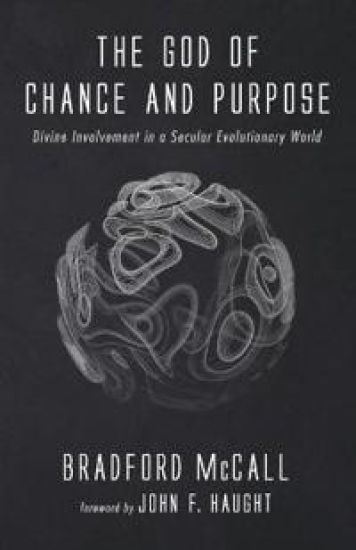
The God of Chance and Purpose

The God of Chance and Purpose

Bradford McCall; John F Haught

Wipf Stock Publishers
2022
pokkari
This brief title will pursue a triangulation of chance, divine involvement, and theology through a fundamentally Peircean lens--at least epistemologically and semiotically. The argument proceeds over five distinct chapters, and a conclusion that constitutes a sixth chapter. In Part I, I discuss the Modern Synthetic theory in evolutionary biology. In particular, I refer to what I have labeled the secular evolutionary worldview (SEW). Also in Part I, I dismiss the French physicist Pierre-Simon de Laplace's claim that a sufficiently informed intelligence could forecast everything that is going to happen in the whole universe--and, working backwards, tell you everything that did happen, not by direct citation and rebuke, but rather by implicit argumentation and demonstration of the God of Chance. In Part II of this book, I explore the God of chance and purpose, with theological assists provided by Philip Clayton and Alister McGrath over two chapters. So then, we live in a world of both chance and purpose. One may even go so far as to state that this world is designed for both chance and purpose.
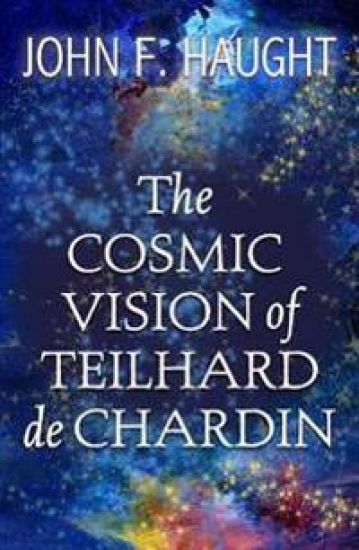
The Cosmic Vision of Teilhard de Chardin

The Cosmic Vision of Teilhard de Chardin

John F. Haught

ORBIS BOOKS (USA)
2021
pokkari
"An expert in Teilhardian thought brings together for the first time Teilhard in conversation with other significant religious thinkers, philosophers, and scientists, including Kant, Whitehead, Barbour, Moltmann and Tillich, on topics ranging from the problem of suffering to astrobiology. The Jesuit paleontologist and theologian, Teilhard de Chardin, has been much admired as well as much misunderstood. In this unique treatment, John F. Haught clarifies Teilhard's thought, while not shying away from the controversies and criticisms. Each chapter explores a different topic--including the cosmos, spirituality, suffering, thought, God, and life--and how each topic has developed the author's own theology. In particular, Haught focuses on the cosmic future and the implications of Teilhard's thought for this century and beyond."
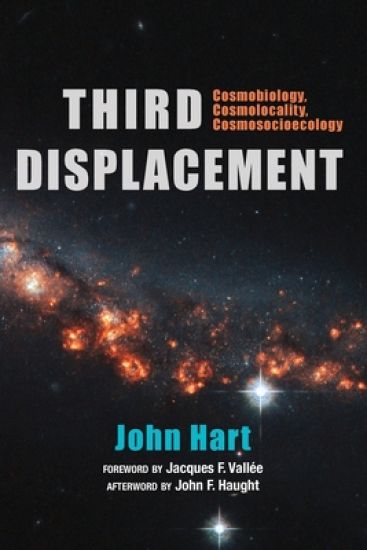
Third Displacement

Third Displacement

John Hart; Jacques F Vallée; John F Haught

Cascade Books
2020
sidottu
The question, "Are we alone in the cosmos?" has been answered. We are not alone. Geologist-paleontologist Pierre Teilhard de Chardin, SJ, stated, as early as the mid-1920s, that intelligent life likely exists elsewhere and distinguished scientists of today, including Harvard biologist, E. O. Wilson; Cambridge cosmologist, Stephen Hawking; astrophysicist and noted UAP researcher, Jacques Vallee; astronomer, Allen Hynek; and many others concur. The oral traditions of Native American elders teach that they have interacted periodically with Star People who are respected ancestors. Credible witness-participants today describe abductions by benevolent and malevolent Others. Discoveries by the Kepler, Hubble, and Gaia space telescopes, ground-based arrays of radio telescopes, and TESS (Transiting Exoplanet Survey Satellite) suggest that in the Milky Way, twenty-five billion planets are in the life-friendly Goldilocks Zone. In Third Displacement: Cosmobiology, Cosmolocality, Cosmosocioecology, author John Hart links experiences with research in science-based and Spirit-focused books and articles--including narratives about close encounters with Visitors from elsewhere in space (ETI) or Others from other cosmos dimensions (IDI)--in examination of the claim that Intelligent ExoEarth life exists, that Otherkind has visited humankind.
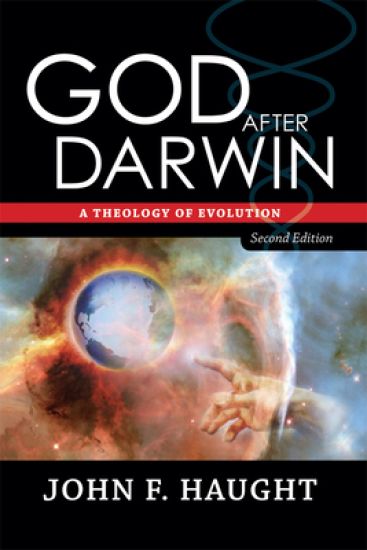
God After Darwin

God After Darwin

John F. Haught; John Haught

Routledge
2019
sidottu
In God After Darwin, eminent theologian John F. Haught argues that the ongoing debate between Darwinian evolutionists and Christian apologists is fundamentally misdirected: Both sides persist in focusing on an explanation of underlying design and order in the universe. Haught suggests that what is lacking in both of these competing ideologies is the notion of novelty, a necessary component of evolution and the essence of the unfolding of the divine mystery. He argues that Darwin's disturbing picture of life, instead of being hostile to religion-as scientific skeptics and many believers have thought it to be-actually provides a most fertile setting for mature reflection on the idea of God. Solidly grounded in scholarship, Haught's explanation of the relationship between theology and evolution is both accessible and engaging. The second edition of God After Darwin features an entirely new chapter on the ongoing, controversial debate between intelligent design and evolution, including an assessment of Haught's experience as an expert witness in the landmark case of Kitzmiller v. Dover Area School District on teaching evolution and intelligent design in schools.
A John Haught Reader

A John Haught Reader

John F Haught

Wipf Stock Publishers
2018
pokkari
Classical Christian theologies came to expression at a time when the universe seemed relatively fixed and unchanging. The otherworldly spiritual instincts of many religions reflected a static, vertical, and hierarchical understanding of the natural world. Today, however, especially because of developments in the sciences, it appears that the universe is still coming into being. The writings offered in this book reflect their author's belief that if the universe is unfinished, new thoughts about God and all the traditional theological topics are essential to make sense of it all. John Haught argues that the universe is best understood according to the metaphor of drama rather than design. This means that the most important question in science and theology today is not whether the intricate complexity of life points to a deity, or even how God acts in nature, but whether the cosmic drama as a whole carries a meaning. Unfortunately, the devotional life of most religious people on our planet still presupposes an essentially immobile universe. Christian instruction, for example, continues to nurture an otherworldly piety that estranges nature unnecessarily from God. The readings in this book, however, suggest that the ancient Abrahamic hope for the coming of God from out of the future may now become the foundation of a scientifically up-to-date theology of nature that affirms divine transcendence without robbing nature of its significance. John F. Haught is Distinguished Research Professor of theology at Georgetown University in Washington, DC. He has dedicated his academic life to teaching, lecturing, and writing on issues pertaining to science, cosmology, evolution, ecology, and religion. He is best known for his works on evolution and Christian faith. He is the author of twenty books, including God After Darwin and (most recently) The New Cosmic Story: Inside Our Awakening Universe.
The New Cosmic Story

The New Cosmic Story

John F. Haught

Yale University Press
2017
sidottu
A foremost thinker on science and religion argues that an adequate understanding of cosmic history requires attention to the emergence of interiority, including religious aspiration Over the past two centuries scientific advances have made it clear that the universe is a story still unfolding. In this thought-provoking book, John F. Haught considers the deeper implications of this discovery. He contends that many others who have written books on life and the universe—including Stephen Hawking, Stephen Jay Gould, and Richard Dawkins—have overlooked a crucial aspect of cosmic history: the drama of life’s awakening to interiority and religious awareness. Science may illuminate the outside story of the universe, but a full telling of the cosmic story cannot ignore the inside development that interiority represents. Haught addresses two primary questions: what does the arrival of religion tell us about the universe, and what does our understanding of the cosmos as an unfinished drama tell us about religion? The history of religion may be ambiguous and sometimes even barbarous, he asserts, but its role in the story of cosmic emergence and awakening must be taken into account.
Resting on the Future

Resting on the Future

John F. Haught

Bloomsbury Academic USA
2015
sidottu
Science has now demonstrated without a doubt that we live in an “unfinished universe.” Discoveries in geology, biology, cosmology and other fields of scientific inquiry have shown that the cosmos has a narrative character and that the story is far from over. The sense of a universe that is still coming into being provides a fertile new framework for thinking about the relationship of faith to science. John F. Haught argues that if we take seriously the fact that the universe is a drama still unfolding, we can think new thoughts about God, and indeed about all the perennial themes of theology. Science’s recent realization that the universe is dramatic, however, has yet to penetrate deeply into either spiritual or intellectual life. Most Christian thought and spirituality still presuppose an essentially static universe while influential academic and intellectual culture remains stuck in a stagnant materialist naturalism and cosmic pessimism. Resting on the Future asks about the meaning of an unfinished universe from the point of view of both Christian theology and contemporary intellectual life. Each chapter covers a distinct aspect of what Haught takes to be an essential transition to a new age in Catholic life and thought. Biology, cosmology, and other fields of science now provide the setting for a wholesome transformation of Catholic thought from a still predominantly pre-scientific to a more hopeful and scientifically informed vision of God, humanity and the natural world.
Resting on the Future

Resting on the Future

John F. Haught

Bloomsbury Academic USA
2015
nidottu
Science has now demonstrated without a doubt that we live in an “unfinished universe.” Discoveries in geology, biology, cosmology and other fields of scientific inquiry have shown that the cosmos has a narrative character and that the story is far from over. The sense of a universe that is still coming into being provides a fertile new framework for thinking about the relationship of faith to science. John F. Haught argues that if we take seriously the fact that the universe is a drama still unfolding, we can think new thoughts about God, and indeed about all the perennial themes of theology. Science’s recent realization that the universe is dramatic, however, has yet to penetrate deeply into either spiritual or intellectual life. Most Christian thought and spirituality still presuppose an essentially static universe while influential academic and intellectual culture remains stuck in a stagnant materialist naturalism and cosmic pessimism. Resting on the Future asks about the meaning of an unfinished universe from the point of view of both Christian theology and contemporary intellectual life. Each chapter covers a distinct aspect of what Haught takes to be an essential transition to a new age in Catholic life and thought. Biology, cosmology, and other fields of science now provide the setting for a wholesome transformation of Catholic thought from a still predominantly pre-scientific to a more hopeful and scientifically informed vision of God, humanity and the natural world.
Making Sense of Evolution

Making Sense of Evolution

John F. Haught

Westminster/John Knox Press,U.S.
2010
nidottu
Evolution makes good scientific sense. The question is whether it makes good theological sense as well. Christians who find evolution contrary to faith often do so because they focus solely on the issues of the world's design and the notion of the gradual descent of all life from a common ancestry. But that point of view overlooks the significance of the dramatic narrative going on beneath the surface. What evolution is has become more important than what it means. Haught suggests that, rather than necessarily contradicting one another, theologians and Darwinian scientists actually share an appreciation of the underlying meaning and awe-inspiring mystery of evolution. He argues for a focus on evolution as an ongoing drama and suggests that we simply cannot-indeed need not-make complete sense of it until it has fully played out. Ultimately, when situated carefully within a biblical vision of the world as open to a God who makes all things new, evolution makes sense scientifically and theologically.
Nested Ecology

Nested Ecology

Edward T. Wimberley; John F. Haught

Johns Hopkins University Press
2009
pokkari
Nested Ecology provides a pragmatic and functional approach to realizing a sustainable environmental ethic. Edward T. Wimberley asserts that a practical ecological ethic must focus on human decision making within the context of larger social and environmental systems. Think of a set of mixing bowls, in which smaller bowls sit within larger ones. Wimberley sees the world in much the same way, with personal ecologies embedded in social ecologies that in turn are nested within natural ecologies. Wimberley urges a complete reconceptualization of the human place in the ecological hierarchy. Going beyond the physical realms in which people live and interact, he extends the concept of ecology to spirituality and the "ecology of the unknown." In doing so, Wimberley defines a new environmental philosophy and a new ecological ethic.
Nested Ecology

Nested Ecology

Edward T. Wimberley; John F. Haught

Johns Hopkins University Press
2009
sidottu
Nested Ecology provides a pragmatic and functional approach to realizing a sustainable environmental ethic. Edward T. Wimberley asserts that a practical ecological ethic must focus on human decision making within the context of larger social and environmental systems. Think of a set of mixing bowls, in which smaller bowls sit within larger ones. Wimberley sees the world in much the same way, with personal ecologies embedded in social ecologies that in turn are nested within natural ecologies. Wimberley urges a complete reconceptualization of the human place in the ecological hierarchy. Going beyond the physical realms in which people live and interact, he extends the concept of ecology to spirituality and the "ecology of the unknown." In doing so, Wimberley defines a new environmental philosophy and a new ecological ethic.
God and the New Atheism

God and the New Atheism

John F. Haught

Westminster/John Knox Press,U.S.
2008
nidottu
In God and the New Atheism, a world expert on science and theology gives clear, concise, and compelling answers to the charges against religion laid out in recent best-selling books by Richard Dawkins (The God Delusion), Sam Harris (The End of Faith), and Christopher Hitchens (God Is Not Great). For some, these "new atheists" appear to say extremely well what they believe to be wrong with religion. But, as John Haught shows, the treatment of religion in these books is riddled with logical inconsistencies, shallow misconceptions, and crude generalizations. Can God really be dismissed as a mere delusion? Is faith really the enemy of reason? And does religion really poison everything? God and the New Atheism offers a much-needed antidote to the extremist claims of scientific fundamentalism. This provocative and accessible little book will enable readers to see through the rhetorical fog of this recent phenomenon and come to a clearer understanding of the issues at stake in this crucial debate.
Christianity and Science

Christianity and Science

John F. Haught

Orbis Books (USA)
2007
nidottu
In his many previous books John Haught established a reputation as the leading Catholic theological voice in the study of science and religion. In this work he offers his most systematic theological reflections on the relation between Christian revelation and the unfolding story of the universe. In the face of recent discoveries some maintain their faith by clinging to a pre-scientific worldview; others conclude that perhaps "the universe has outgrown the biblical God who is said to be its creator." For Haught, however, exploration of the "three infinities" - the immense, the infinitesimal, and the complex - serves as invitation to an unprecedented appreciation for the grandeur of God, creation, Christ, and redemption.
God After Darwin

God After Darwin

John F. Haught; John Haught

Westview Press Inc
2007
nidottu
In God After Darwin, eminent theologian John F. Haught argues that the ongoing debate between Darwinian evolutionists and Christian apologists is fundamentally misdirected: Both sides persist in focusing on an explanation of underlying design and order in the universe. Haught suggests that what is lacking in both of these competing ideologies is the notion of novelty, a necessary component of evolution and the essence of the unfolding of the divine mystery. He argues that Darwin's disturbing picture of life, instead of being hostile to religion-as scientific skeptics and many believers have thought it to be-actually provides a most fertile setting for mature reflection on the idea of God. Solidly grounded in scholarship, Haught's explanation of the relationship between theology and evolution is both accessible and engaging. The second edition of God After Darwin features an entirely new chapter on the ongoing, controversial debate between intelligent design and evolution, including an assessment of Haught's experience as an expert witness in the landmark case of Kitzmiller v. Dover Area School District on teaching evolution and intelligent design in schools.