Kirjojen hintavertailu – 12 903 725 kirjaa ja 27 kauppaa

Kirjailija

John Forge

Kirjat ja teokset yhdessä paikassa: 9 kirjaa, julkaisuja vuosilta 1998–2020, suosituimpiin kuuluu The Morality of Weapons Design and Development. Vertaile teosten hintoja ja tarkista saatavuus suomalaisista kirjakaupoista.

9 kirjaa

Kirjojen julkaisuvuodet: 1998–2020.

Explanation, Quantity and Law

Explanation, Quantity and Law

John Forge

Routledge
2020
nidottu
Published in 1999, this work sets out to give an account of explanation which is adequate to the problems that arise when looking at physical science. It offers a theory of explanation with supporting analysis, and also an application to the task of giving an account of explanation in quantum mechanics.
The Morality of Weapons Research

The Morality of Weapons Research

John Forge

Springer Nature Switzerland AG
2019
nidottu
This book addresses the morality of engaging in weapons research, a topic that has been neglected but which is extremely important. It is argued that this activity is both morally wrong and morally unjustifiable, and this implies that moral persons should not engage in it. The argument is not based on any pacifist assumptions: it is not assumed that neither individuals nor states should not defend themselves. What is wrong with weapons research is that it is the first step in the production of weapons, weapons are the means to harm, and harming without justification is always wrong. Those who study science, for instance those who are interested in the responsibilities of the scientist, are given a new perspective, while those who are practicing scientists will realize that they should not consider working to design new or improved weapons systems. This book is of interest to students and researchers working in ethics and technology, philosophy of technology, military ethics, and history of technology.
Explanation, Quantity and Law

Explanation, Quantity and Law

John Forge

Routledge
2018
sidottu
Published in 1999, this work sets out to give an account of explanation which is adequate to the problems that arise when looking at physical science. It offers a theory of explanation with supporting analysis, and also an application to the task of giving an account of explanation in quantum mechanics.
The Morality of Weapons Design and Development
Countries around the globe are continuously investing money into weapon development and manufacturing. While weapon design has been a relevant topic, from the Middle Ages to today, the morality of this practice is not commonly presented in research. The Morality of Weapons Design and Development: Emerging Research and Opportunities is an essential scholarly resource that presents detailed discussions on ethical dilemmas in weapons design and innovations. While highlighting relevant topics including projectile and nuclear weapons, the true costs of war, design in peacetime, and weapons development and justification, this book is an ideal resource for researchers, engineers, graduate students, and professionals who have an interest in weapons design, development, and ethics.
Designed to Kill: The Case Against Weapons Research
The pilot-less drones, smart bombs and other high-tech weapons on display in recent conflicts are all the outcome of weapons research. However, the kind of scientific and technological endeavour has been around for a long time, producing not only the armaments of Nazi Germany and the atomic bombs dropped on Japan, but the catapults used in ancient Greece and Rome and the assault rifles used by child soldiers in Africa. In this book John Forge examines such weapons research and asks whether it is morally acceptable to undertake such an activity. He argues that it is in fact morally wrong to take part in weapons research as its primary purpose is to produce the means to harm others, and moreover he argues that all attempts to then justify participation in weapons research do not stand up to scrutiny. This book has wide appeal in fields of philosophy and related areas, as well to a more general audience who are puzzled about the rate at which new weapons are accumulated.
Designed to Kill: The Case Against Weapons Research
The pilot-less drones, smart bombs and other high-tech weapons on display in recent conflicts are all the outcome of weapons research. However, the kind of scientific and technological endeavour has been around for a long time, producing not only the armaments of Nazi Germany and the atomic bombs dropped on Japan, but the catapults used in ancient Greece and Rome and the assault rifles used by child soldiers in Africa. In this book John Forge examines such weapons research and asks whether it is morally acceptable to undertake such an activity. He argues that it is in fact morally wrong to take part in weapons research as its primary purpose is to produce the means to harm others, and moreover he argues that all attempts to then justify participation in weapons research do not stand up to scrutiny. This book has wide appeal in fields of philosophy and related areas, as well to a more general audience who are puzzled about the rate at which new weapons are accumulated.
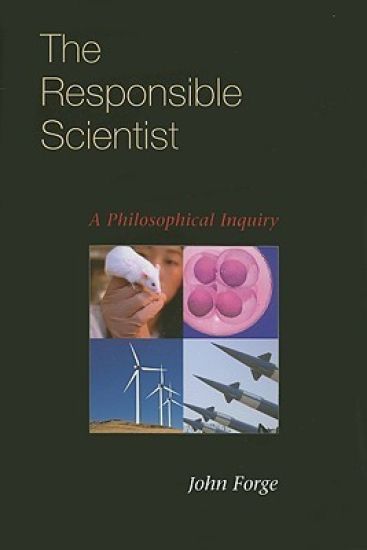
The Responsible Scientist

The Responsible Scientist

John Forge

University of Pittsburgh Press
2008
sidottu
When Fat Boy, the first atomic bomb was detonated at Los Alamos, New Mexico in 1945, moral responsibility in science was forever thrust into the forefront of philosophical debate. The culmination of the famed Manhattan Project, which employed many of the world's best scientific minds, was a singular event that signaled a new age of science for power and profit and the monumental responsibility that these actions entailed. Today, the drive for technological advances in areas such as pharmaceuticals, biosciences, communications, and the defense industry channels the vast majority of scientific endeavor into applied research. In ""The Responsible Scientist"", John Forge examines the challenges of social, moral, and legal responsibility faced by today's scientists. Focusing on moral responsibility, Forge argues that scientists have a responsibility not to do work that has harmful outcomes and that they are encouraged to do work that prevents harm. Scientists also have a backward-looking responsibility, whereby they must prevent wrongful outcomes and omissions that they are in a position to foresee. Forge presents a broad overview of many areas of scientific endeavor, citing the responsibility of corporations, employees, and groups of scientists as judged by the values of science and society's appraisals of actions and outcomes. He maintains that ultimate responsibility lies in the hands of the individual - the responsible scientist - who must exhibit the diligence and foresight to anticipate the use and abuse of his or her work.

Science, Technology and Society

Science, Technology and Society

Martin Bridgstock; David Burch; John Forge; John Laurent; Ian Lowe

Cambridge University Press
1998
pokkari
This book provides a comprehensive introduction to the human, social and economic aspects of science and technology. It examines a broad range of issues from a variety of perspectives, using examples and experiences from Australia and around the world. The authors present complex issues in an accessible and engaging form. Topics include the responsibilities of scientists, ethical dilemmas and controversies, the Industrial Revolution, economic issues, public policy, and science and technology in developing countries. The book ends with a thoughtful and provocative look towards the future. It includes extensive guides to further reading, as well as a useful section on information searching skills. This book will provoke, engage, inform and stimulate thoughtful discussion about culture, society and science. Broad and interdisciplinary, it will be of considerable value to students and teachers.
Science, Technology and Society

Science, Technology and Society

Martin Bridgstock; David Burch; John Forge; John Laurent; Ian Lowe

Cambridge University Press
1998
sidottu
This book provides a comprehensive introduction to the human, social and economic aspects of science and technology. It examines a broad range of issues from a variety of perspectives, using examples and experiences from Australia and around the world. The authors present complex issues in an accessible and engaging form. Topics include the responsibilities of scientists, ethical dilemmas and controversies, the Industrial Revolution, economic issues, public policy, and science and technology in developing countries. The book ends with a thoughtful and provocative look towards the future. It includes extensive guides to further reading, as well as a useful section on information searching skills. This book will provoke, engage, inform and stimulate thoughtful discussion about culture, society and science. Broad and interdisciplinary, it will be of considerable value to students and teachers.