Kirjojen hintavertailu – 12 865 492 kirjaa ja 27 kauppaa

Kirjailija

John Frow

Kirjat ja teokset yhdessä paikassa: 12 kirjaa, julkaisuja vuosilta 1986–2025, suosituimpiin kuuluu On Value and Valuation. Vertaile teosten hintoja ja tarkista saatavuus suomalaisista kirjakaupoista.

12 kirjaa

Kirjojen julkaisuvuodet: 1986–2025.

On Value and Valuation

On Value and Valuation

John Frow

TAYLOR FRANCIS LTD
2025
sidottu
On Value and Valuation asks whether the category of economic value remains theoretically viable, how value is formed, and how it should be understood. It explores the interlinkages between economic value and social and cultural values. On the one hand, the book draws on anthropological and sociological accounts of the evaluative frameworks within which things take on their social meanings; on the other, it explores and critiques the Marxist account of the formation of value in capitalist production. Its aim is to reconcile these two conceptions, and it does so by arguing that economic value is not a property of goods and services but is formed in specific institutions of valuation. It analyses new sources of value generated in markets in derivatives, in carbon credits and ecosystem services, in expert systems, and in new digital entities and seeks to deepen our understanding of value as a force driven by a web of social relations of accumulation that channel power and coercion. This book will be of interest to students of heterodox economics and Marxist theory, as well as to those with a wider concern with questions of social and economic value.
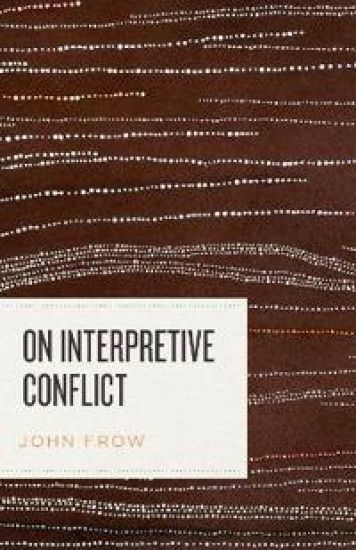
On Interpretive Conflict

On Interpretive Conflict

John Frow

University of Chicago Press
2019
pokkari
"Interpretation" is a term that encompasses both the most esoteric and the most fundamental activities of our lives, from analyzing medical images to the million ways we perceive other people's actions. Today, we also leave interpretation to the likes of web cookies, social media algorithms, and automated markets. But as John Frow shows in this thoughtfully argued book, there is much yet to do in clarifying how we understand the social organization of interpretation. On Interpretive Conflict delves into four case studies where sharply different sets of values come into play--gun control, anti-Semitism, the religious force of images, and climate change. In each case, Frow lays out the way these controversies unfold within interpretive regimes that establish what counts as an interpretable object and the protocols of evidence and proof that should govern it. Whether applied to a Shakespeare play or a Supreme Court case, interpretation, he argues, is at once rule-governed and inherently conflictual. Ambitious and provocative, On Interpretive Conflict will attract readers from across the humanities and beyond.
On Interpretive Conflict

On Interpretive Conflict

John Frow

University of Chicago Press
2019
sidottu
"Interpretation" is a term that encompasses both the most esoteric and the most fundamental activities of our lives, from analyzing medical images to the million ways we perceive other people's actions. Today, we also leave interpretation to the likes of web cookies, social media algorithms, and automated markets. But as John Frow shows in this thoughtfully argued book, there is much yet to do in clarifying how we understand the social organization of interpretation. On Interpretive Conflict delves into four case studies where sharply different sets of values come into play--gun control, anti-Semitism, the religious force of images, and climate change. In each case, Frow lays out the way these controversies unfold within interpretive regimes that establish what counts as an interpretable object and the protocols of evidence and proof that should govern it. Whether applied to a Shakespeare play or a Supreme Court case, interpretation, he argues, is at once rule-governed and inherently conflictual. Ambitious and provocative, On Interpretive Conflict will attract readers from across the humanities and beyond.
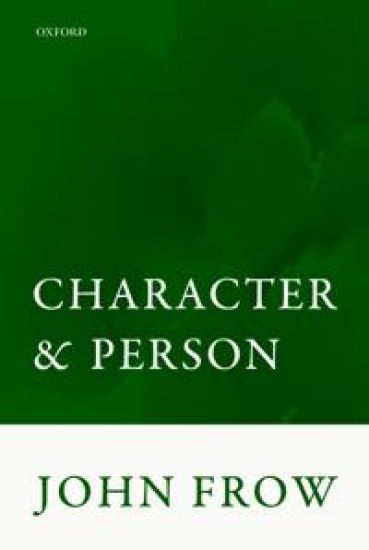
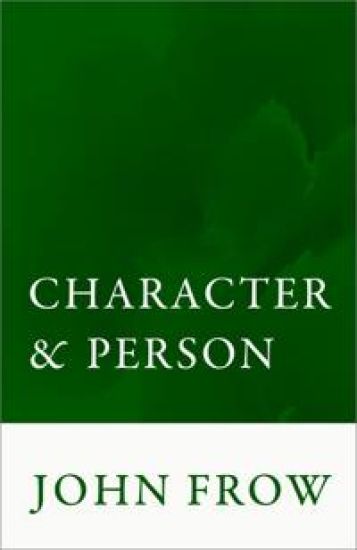
Character and Person

Character and Person

John Frow

Oxford University Press
2016
nidottu
Fictional character is an ontologically ambivalent category -- at once a formal construct and a quasi-person -- which lies at the heart of the life of textual fictions of all kinds. Character and Person explores that ambivalence by investigating not only the kinds of thing that character is but how it works to engage readers and the range of typologies through which it has been constructed in very different periods, media, and genres. John Frow seeks to explore the ways in which character is person-like, and through that the question of what it means to be a social person. His focus is thus on the interaction between its two major categories, and its method involves a constant play back and forth between them: from philosophical theories of face to an account of the mask in the New Comedy; from an exploration of medieval beliefs about the body's existence in the afterlife to a reading of Dante's Purgatorio; from the history of humoral medicine to the figure of the melancholic in Jacobean drama; and from Proust and Pessoa to cognitive science. What develops from this methodological commitment to fusing the categories of character and person is an extended analysis of the schemata that underpin each of them in their distinct but mutually constitutive spheres of operation.
Genre

Genre

John Frow

Routledge
2014
sidottu
This second edition of John Frow’s Genre offers a comprehensive and accessible introduction to the area. Genre is a key means by which we categorize the many forms of literature and culture, but it is also much more than that: in talk and writing, in music and images, in film and television, genres actively generate and shape our knowledge of the world. Understanding genre as a dynamic process rather than a set of stable rules, this book explores:the relation of simple to complex genresthe history of literary genre in theorythe generic organisation of implied meaningsthe structuring of interpretation by genrethe uses of genre in teachingJohn Frow’s lucid exploration of this fascinating concept has become essential reading for students of literary and cultural studies, and the second edition expands on the original to take account of recent debates in genre theory and the emergence of digital genres.
Genre

Genre

John Frow

Routledge
2014
nidottu
This second edition of John Frow’s Genre offers a comprehensive and accessible introduction to the area. Genre is a key means by which we categorize the many forms of literature and culture, but it is also much more than that: in talk and writing, in music and images, in film and television, genres actively generate and shape our knowledge of the world. Understanding genre as a dynamic process rather than a set of stable rules, this book explores:the relation of simple to complex genresthe history of literary genre in theorythe generic organisation of implied meaningsthe structuring of interpretation by genrethe uses of genre in teachingJohn Frow’s lucid exploration of this fascinating concept has become essential reading for students of literary and cultural studies, and the second edition expands on the original to take account of recent debates in genre theory and the emergence of digital genres.
Character and Person

Character and Person

John Frow

Oxford University Press
2014
sidottu
Fictional character is an ontologically ambivalent category -- at once a formal construct and a quasi-person -- which lies at the heart of the life of textual fictions of all kinds. Character and Person explores that ambivalence by investigating not only the kinds of thing that character is but how it works to engage readers and the range of typologies through which it has been constructed in very different periods, media, and genres. John Frow seeks to explore the ways in which character is person-like, and through that the question of what it means to be a social person. His focus is thus on the interaction between its two major categories, and its method involves a constant play back and forth between them: from philosophical theories of face to an account of the mask in the New Comedy; from an exploration of medieval beliefs about the body's existence in the afterlife to a reading of Dante's Purgatorio; from the history of humoral medicine to the figure of the melancholic in Jacobean drama; and from Proust and Pessoa to cognitive science. What develops from this methodological commitment to fusing the categories of character and person is an extended analysis of the schemata that underpin each of them in their distinct but mutually constitutive spheres of operation
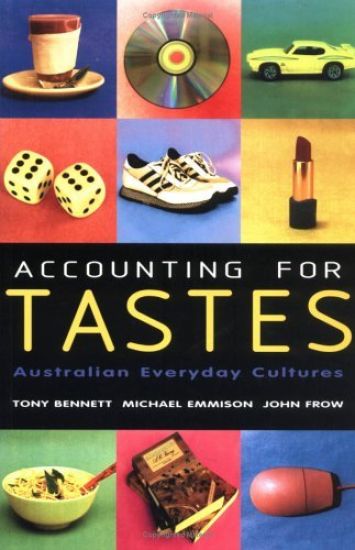
Accounting for Tastes

Accounting for Tastes

Tony Bennett; Michael Emmison; John Frow

Cambridge University Press
1999
pokkari
Accounting for Tastes was the most systematic and substantial study of Australian cultural tastes, preferences and activities ever published. Taking its inspiration from Pierre Bourdieu's work, this 1999 book examines the relationships between the patterns of participation in the different fields of cultural practice in Australia, and analyses trends of consumption and choice that Australians make in their everyday lives. The book contains detailed examinations of people's cultural choices through a large-scale survey and interviews. It also examines the influence of American culture on Australian choices, and the way work cultures and cultures of friendship affect how Australians choose to spend their leisure time. Accounting for Tastes makes a substantial contribution to the empirical and policy-oriented social inquiry into questions of cultural practices and preferences.
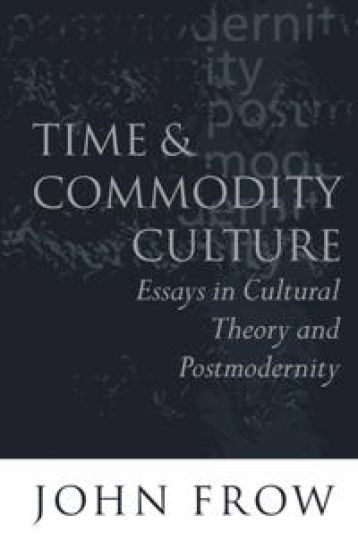
Time and Commodity Culture

Time and Commodity Culture

John Frow

Clarendon Press
1997
nidottu
Time and Commodity Culture is a set of four linked essays on the cultural systems of postmodernity. Rather than taking modernity and postmodernity as real historical epochs, however, it understands them as strategies for organizing time and social order by means of a `nostalgic' division within them. Each essay explores a particular dimension of this organization of time, especially in relation to the anxieties and the possibilities created by the commodification of culture. The central essay, `Gift and Commodity', studies two areas in which the speed of commodification has increased markedly in recent years: that of the person, and that of information. Using a mix of anthropological, legal, economic, and historical materials, it investigates the privatization of the commons in information by way of such things as the development of markets in human DNA, the trade in human organs, and the creation of property rights in `personality'. `What Was Postmodernism?' analyses the structured anxiety about the commodification of culture that is called `postmodern theory'. A further essay explores tourism as a figure of modernity, and a final essay on memory explores the phenomena of `recovered memory' and of Holocaust remembrance as ways of constructing temporally ordered forms of the real.
Time and Commodity Culture

Time and Commodity Culture

John Frow

Clarendon Press
1997
sidottu
Time and Commodity Culture is a set of four linked essays on the cultural systems of postmodernity. Rather than taking modernity and postmodernity as real historical epochs, however, it understands them as strategies for organizing time and social order by means of a `nostalgic' division within them. Each essay explores a particular dimension of this organization of time, especially in relation to the anxieties and the possibilities created by the commodification of culture. The central essay, `Gift and Commodity', studies two areas in which the speed of commodification has increased markedly in recent years: That of the person, and that of information. Using a mix of anthropological, legal, economic, and historical materials, it investigates the privatization of the commons in information by way of such things as the development of markets in human DNA, the trade in human organs, and the creation of property rights in `personality'. `What Was Postmodernism?' analyses the structured anxiety about the commodification of culture that is called `postmodern theory'. A further essay explores tourism as a figure of modernity, and a final essay on memory explores the phenomena of `recovered memory' and of Holocaust remembrance as ways of constructing temporally ordered forms of the real.
Cultural Studies and Cultural Value

Cultural Studies and Cultural Value

John Frow

Clarendon Press
1995
nidottu
Cultural Studies and Cultural Value is a major critique of the important new discipline of cultural studies. Cultural studies has generally organized itself around the opposition of high to low culture, reversing the traditional hierarchy of value, but leaving intact the polarity and the direct correlation of culture and class. Through detailed readings of the work of Pierre Bourdieu, Michel de Certeau, Stuart Hall, and Ernesto Laclau, John Frow challenges this key assumption. He argues that the field of culture now has multiple centres and multiple domains of value and that these are irreducible to a single scale. Intellectuals play the crucial role in the mediation of the cultural field; their possession of cultural capital endows intellectuals with specific class interests which are distinct from those of the classes of groups for whom they claim to speak. Cultural Studies and Cultural Value seeks a revitalized and 'poststructuralist' account of social class, a basis from which cultural studies can effect a much-needed reorientation.
Marxism and Literary History

Marxism and Literary History

John Frow

Harvard University Press
1986
sidottu
John Frow's book is a novel contribution to Marxist literary theory, proposing a reconciliation of formalism and historicism in order to establish the basis for a new literary history. Through a critique of his forerunners in Marxist theory (the historicist Marxism of Lukacs, the work of Macherey, Eagleton, and Jameson), Frow seeks to define the strengths and the limitations of this tradition and then to extend its possibilities in a radical reworking of the concept of discourse. He develops the notion of literature as a historically specific system within a network of discourses. Frow goes on to elaborate a number of central theoretical categories and to explore the historical dimension of those categories. Drawing in particular on Russian Formalism, he develops a theory of the dynamics of literary change and of the historical pressures that shape the literary system. He tests and extends his categories through readings of texts by Petronius, Holderlin, DeLillo, Dickens, Frank Hardy, and others. The final chapter, a reading of Derrida and Foucault, poses the question of the possibility of setting limits to reading and the power of limits to determine literary history.