Kirjojen hintavertailu – 12 859 819 kirjaa ja 27 kauppaa

Kirjailija

John Hattie

Kirjat ja teokset yhdessä paikassa: 88 kirjaa, julkaisuja vuosilta 1991–2026, suosituimpiin kuuluu Developing Curriculum for Deep Thinking. Vertaile teosten hintoja ja tarkista saatavuus suomalaisista kirjakaupoista.

88 kirjaa

Kirjojen julkaisuvuodet: 1991–2026.

Making Room for Impact

Making Room for Impact

Arran Hamilton; John Hattie; Dylan Wiliam

SAGE PUBLICATIONS INC
2023
nidottu
Dial back and make room for impact With teacher and leader workloads and burnout at an all-time high, it’s time for de-implementation: de-prioritizing and deleting the less effective, higher-cost initiatives we implement in schools. De-implementation allows us to focus on practices that have more supporting evidence and a higher probability of positive impact on students, and at the same time gain much-needed work-life balance. In Making Room for Impact, the internationally respected education experts and authors provide a clear four-stage process for winnowing down teaching and learning to high-effect practices. Informed by the latest research in learning, education, healthcare, and psychology, each step and tool is designed to move educators through the hard parts of letting go. Inside, you’ll find: Research that tells us the process of schooling is often over-engineered and that gives us permission to dial back, carefullyA step-by-step process for deciding which initiatives are most effective—and how to let go of the ones that are notUseful tools, templates, and charts that educators can immediately use in their de-implementation work—at school, in teaching teams, or at the system level It’s time to get our lives back—without harming student learning. If we can collectively learn to let go and understand how to identify which initiatives are worthwhile, we’ll have more time for what truly matters.

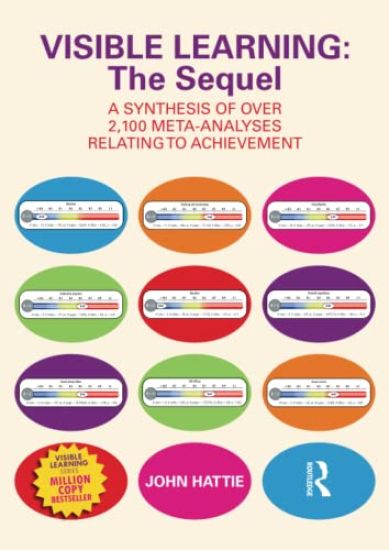
Visible Learning: The Sequel

Visible Learning: The Sequel

John Hattie

TAYLOR FRANCIS LTD
2023
sidottu
When the original Visible Learning® was published in 2008, it instantly became a publishing sensation. Interest in the book was unparalleled; it sold out in days and was described by the TES as revealing "teaching’s Holy Grail". Now John Hattie returns to this ground-breaking work. The research underlying this book is now informed by more than 2,100 meta-analyses (more than double that of the original), drawn from more than 130,000 studies, and has involved more than 400 million students from all around the world. But this is more than just a new edition. This book is a sequel that highlights the major story, taking in the big picture to reflect on the implementation in schools of Visible Learning, how it has been understood – and at times misunderstood – and what future directions research should take. Visible Learning: The Sequel reiterates the author’s desire to move beyond claiming what works to what works best by asking crucial questions such as: Why is the current grammar of schooling so embedded in so many classrooms, and can we improve it? Why is the learning curve for teachers after the first few years so flat? How can we develop teacher mind-frames to focus more on learning and listening? How can we incorporate research evidence as part of the discussions within schools? Areas covered include:The evidence base and reactions to Visible Learning The Visible Learning modelThe intentional alignment of learning and teaching strategiesThe influence of home, students, teachers, classrooms, schools, learning, and curriculum on achievementThe impact of technologyBuilding upon the success of the original, this highly anticipated sequel expands Hattie’s model of teaching and learning based on evidence of impact and is essential reading for anyone involved in the field of education either as a researcher, teacher, student, school leader, teacher trainer, or policy maker.
Visible Learning: The Sequel

Visible Learning: The Sequel

John Hattie

TAYLOR FRANCIS LTD
2023
nidottu

Halvin toimitettuna 36,50 €

When the original Visible Learning® was published in 2008, it instantly became a publishing sensation. Interest in the book was unparalleled; it sold out in days and was described by the TES as revealing "teaching’s Holy Grail". Now John Hattie returns to this ground-breaking work. The research underlying this book is now informed by more than 2,100 meta-analyses (more than double that of the original), drawn from more than 130,000 studies, and has involved more than 400 million students from all around the world. But this is more than just a new edition. This book is a sequel that highlights the major story, taking in the big picture to reflect on the implementation in schools of Visible Learning, how it has been understood – and at times misunderstood – and what future directions research should take. Visible Learning: The Sequel reiterates the author’s desire to move beyond claiming what works to what works best by asking crucial questions such as: Why is the current grammar of schooling so embedded in so many classrooms, and can we improve it? Why is the learning curve for teachers after the first few years so flat? How can we develop teacher mind-frames to focus more on learning and listening? How can we incorporate research evidence as part of the discussions within schools? Areas covered include:The evidence base and reactions to Visible Learning The Visible Learning modelThe intentional alignment of learning and teaching strategiesThe influence of home, students, teachers, classrooms, schools, learning, and curriculum on achievementThe impact of technologyBuilding upon the success of the original, this highly anticipated sequel expands Hattie’s model of teaching and learning based on evidence of impact and is essential reading for anyone involved in the field of education either as a researcher, teacher, student, school leader, teacher trainer, or policy maker.
Skolledarens verktygslåda : med fokus på hälsa och välmående

Skolledarens verktygslåda : med fokus på hälsa och välmående

Kennet Fröjd; John Hattie

Studentlitteratur AB
2023
nidottu
Tänk dig att du mår bra och har energi kvar till en rik fritid samtidigt som du presterar väl i din roll som skolledare. Låter inte det ganska lockande? Den här boken ger dig en verktygslåda för just det. Även om mycket i boken handlar om ledarskap och om hur du kan vända utmaningar till framgångar så ligger bokens främsta fokus på skolledarens hälsa, det vill säga på din hälsa. Det handlar om att göra det som är viktigt snarare än det som är bråttom och om att ägna tid åt det du vill prioritera vid rätt tidpunkt. Du får flera redskap för ditt ledarskap och evidensbaserade lärstrategier för att leda mot inkludering - målet är ju att leda så att varenda elev trivs, mår bra och utvecklas väl. Genom hela boken får du liknelser från idrottens värld och boken avslutas med ett antal scenarier med stor igenkänningsfaktor och förslag på lösningar som är baserade på bokens olika verktyg.
BUNDLE: Hattie: On-Your-Feet Guide: Visible Learning: 10 Mindframes for Teachers: 10 Pack
The 10 Visible Learning Mindframes are a foundational concept in Visible Learning - but it's hard to know what the mindframes look like in practice. In this On-Your-Feet Guide , we provide teachers with a reflective tool to help them identify their mindframes and embody the VL Mindframes in their classrooms. The 10 Mindframes are: I am an evaluator Assessment shows me my effect I collaborate I'm a change agent I take on challenges and don't fear failure I give and take feedback I teach through dialogue, not monologue I use our school's common "language" of learning I develop positive relationships I talk about "learning" much more than "teaching" On-Your-Feet Guides (OYFGs) provide you with the ultimate "cheat sheet" to implement effective change in your classroom while in the moment of teaching. Designed for accessibility, and providing step-by-step guidance, the OYFGs are written by experts who take research-based practices and make them doable for the busy teacher. Each On-Your-Feet Guide is laminated, 8.5"x11" tri-fold (6 pages), and 3-hole punched. Use the On-Your-Feet Guides : When you know the "what" but need help with the "how" As a quick reference to support a practice you learned in a PD workshop or book To learn how to implement foundational practices When you want to help your students learn a specific strategy, routine, or approach, but aren't sure how to do it yourself
Building to Impact

Building to Impact

Arran Hamilton; Douglas B. Reeves; Janet May Clinton; John Hattie

SAGE PUBLICATIONS INC
2022
nidottu
Turn ideas into goals—and goals into impact The road to school improvement and student achievement is paved with good intentions—so why does the destination seem so far away? If you’re like most educators, the answer is a pothole known as the implementation gap. This book provides a road map to bypassing that gap in your school or district, offering a carefully researched, field-tested methodology that takes leadership teams, professional learning communities, and educators all the way from good ideas to systematic impact. Following the five Ds, you’ll: Discover goals worth pursuing and problems worth addressingDesign instruments and actions that generate deep impactDeliver interventions and collect dataDouble-back to monitor your progress and evaluate the impactDouble-up to enhance, sustain, and scale your success You became an educator to make a difference in students’ lives. With this playbook, you’ll transform research and ideas into achievable actions—and make maximum impact.
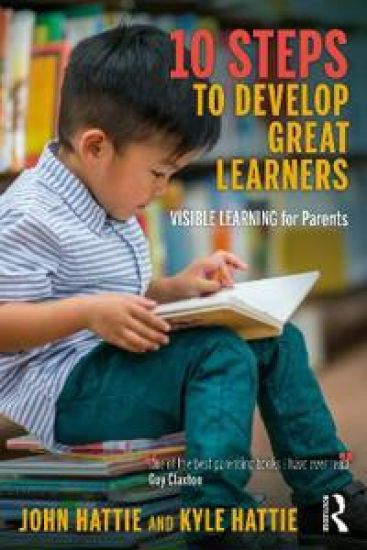
10 Steps to Develop Great Learners

10 Steps to Develop Great Learners

John Hattie; Kyle Hattie

TAYLOR FRANCIS LTD
2022
nidottu

Halvin toimitettuna 27,80 €

What can concerned parents and carers do to ensure their children, of all ages, develop great learning habits which will help them achieve their maximum at school and in life? This is probably one of the most important questions any parent can ask and now John Hattie, one of the most respected and renowned Education researchers in the world draws on his globally famous Visible Learning research to provide some answers. Writing this book with his own son Kyle, himself a respected teacher, the Hatties offer a 10-step plan to nurturing curiosity and intellectual ambition and providing a home environment that encourages and values learning. These simple steps based on the strongest of research evidence and packed full of practical advice can be followed by any parent or carer to support and enhance learning and maximize the potential of their children. Areas covered include: Communicating effectively with teachers Being the ‘first learner’ and demonstrating openness to new ideas and thinking Choosing the right school for your child Promoting the ‘language of learning’ Having appropriately high expectations and understanding the power of feedbackAnyone concerned about the education and development of our children should read this book. For parents it is an essential guide that could make a vital difference to your child's life. For schools, school leaders and education authorities this is a book you should be encouraging every parent to read to support learning and maximize opportunities for all.
10 Steps to Develop Great Learners

10 Steps to Develop Great Learners

John Hattie; Kyle Hattie

TAYLOR FRANCIS LTD
2022
sidottu
What can concerned parents and carers do to ensure their children, of all ages, develop great learning habits which will help them achieve their maximum at school and in life? This is probably one of the most important questions any parent can ask and now John Hattie, one of the most respected and renowned Education researchers in the world draws on his globally famous Visible Learning research to provide some answers. Writing this book with his own son Kyle, himself a respected teacher, the Hatties offer a 10-step plan to nurturing curiosity and intellectual ambition and providing a home environment that encourages and values learning. These simple steps based on the strongest of research evidence and packed full of practical advice can be followed by any parent or carer to support and enhance learning and maximize the potential of their children. Areas covered include: Communicating effectively with teachers Being the ‘first learner’ and demonstrating openness to new ideas and thinking Choosing the right school for your child Promoting the ‘language of learning’ Having appropriately high expectations and understanding the power of feedbackAnyone concerned about the education and development of our children should read this book. For parents it is an essential guide that could make a vital difference to your child's life. For schools, school leaders and education authorities this is a book you should be encouraging every parent to read to support learning and maximize opportunities for all.
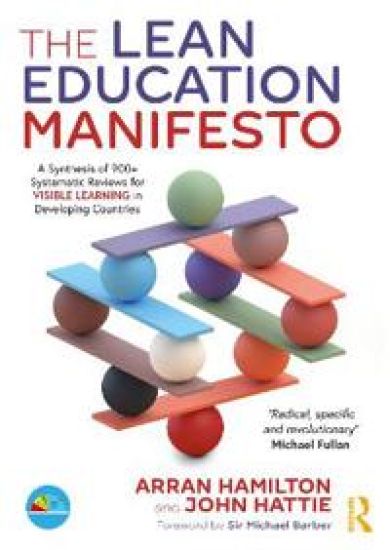
The Lean Education Manifesto

The Lean Education Manifesto

Arran Hamilton; John Hattie

TAYLOR FRANCIS LTD
2022
nidottu
The global expansion of education is one of the greatest successes of the modern era. More children have access to schooling and leave with higher levels of learning than at any time in history. However, 250 million+ children in developing countries are still not in school, and 600 million+ attend but get little out of it – a situation further exacerbated by the dislocations from COVID-19. In a context where education funding is stagnating and even declining, Arran Hamilton and John Hattie suggest that we need to start thinking Lean and explicitly look for ways of unlocking more from less. Drawing on data from 900+ systematic reviews of 53,000+ research studies – from the perspective of efficiency of impact – they controversially suggest that for low- and middle-income countries: Maybe pre-service initial teacher training programs could be significantly shortened and perhaps even stopped Maybe teachers need not have degree-level qualifications in the subjects they teach, and they might not really need degrees at all! Maybe the hours per week and years of schooling that each child receives could be significantly reduced, or at least not increased Maybe learners can be taught more effectively and less resource intensively in mixed-age classrooms, with peers tutoring one another Maybe different approaches to curriculum, instruction, and the length of the school day might be more cost-effective ways of driving up student achievement than hiring extra teachers, reducing class sizes, or building more classrooms Maybe school-based management, public–private partnerships, and performance-related pay are blind and expensive alleys that have limited influence or impact on what teachers actually do in classrooms. This groundbreaking and thought-provoking work also identifies a range of initiatives that are worth starting. It introduces the Leaning to G. O. L. D. methodology to support school and system leaders in selecting, implementing, and scaling those high-probability initiatives; and to rigorously de-implement those to be stopped. It is essential reading for anyone with an interest in education.
The Lean Education Manifesto

The Lean Education Manifesto

Arran Hamilton; John Hattie

TAYLOR FRANCIS LTD
2022
sidottu
The global expansion of education is one of the greatest successes of the modern era. More children have access to schooling and leave with higher levels of learning than at any time in history. However, 250 million+ children in developing countries are still not in school, and 600 million+ attend but get little out of it – a situation further exacerbated by the dislocations from COVID-19. In a context where education funding is stagnating and even declining, Arran Hamilton and John Hattie suggest that we need to start thinking Lean and explicitly look for ways of unlocking more from less. Drawing on data from 900+ systematic reviews of 53,000+ research studies – from the perspective of efficiency of impact – they controversially suggest that for low- and middle-income countries: Maybe pre-service initial teacher training programs could be significantly shortened and perhaps even stopped Maybe teachers need not have degree-level qualifications in the subjects they teach, and they might not really need degrees at all! Maybe the hours per week and years of schooling that each child receives could be significantly reduced, or at least not increased Maybe learners can be taught more effectively and less resource intensively in mixed-age classrooms, with peers tutoring one another Maybe different approaches to curriculum, instruction, and the length of the school day might be more cost-effective ways of driving up student achievement than hiring extra teachers, reducing class sizes, or building more classrooms Maybe school-based management, public–private partnerships, and performance-related pay are blind and expensive alleys that have limited influence or impact on what teachers actually do in classrooms. This groundbreaking and thought-provoking work also identifies a range of initiatives that are worth starting. It introduces the Leaning to G. O. L. D. methodology to support school and system leaders in selecting, implementing, and scaling those high-probability initiatives; and to rigorously de-implement those to be stopped. It is essential reading for anyone with an interest in education.
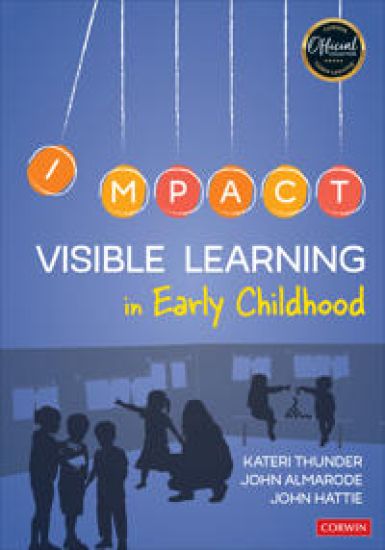
Visible Learning in Early Childhood

Visible Learning in Early Childhood

Kateri Thunder; John T. Almarode; John Hattie

SAGE PUBLICATIONS INC
2022
nidottu
Make learning visible in the early years Early childhood is a uniquely sensitive time, when young learners are rapidly developing across multiple domains, including language and literacy, mathematics, and motor skills. Knowing which teaching strategies work best and when can have a significant impact on a child’s development and future success. Visible Learning in Early Childhood investigates the critical years between ages 3 and 6 and, backed by evidence from the Visible Learning® research, explores seven core strategies for learning success: working together as evaluators, setting high expectations, measuring learning with explicit success criteria, establishing developmentally appropriate levels of learning, viewing mistakes as opportunities, continually seeking feedback, and balancing surface, deep, and transfer learning. The authors unpack the symbiotic relationship between these seven tenets through Authentic examples of diverse learners and settings Voices of master teachers from the US, UK, and AustraliaMultiple assessment and differentiation strategiesMultidisciplinary approaches depicting mathematics, literacy, art and music, social-emotional learning, and more Using the Visible Learning research, teachers partner with children to encourage high expectations, developmentally appropriate practices, the right level of challenge, and a focus on explicit success criteria. Get started today and watch your young learners thrive!
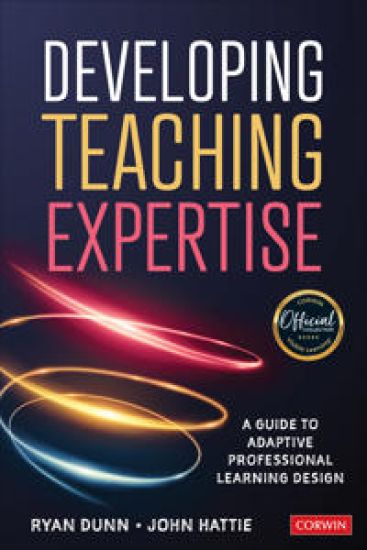
Developing Teaching Expertise

Developing Teaching Expertise

Ryan Dunn; John Hattie

SAGE Publications Inc
2021
nidottu
Cultivate a Culture of Learning by Doing In Teacher Development Picture a world where teachers, equipped with the expertise to produce the best outcomes in every context, confidently and intentionally inquire, adapt, and change instruction based on student needs. Do you know how to get them there? Developing Teaching Expertise offers a proactive framework for teachers to work through iterative design cycles and understand how to make ‘what works best’ work in their unique classroom. Aligned to the varied components of teacher professional learning, this book supports the development of teaching expertise by: Exploring how specific design and leadership approaches can be integrated to form a useful framework for leading teacher professional learningHighlighting ways to navigate through complex educational environmentsIncorporating illustrative tools and vignettes, and real-life examples of results from different educational settings This book offers a deep exploration to lead and intentionally cultivate a culture of lifelong teacher learning.
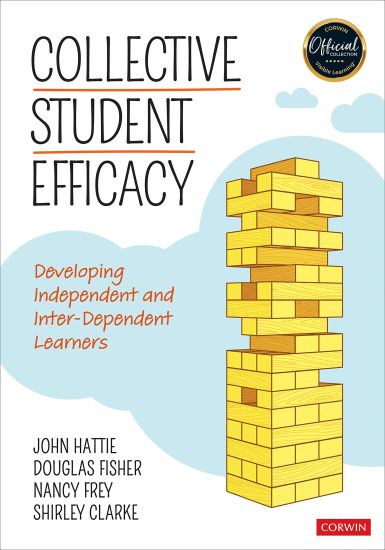
Collective Student Efficacy

Collective Student Efficacy

John Hattie; Douglas Fisher; Nancy Frey; Shirley Clarke

SAGE Publications Inc
2021
nidottu
Arm students with the confidence they need to pursue ambitious goals—together. Collective student efficacy— students’ beliefs that by working with other people, they will learn more—can be a powerful accelerator of student learning and a precursor to future employment success. Harnessing twenty-five years of VISIBLE LEARNING® research, Collective Student Efficacy: Developing Independent and Inter-Dependent Learners illuminates the power of collective efficacy and identifies the many ways teachers can activate collective efficacy with their students. More than cooperative and collaborative learning, collective efficacy requires the refinement of both individual and collective tasks that build on each other over time. This innovative book details how knowledge, skills, and dispositions entangle to create collective and individual beliefs, and leads educators to mobilize collective efficacy in the classroom. It includes: The vital components and evidence-based success criteria necessary for students' collective efficacy The "I" and "We" skills that need to be developed to ensure students have the skills and confidence to contribute to group success The nature of learning design, lesson planning, and classroom structures that ensure opportunities for all students to engage in collective efficacy The necessity for constructive alignment between learning intentions, tasks, success criteria, and assessments "Learning from a Distance" actions to facilitate building skills in remote learning environments The time is now to prepare students to meet the demands of the future. Through collective student efficacy, students will learn to become actionable agents of learning and change.
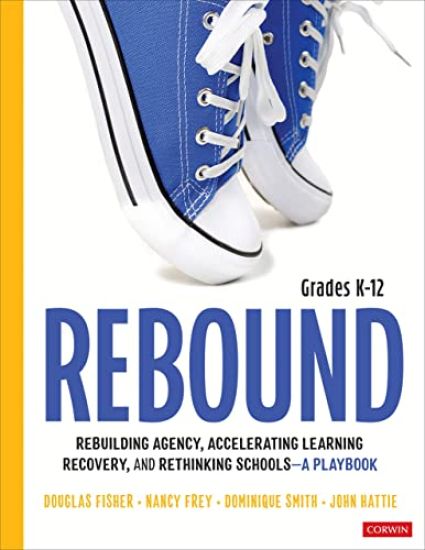
Rebound, Grades K-12

Rebound, Grades K-12

Douglas Fisher; Nancy Frey; Dominique Smith; John Hattie

SAGE Publications Inc
2021
kierre
"The greatest travesty that can arise for schools after 2020/21," Doug, Nancy, Dominique, and John write, "is to rush back to the old normal, and learn nothing, or little, about what worked well. That’s why this book has focused on rebounding, and taking the opportunity to create an even better schooling system, one that serves even more students, and focuses more on what matters most."
Leading the Rebound

Leading the Rebound

Douglas Fisher; Nancy Frey; Dominique Smith; John Hattie

SAGE Publications Inc
2021
nidottu
Let’s make the "next normal" a "better normal" If there ever was a time for our heroic school leadership to persevere, it’s now. Because now, well over one year since the pandemic stretched the resilience and reserves of our school systems, it’s time to "rebound." It’s time to leverage this once-in-a-lifetime opportunity to reboot teaching and learning as we know it so that we magnify the effective practices from the past while leveraging the so many recent lessons learned. This is where Doug Fisher, Nancy Frey, Dominique Smith, and John Hattie, coauthors of The Distance Learning Playbook series, are ideally equipped to serve as your collaborators. Inside Leading the Rebound: 20+ Must-Dos to Restart Teaching and Learning you’ll find immediate actions, mindsets, and approaches to take if we’re to reimagine and improve our schools and school systems. Step by step, you’ll discover explicit guidance on how to: 1. Take care of yourself 2. Take stock and find the path 3. Rebuild teacher agency 4. Rebuild collective teacher efficacy 5. Foreground social and emotional learning 6. Change the learning loss narrative 7. Guide teacher clarity 8. Ensure instructional excellence 9. Use assessments for a range of purposes 10. Design and implement interventions 11. Win back parent-teacher relationships 12. Establish restorative practices 13. Avoid stealing the conflict 14. Enhance teacher-student and student-student interactions 15. Develop early warning systems for attendance, behavior, and course completion 16. Confront cognitive challenges to learning 17. Ensure equitable and restorative grading 18. Enhance PLCs 19. Provide empathetic feedback 20. Host honest performance conversations 21. Maintain your social presence 22. Future-proof teachers and students What’s more Leading the Rebound is backed up with all kinds of resources--including VISIBLE LEARNING® research, sample planning tools, and other essential tips and strategies--to provide you with a start-to-finish roadmap for navigating this absolutely critical next leg in our journey toward a "better normal."
Great Teaching by Design

Great Teaching by Design

John Hattie; Vince Bustamante; John T. Almarode; Douglas Fisher; Nancy Frey

SAGE Publications Inc
2021
nidottu
Turn good intentions into better outcomes—by design! Why leave student success up to chance? By combining your intuition and experience with the latest research on high-impact learning practices, you can evolve your teaching from good to great and make a lasting difference for your students. Organized around the DIIE framework, Great Teaching by Design takes you step-by-step from intention to implementation to accelerate the impact your teaching has on student learning. Inside, you’ll find: A deep dive into the four stages of the DIIE model: Diagnosis and Discovery, Intervention, Implementation, and Evaluation A fresh look at the Visible Learning research, which identifies the most powerful strategies for teaching and learning Stories of best practices in action and examples from classrooms around the world Great teaching may come by chance, but it will come by design. Whether you’re new to teaching or looking to give your instruction a boost, take up the challenge and discover a new framework for teaching with true intentionality.
The Distance Learning Playbook for School Leaders

The Distance Learning Playbook for School Leaders

Douglas Fisher; Nancy Frey; Dominique Smith; John Hattie

SAGE Publications Inc
2020
nidottu
Effective school leadership is effective leadership, regardless of where it occurs In March 2020, there was no manual for leading schools and school systems during a pandemic. School leaders had to figure things out as the crisis unfolded. But starting now, leaders have the opportunity to prepare for leading schools through distance learning with purpose and intent—using what works best to accelerate students’ learning all the while maintaining an indelible focus on equity. Harnessing the insights and experience of renowned educators Douglas Fisher, Nancy Frey, and John Hattie, The Distance Learning Playbook for School Leaders applies the wisdom and evidence of the VISIBLE LEARNING® research to understand what works best. Spanning topics from school climate at a distance, leader credibility, care for self and colleagues, instructional leadership teams, stakeholder advisory groups, and virtual visibility, this comprehensive playbook details the research- and evidence-based strategies school leaders can mobilize to lead the delivery of high-impact learning in an online, virtual, and distributed environment. This powerful guide includes: Actionable insights and hands-on steps for each module to help school leaders realize the evidence-based leadership practices that result in meaningful learning in a distance environmentDiscussion of equity challenges associated with distance learning, along with examples of how leaders can work to ensure that equity gains that have been realized are not lost. Analysis of the mindsets that empower leaders to manage change, rather than technologySpace to write and reflect on current practices and plan future leadership strategiesThe mindframes for distance learning that serve leaders well in any instructional setting and will position schools after the pandemic to come back better than they were before The Distance Learning Playbook for School Leaders is the essential hands-on guide to leading school and school systems from a distance and delivering on the promise of equitable, quality learning experiences for students.
The Turning Point for the Teaching Profession

The Turning Point for the Teaching Profession

Field Rickards; John Hattie; Catherine Reid

Routledge
2020
sidottu
A revolution is happening in education, with leaders and teachers now asked to focus on learning, to develop collaborative teams to impact on students, to use and raise professional standards, and to identify and esteem expertise in our profession. With new demands relating to technological advances, changing demographics, internationalism, and the inclusion of ‘twenty-first-century skills,’ there is pressure on schools to deliver greater and deeper success with more students. The Turning Point aims to present the factors needed to affect real change for school systems, in classrooms, and in the teaching profession by: Arguing for the establishment of teaching as a true 'profession' alongside areas such as medicine or law. Identifying the expertise fundamental to the meeting demands of schools. Elaborating on evaluative thinking and clinical practice as the basis of this new profession. Outlining core levers of change to show how teachers can have profound impacts on educational, medical, and social dimensions of students. This book is essential reading for teachers, school leaders, education policymakers, teacher candidates, and teacher educators. Those working in affiliated professions, such as adolescent psychologists and health workers, will also find aspects of the book relevant to their work.
The Turning Point for the Teaching Profession

The Turning Point for the Teaching Profession

Field Rickards; John Hattie; Catherine Reid

Routledge
2020
nidottu
A revolution is happening in education, with leaders and teachers now asked to focus on learning, to develop collaborative teams to impact on students, to use and raise professional standards, and to identify and esteem expertise in our profession. With new demands relating to technological advances, changing demographics, internationalism, and the inclusion of ‘twenty-first-century skills,’ there is pressure on schools to deliver greater and deeper success with more students. The Turning Point aims to present the factors needed to affect real change for school systems, in classrooms, and in the teaching profession by: Arguing for the establishment of teaching as a true 'profession' alongside areas such as medicine or law. Identifying the expertise fundamental to the meeting demands of schools. Elaborating on evaluative thinking and clinical practice as the basis of this new profession. Outlining core levers of change to show how teachers can have profound impacts on educational, medical, and social dimensions of students. This book is essential reading for teachers, school leaders, education policymakers, teacher candidates, and teacher educators. Those working in affiliated professions, such as adolescent psychologists and health workers, will also find aspects of the book relevant to their work.
The Distance Learning Playbook for Parents

The Distance Learning Playbook for Parents

Rosalind Wiseman; Douglas Fisher; Nancy Frey; John Hattie

SAGE Publications Inc
2020
nidottu
We are in this together and will get through this together Parent involvement has always been a vital part of any child’s education, but the pandemic and resulting remote instruction require that parents and educators partner at a deeper level. Following the tremendous success of The Distance Learning Playbook, K-12, education authorities Doug Fisher, Nancy Frey, and John Hattie have teamed up with New York Times bestselling author and parenting expert Rosalind Wiseman to bring you the consummate guide to support your child's academic, social, and emotional development in any learning environment – while not overwhelming you in the process. This essential guide will arm you with the tools and insight to Create an environment conducive to learning, establish routines, and most importantly, take care of yourself and your childMaximize the time you spend supporting learning by focusing on what is proven to work best in educationHelp your child develop the cognitive attitudes and habits that foster creativity, critical thinking, and increased responsibility for their learning Support the development of your child’s social and emotional learning skills, including the ability to navigate social interactions, build friendships, and regulate emotions at a time when they have never been more important to have, and more challenging to maintain The Distance Learning Playbook for Parents outlines supportive strategies for navigating virtual environments to ensure effective and impactful learning that aligns the needs and expectations of teachers, parents, and students alike.