Kirjojen hintavertailu – 12 859 819 kirjaa ja 27 kauppaa

Kirjailija

John Henry Newman

Kirjat ja teokset yhdessä paikassa: 606 kirjaa, julkaisuja vuosilta 1864–2026, suosituimpiin kuuluu The Ecclesiastical History Of M. L'Abbe Fleury From A.D. 400-429 A.D. (1842). Vertaile teosten hintoja ja tarkista saatavuus suomalaisista kirjakaupoista.

606 kirjaa

Kirjojen julkaisuvuodet: 1864–2026.

On the Scope of University Education

On the Scope of University Education

John Henry Newman

Cosimo Classics
2005
pokkari
In 1854, Father John Henry Newman, future Cardinal of the Roman Catholic Church, entered the new Catholic University in Dublin as Rector - a post he held for four years. By way of preparation in 1852, Father Newman authored and published O JOHN HENRY CARDINAL NEWMAN (1801-1890) was known as "The Father of The Second Vatican Council" and a - if not the - leading figure in the Church of England. Prior to his conversion to Catholicism in 1845, Cardinal Newman was an outstanding
An Essay on the Development of Christian Doctrine

An Essay on the Development of Christian Doctrine

John Henry Newman

Wipf Stock Publishers
2005
pokkari
John Henry Cardinal Newman begins the 'Essay' with a definition of development, pointing out that the real problem is how to distinguish true developments from corruptions and decays. He then goes on to a sweeping consideration of the growth and development of doctrine in the Catholic Church, from the time of the Apostles to Newman's own era. He demonstrates that the basic "rule" under which Christianity proceeded through the centuries is to be found in the principle of development, and emphasized that throughout the entire life of the Church this law of development has been in effect and safeguards the faith from any real corruption.
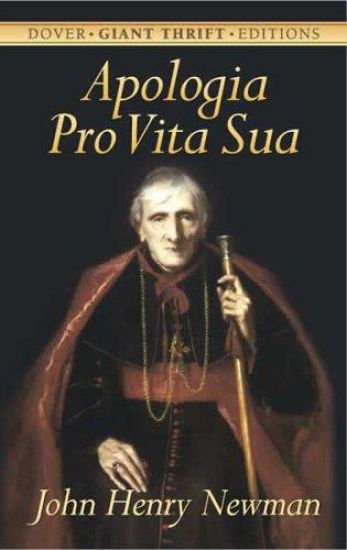
Apologia Pro Vita Sua

Apologia Pro Vita Sua

John Henry Newman

Dover Publications Inc.
2005
nidottu
A highly influential figure in the Church of England, John Henry Newman stunned the Anglican community in 1843, when he left his position as vicar of St. Mary's, Oxford, to join the Roman Catholic church. Perhaps no one took greater offense than Protestant clergyman Charles Kingsley, whose scathing attacks against Newman's faith and honor inspired this brilliant response. "Apologia Pro Vita Sua, Newman's spiritual autobiography, explores the depths and nature of Christianity with flowing prose and a conversational style that has ensured its status as a classic.
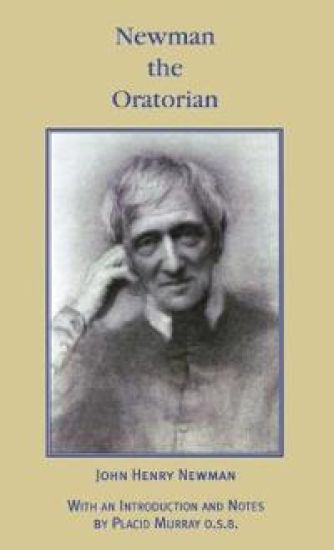
Newman the Oratorian

Newman the Oratorian

John Henry Newman

GRACEWING
2004
sidottu
The unpublished Oratory Papers of Blessed John Henry Cardinal Newman edited with an Introductory Study on the Continuity between his Anglican and his Catholic Ministry. These are Newman's Chapter Addresses and other writings on the purpose and characteristics of Oratorian life. As Superior, Newman wanted his community to consist of responsible persons bound together by tact and discretion, obeying an unwritten law of love. He exercised endless patience in his desire to preserve this 'weaponless state' of the Oratory in spite of tensions, dissensions, opposition and even separation. Each paper has been transcribed from the original manuscripts in the Birmingham Oratory Archives, and has been provided with a succinct introduction and notes. The editor has, moreover, furnished a full-length introductory study on Newman's spirituality as a priest against the background of the Anglican Ministry (1824-45), since it is true to say that Newman learned to live as a priest while still an Anglican. Four major areas of his Anglican ministry - the Care of Souls, Preaching, the Eucharistic Ministry and Prayer - have been closely examined both in themselves and in their renewed appearance in Newman's life as a Catholic priest. The editor, Fr Placid Murray, is a Benedictine monk of Glenstal Abbey, Ireland.
John Newman

John Newman

John Henry Newman

Fyfield Books
2002
nidottu
This selection from the most productive Christian pen of the 19th century is also an introduction to one of its most compelling and troubled minds. John Henry Newman (1801-1891) was a dominant figure in both the Anglican and the Roman Catholic churches. His writings and his human presence in Oxford and elsewhere had an abiding impact on both communions and contribute still to the spirit of ecumenicism. This bok concentrates on Newman's life and work up to 9 October 1845, the mid-point of his life and the moment be became a Roman Catholic. He was a prolific and subtle writer, a great prose artist whose sermons, tracts and polemics, together with a talent for organization and an ability to inspire others to faith and action, launched the Oxford Movement and the controversies that still follow from it. The 12 years between 1833 and 1845 are among the most important for English Christianity, and they were shaped for the most part by the pen and energy of Newman, a rather shy, quiet Oxford don, whose enduring legacy was to restore to the Church of England its Catholic heritage. Newman was complex and sometimes contradictory as a man, and even in his most formal writings the man is present, responding to social and political pressures of church and state. A great communicator, with a need for self-disclosure, he is nonetheless revealed "and" concealed in his writings.
Lectures on the Doctrine of Justification

Lectures on the Doctrine of Justification

John Henry Newman

Wipf Stock Publishers
2001
pokkari
In Lectures on the Doctrine of Justification (1838) Newman attempts to find a via media between justification by faith and by works. His emphasis on sanctification and his suspicion of a merely imputed righteousness is marked by a return to an emphasis on the imparted righteousness of the indwelling Christ.
The Letters and Diaries of John Henry Newman: Volume VIII: Tract 90 and the Jerusalem Bishopric
John Henry Newman (1801-90) was brought up in the Church of England in the Evangelical tradition. An Oxford graduate and Fellow of Oriel College, he was appointed Vicar of St Mary's Oxford in 1828; from 1839 onwards he began to have doubts about the claims of the Anglican Church and in 1845 he was received into the Roman Catholic Church. He was made a Cardinal in 1879. His influence on both the restoration of Roman Catholicism in England and the advance of Catholic ideas in the Church of England was profound. Volume VIII covers a turbulent period in Newman's life with the publication of Tract 90. His attempt to show the compatibility of the 39 Articles with Catholic doctrine caused a storm both in the University of Oxford and in the Church. He and others were horrified by the establishment of a joint Anglo-Prussian Bishopric in Jerusalem, considering it an attempt to give Apostolical succession to an heretical church. In 1842 he moved away from the hubbub of Oxford life to nearby Littlemore.
Selected Sermons, Prayers, and Devotions

Selected Sermons, Prayers, and Devotions

John Henry Newman

Vintage Books
1999
pokkari
Presents an inspirational anthology of sermons, prayers, devotions, and other religious writings by the influential Catholic cardinal, in a collection that explores such topics as how to reconcile faith and reason and the necessity to seek the holiness in life. Original. 15,000 first printing.
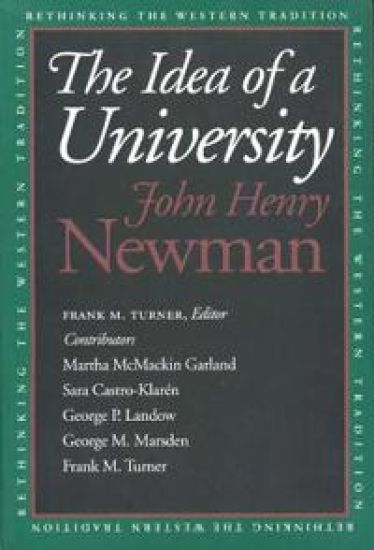
The Idea of a University

The Idea of a University

John Henry Newman

Yale University Press
1996
pokkari
Since its publication almost 150 years ago, The Idea of a University has had an extraordinary influence on the shaping and goals of higher education. The issues that John Henry Newman raised—the place of religion and moral values in the university setting, the competing claims of liberal and professional education, the character of the academic community, the cultural role of literature, the relation of religion and science—have provoked discussion from Newman's time to our own. This edition of The Idea of a University includes the full text of "University Teaching" and four selections from "University Subjects," together with five essays by leading scholars that explore the background and the present day relevance of Newman's themes. In the essays Martha Garland discusses the character and organization of the early nineteenth-century English universities upon which Newman based much of his vision; Frank M. Turner traces the impact of Newman's influence during the vast expansion of higher education since World War II; George Marsden investigates how the decreasing emphasis on religion has affected higher education; Sara Castro Klaren examines the implications of Newman's views on education and literature for current debates between proponents of a curriculum based on western civilization and one based on multiculturalism; and George Landow considers what the advent of electronic communication will mean to university teaching, research, and community. To aid accessibility, the edition also includes an analytical table of contents, a chronology and biographical sketch of Newman's life, questions for discussion, expanded notes, and a glossary of names, all of which will help make this the standard teaching text for Newman's work.
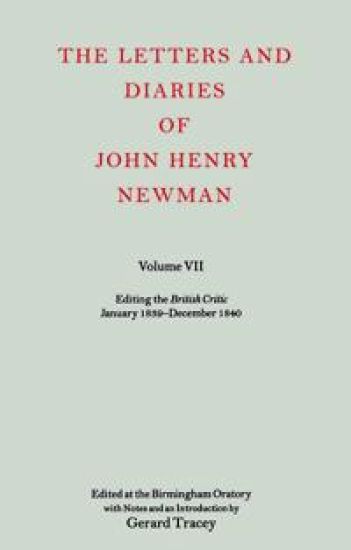
The Letters and Diaries of John Henry Newman: Volume VII: Editing the British Critic January 1839 - December 1840
John Henry Newman (1801-90) was at the height of his position in the Church of England in 1839, when he first began to feel doubts concerning the claims of the Anglican Church. His Editorship of the British Critic took up a great deal of time but he was greatly encouraged by its increasing sales. Uncomfortable with his position as Vicar of St Mary's, Oxford, Newman was considering giving up the living at the end of 1840. This volume covers a significant period in Newman's life, with a background of social ferment and political tension: the Corn Laws, Chartism, an inexperienced monarch, weak government, and foreign problems. Contemporary writers such as Carlyle attracted Newman's attention, and university reform was a live issue.
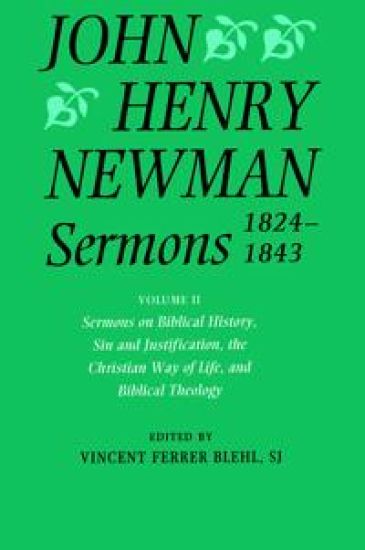
John Henry Newman Sermons 1824-1843: Volume II: Sermons on Biblical History, Sin and Justification, the Christian Way of Life, and Biblical Theology
From 1824 to 1843 Newman was an active clergyman of the Chruch of England; during these years he entered the pulpit about 1,270 times. Newman published 217 of the sermons which he wrote during these years; a further 246 sermons survive in manuscript in the Archives of the Birmingham Oratory, some only as fragments but the majority as full texts. Volume I was published in 1991; the series will consist of five volumes in all. This volume presents 58 previously unpublished sermons of John Henry Newman. Those preached in his early days as Vicar of St Mary's Oxford include a series of sermons devoted to Biblical history and contain some searching moral portraits of patriarchs and kings. Another series of sermons on the Epistle to the Romans with subsequent extensive revisions reveals the development of Newman's views on Justification and Faith leading up to the Lectures on Justification published in 1838. Of the sermons surviving from St Clement's, 1824-1826, when Newman held Evangelical views, the present volume contatins a number of practical sermons dealing with details of Christian living. These are followed by sermons devoted to Biblical theology in which Newman among other issues explores various aspects of the Jewish religion as presented in the Old Testament. As many of these sermons were revised and subsequently preached again, they are important for an undrestanding of the growth of Newman's spiritual theology.
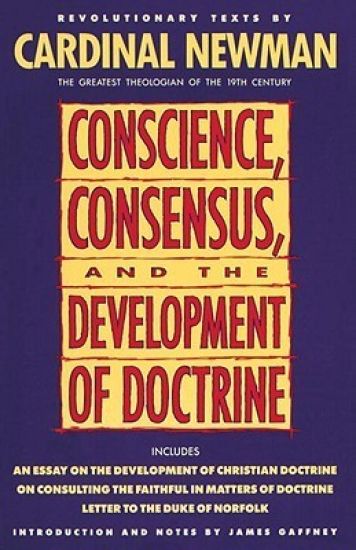
Conscience, Consensus, and the Development of Doctrine
"Certainly, if I am obliged to bring religion into after-dinner toasts (which indeed does not seem quite the thing), I shall drink -- to the Pope, if you please -- still, to Conscience first, and to the Pope afterwards."--John Henry Cardinal Newman In the works collected here, including An Essay on the Development of Christian doctrine, A Letter Addressed to His Grace the Duke of Norfolk, and On Consulting the Faithful in Matters of Doctrine, John Henry Cardinal Newman, the great nineteenth-century English theologian, debunks a few Catholic myths: Myth #1: The teaching of the Catholic Church on faith and morals has never changed and never will change. Not so, this brilliant scholar says. For just as each era has new ways of understanding, so, too, must the Catholic Church always change in its understanding of faith and morals. Myth #2: Catholics have to do whatever the Pope says. To the contrary, according to Newman's famous quip on after-dinner toasts, the ultimate obligation of Catholics is to conscience, not the Pope. Myth #3: It's the bishops who teach, the laity who follows. Newman turns this notion upside down: The laity, he says, are the source and final seal of the church's teaching; thus the bishops must listen to them. Never before collected in one volume, these classic works reveal Newman at his eloquent best as he speaks to the religious crises of our time.

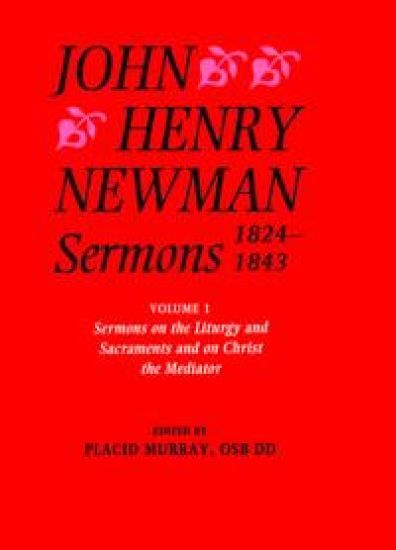
John Henry Newman Sermons 1824-1843: Volume I: Sermons on the Liturgy and Sacraments and on Christ the Mediator
From 1824 to 1843 Newman was an active clergyman of the Church of England; during this time, he entered the pulpit about 1,270 times. Newman published 217 of the sermons which he wrote during these years; a further 246 sermons survive in manuscript in the Archives of the Birmingham Oratory, some only as fragments but the majority as full texts. These sermons will be published in a series of five volumes, the aim being to transcribe them accurately, with sufficient editorial apparatus for the theological development within them to be understood, and their historical situation to be clear. The forty-three sermons contained in Volume I reveal Newman's attitude to his pastoral charge, his theology of liturgy based on the Book of Common Prayer; his gradual acceptance of the doctrine of baptismal regeneration as a substitute for his earlier belief in conversion as understood by the Evangelicals; the eventual supremacy of the Eucharist in his own spiritual life; his growing reserve about preaching on the Atonement; his faith in the divinity of Christ the Mediator; and finally, his understanding of the Church as the remedial and mediatorial kingdom of Christ on earth.
The Via Media of the Anglican Church

The Via Media of the Anglican Church

John Henry Newman

Clarendon Press
1990
sidottu
This is the first of Newman's Anglican works to be presented in a fully annotated edition. Newman published the first two editions in 1836 and 1837 at the height of his career within the Oxford Movement. The third edition was published in 1877, when Newman had been a Roman Catholic for thiry-two years. It represents a dialogue between the Evangelical Anglican, Anglo-Catholic, and Roman Catholic Newman. As such it is a critical work in understanding Newman's development, as well as the impact of his thought on the larger Christian Church in his century and even in this one as it comes to a close. The text of this edition is based on the edition of 1889 (with obvious errors and misprints silently corrected), the edition to be seen through the press by Newman before his death in 1890; its pagination is preserved in the margin alongside the present text to facilitate reference to the uniform edition of the collected works. The text is supplemented by an introduction and textual appendix which lists all the variant readings between the editions of 1836, 1837, 1877 and the final edition.
An Essay in Aid of a Grammar of Assent

An Essay in Aid of a Grammar of Assent

John Henry Newman

Oxford University Press
1985
sidottu
This book provides the first critical edition of John Henry Newman's classic work, A Grammar of Assent. The editor's introduction contains a synopsis of Newman's argument as well as an account of the development of his thought and a history of the composition of the final text. Ker discusses critical reaction to the Grammar and attempts to clarify and interpret Newman's thoughts in areas where his meaning has been misunderstood. A Textual Appendix lists every variant published in Newman's lifetime and the editor's Notes include detailed references to Newman's other writings. full use has been made of the manuscript drafts and all available philosophical notebooks and papers.