Kirjojen hintavertailu – 12 859 818 kirjaa ja 27 kauppaa

Kirjailija

John Hiden

Kirjat ja teokset yhdessä paikassa: 14 kirjaa, julkaisuja vuosilta 1983–2023, suosituimpiin kuuluu Neighbours or enemies?. Vertaile teosten hintoja ja tarkista saatavuus suomalaisista kirjakaupoista.

14 kirjaa

Kirjojen julkaisuvuodet: 1983–2023.

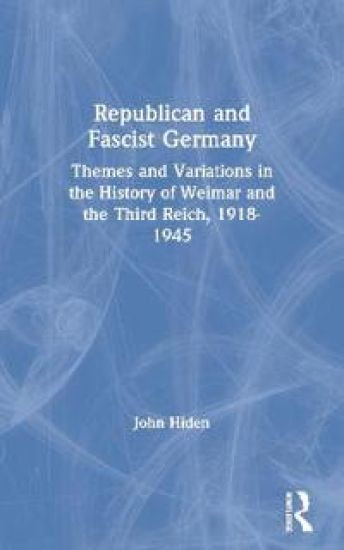
Republican and Fascist Germany

Republican and Fascist Germany

John Hiden

TAYLOR FRANCIS LTD
2023
sidottu
This important addition to modern German studies treats the Weimar Republic and the Third Reich as a continuum, exploring its themes through the 1920s and 1930s without artificial breaks. John Hiden looks at key issues in political, social and economic history, and in international relations. He highlights Germany's potentially constructive role in Europe before Hitler; analyses the country's structural problems; considers the importance of personalities and personal responsibility in the period; and examines the legacy of the Third Reich to postwar Germany. Filled with energy and ideas, the book has an intellectual substance far beyond its relatively modest length.

Germany and Europe 1919-1939

Germany and Europe 1919-1939

John Hiden

Routledge
2016
sidottu
This is the only short study in English to survey Germany's foreign policy from a German viewpoint across the entire inter-war period. The approach, which sets Germany in her full European context, is not narrowly diplomatic; and it gives as much attention to the Weimar years of the 1920s as it gives to the more familiar story of Germany's international relations under the Third Reich. John Hiden has now thoroughly revised his text to take account of new scholarship since the book first appeared in 1977.
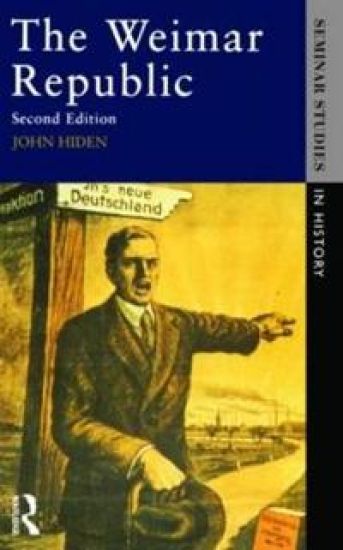
The Weimar Republic

The Weimar Republic

John Hiden

Routledge
2016
sidottu
It is often assumed that the Weimar Republic was bound to fail due to the harsh terms of the Versailles Settlement. Professor Hiden dispels this simplistic view and shows that it was a complex set of factors which finally brought Hitler to power. This clear and balanced study is now fully revised - for the first time since its publication in 1974 - to take account of the latest research.
The Baltic Nations and Europe

The Baltic Nations and Europe

John Hiden; Patrick Salmon

Routledge
2015
sidottu
Of all the Soviet Union's subject nationalities, the three Baltic republics, Estonia, Latvia and Lithuania, were the most determined and best organised in seizing the opportunities created by glasnost and perestroika to win freedom from Moscow's grip. At the time of first publication, in 1991, the final section of the book was speculative. Now for this revised edition, the authors have provided a new final chapter which brings the story up to date -- and the three republics to political independence again.
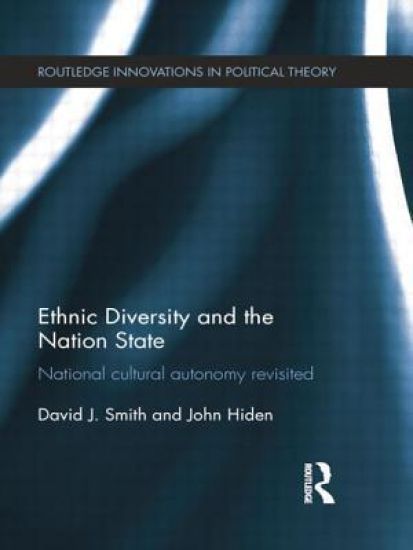
Ethnic Diversity and the Nation State

Ethnic Diversity and the Nation State

David Smith; John Hiden

Routledge
2015
nidottu
This book explores a largely forgotten legacy of multicultural political thought and practice from within Eastern Europe and examines its relevance to post-Cold War debates on state and nationhood. Featuring a Preface by former UK Home Secretary Charles Clarke, it weaves theory and practice to challenge established understandings of the nation state. Eastern Europe is still too often viewed through the prism of ethnic conflict, which overlooks the region’s positive contribution to modern debates on the political management of ethno-cultural diversity, and towards the construction of a united Europe ‘beyond the nation-state’. Based on extensive archival research in Estonia, Latvia, Germany, Russia, as well as the League of Nations Archive in Geneva, this book explores this neglected multicultural legacy and assesses its significance in the post-Cold War era, which has seen the reappearance of national cultural autonomy laws in several states of Eastern Europe. Ethnic Diversity and the Nation State is invaluable reading for students and scholars of political science, history, sociology and European studies, and also for policy makers and others interested in minority rights and ethnic conflict regulation.
Ethnic Diversity and the Nation State

Ethnic Diversity and the Nation State

David Smith; John Hiden

Routledge
2012
sidottu
This book explores a largely forgotten legacy of multicultural political thought and practice from within Eastern Europe and examines its relevance to post-Cold War debates on state and nationhood. Featuring a Preface by former UK Home Secretary Charles Clarke, it weaves theory and practice to challenge established understandings of the nation state. Eastern Europe is still too often viewed through the prism of ethnic conflict, which overlooks the region’s positive contribution to modern debates on the political management of ethno-cultural diversity, and towards the construction of a united Europe ‘beyond the nation-state’. Based on extensive archival research in Estonia, Latvia, Germany, Russia, as well as the League of Nations Archive in Geneva, this book explores this neglected multicultural legacy and assesses its significance in the post-Cold War era, which has seen the reappearance of national cultural autonomy laws in several states of Eastern Europe. Ethnic Diversity and the Nation State is invaluable reading for students and scholars of political science, history, sociology and European studies, and also for policy makers and others interested in minority rights and ethnic conflict regulation.
Neighbours or enemies?

Neighbours or enemies?

John Hiden; Martyn Housden

Editions Rodopi B.V.
2008
nidottu
This is the first attempt to redress the injustice done to the memory of German minorities by the popular equation of ‘Lebensraum’ and Nazism; minorities, many of whom chose to be neighbours rather than enemies and who over time peacefully shared with other nationalities the territorial space east of the Reich. Their borderland experiences, particularly in the Baltic region, the historic interface between East and West, are all the more relevant as Hitler’s regime recedes into the past and Europe seeks to renew itself in the wake of the Cold War.
Defender of Minorities

Defender of Minorities

John Hiden

C Hurst Co Publishers Ltd
2004
nidottu
The Latvian-German politician and journalist Paul Schiemann was a passionate advocate of independence for the indigenous Baltic peoples. He unflinchingly resisted all forms of political extremism and wrote one of the earliest extended critical analysis of National Socialism. Schiemann vigorously opposed Nazi infiltration of the German minorities' movement and through this the European Nationalities' Congress. He also endured and commented bitingly on his experience of life under communist rule in the Baltic states. His memories, which he began to dictate to a young Jewish girl whom he was hiding, testify to his ideas on minority rights, extremism and Europe's future. Hiden's biography of this courageous man who battled against both Baltic and German nationalism opens up a little-explored chapter of Baltic history in a region today seen once more as the litmus test of the new Europe.
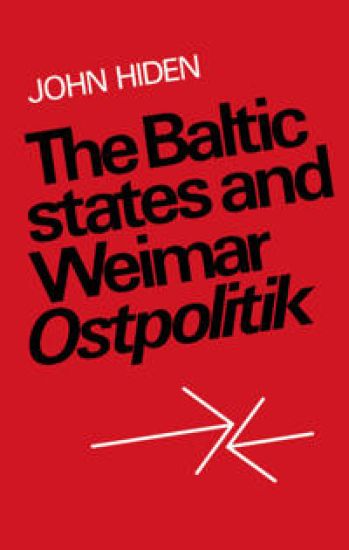
The Baltic States and Weimar Ostpolitik

The Baltic States and Weimar Ostpolitik

John Hiden

Cambridge University Press
2002
pokkari
The historical and geographical significance of the Baltic Sea as a Russian gateway to the West has sometimes overshadowed its reciprocal significance as a German window on the East, but in the period after the First World War the Baltic was to become of critical importance to a German state then shorn of much international authority. This study shows in detail how the Weimar Republic sought to develop its economic influence in the newly independent Baltic states, to ensure the retention of a vital ‘springboard’ into Russia after 1918. At one level this book therefore presents a fresh chapter in the chronicle of Weimar–Soviet relations. In addition, however, Germany’s highly successful trade policy involved competition with other Western powers, notably Britain, and necessarily had important implications for inter-war international politics: analysis of Polish and French diplomatic intentions in the region leads Dr Hiden to a wider evaluation of the whole relationship between trade and foreign policy in Weimar Ostpolitik.
Republican and Fascist Germany
This important addition to modern German studies treats the Weimar Republic and the Third Reich as a continuum, exploring its themes through the 1920s and 1930s without artificial breaks. John Hiden looks at key issues in political, social and economic history, and in international relations. He highlights Germany's potentially constructive role in Europe before Hitler; analyses the country's structural problems; considers the importance of personalities and personal responsibility in the period; and examines the legacy of the Third Reich to postwar Germany. Filled with energy and ideas, the book has an intellectual substance far beyond its relatively modest length.
The Weimar Republic

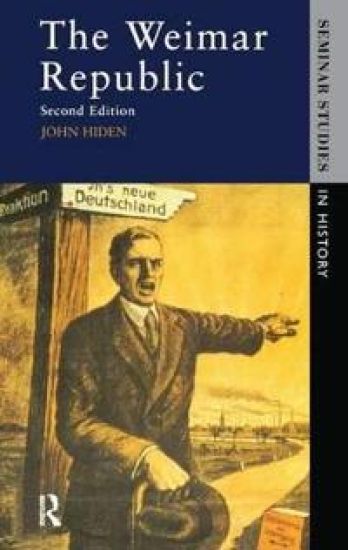
The Weimar Republic

John Hiden

Longman
1996
nidottu
It is often assumed that the Weimar Republic was bound to fail due to the harsh terms of the Versailles Settlement. Professor Hiden dispels this simplistic view and shows that it was a complex set of factors which finally brought Hitler to power. This clear and balanced study is now fully revised - for the first time since its publication in 1974 - to take account of the latest research.
The Baltic Nations and Europe

The Baltic Nations and Europe

John Hiden; Patrick Salmon

Routledge
1994
nidottu
Of all the Soviet Union's subject nationalities, the three Baltic republics, Estonia, Latvia and Lithuania, were the most determined and best organised in seizing the opportunities created by glasnost and perestroika to win freedom from Moscow's grip. At the time of first publication, in 1991, the final section of the book was speculative. Now for this revised edition, the authors have provided a new final chapter which brings the story up to date -- and the three republics to political independence again.
Germany and Europe 1919-1939

Germany and Europe 1919-1939

John Hiden

Routledge
1993
nidottu

Halvin toimitettuna 85,60 €

This is the only short study in English to survey Germany's foreign policy from a German viewpoint across the entire inter-war period. The approach, which sets Germany in her full European context, is not narrowly diplomatic; and it gives as much attention to the Weimar years of the 1920s as it gives to the more familiar story of Germany's international relations under the Third Reich. John Hiden has now thoroughly revised his text to take account of new scholarship since the book first appeared in 1977.