Kirjojen hintavertailu – 12 903 735 kirjaa ja 27 kauppaa
Kirjailija
John I. Kitsuse
Kirjat ja teokset yhdessä paikassa: 9 kirjaa, julkaisuja vuosilta 2000–2022, suosituimpiin kuuluu Constructing Social Problems. Vertaile teosten hintoja ja tarkista saatavuus suomalaisista kirjakaupoista.
This title is part of UC Press's Voices Revived program, which commemorates University of California Press’s mission to seek out and cultivate the brightest minds and give them voice, reach, and impact. Drawing on a backlist dating to 1893, Voices Revived makes high-quality, peer-reviewed scholarship accessible once again using print-on-demand technology. This title was originally published in 1973.
This title is part of UC Press's Voices Revived program, which commemorates University of California Press’s mission to seek out and cultivate the brightest minds and give them voice, reach, and impact. Drawing on a backlist dating to 1893, Voices Revived makes high-quality, peer-reviewed scholarship accessible once again using print-on-demand technology. This title was originally published in 1973.
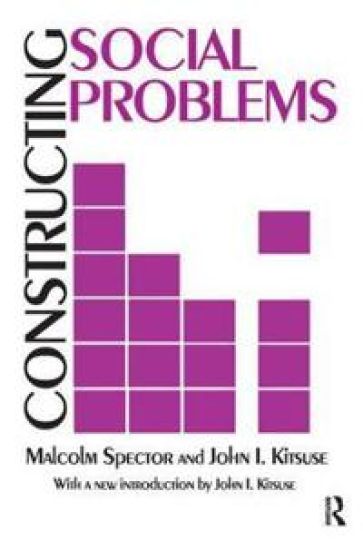
There is no adequate definition of social problems within sociology, and there is not and never has been a sociology of social problems. That observation is the point of departure of this book. The authors aim to provide such a definition and to prepare the ground for the empirical study of social problems. They are aware that their objective will strike many fellow sociologists as ambitious, perhaps even arrogant. Their work challenges sociologists who have, over a period of fifty years, written treatises on social problems, produced textbooks cataloguing the nature, distribution, and causes of these problems, and taught many sociology courses. It is only natural that the authors' work will be viewed as controversial in light of the large literature which has established a "sociology of" a wide range of social problems-the sociology of race relations, prostitution, poverty, crime, mental illness, and so forth. In the 1970s when the authors were preparing for a seminar on the sociology of social problems, their review of the "literature" revealed the absence of any systematic, coherent statement of theory or method in the study of social problems. For many years the subject was listed and offered by university departments of sociology as a "service course" to present undergraduates with what they should know about the various "social pathologies" that exist in their society. This conception of social problems for several decades has been reflected in the substance and quality of the literature dominated by textbooks. In 'Constructing Social Problems', the authors propose that social problems be conceived as the claims-making activities of individuals or groups regarding social conditions they consider unjust, immoral, or harmful and that should be addressed. This perspective, as the authors have formulated it, conceives of social problems as a process of interaction that produces social problems as social facts in society. The authors further propose that this process and the social facts it produces are the data to be researched for the sociology of social problems. This volume will be of interest to those concerned with the discipline of sociology, especially its current theoretical development and growth.
The Managed Casualty: The Japanese American Family In World War II is a non-fiction book written by Leonard Broom. The book explores the experiences of Japanese American families during World War II, particularly those who were forced to relocate to internment camps by the US government. Broom examines the psychological impact of internment on these families, as well as the ways in which they were able to adapt and cope with their situation. He also delves into the larger political and social context of the time, exploring the racism and xenophobia that led to the internment of Japanese Americans. The book provides a detailed and nuanced look at a dark chapter in American history, shedding light on the experiences of those who were directly affected by this unjust policy. Overall, The Managed Casualty is a thought-provoking and insightful read that offers a fresh perspective on a complex and troubling period in American history. University Of California Publications In Culture And Society, V6. Edited By D. R. Cressey, W. R. Goldschmidt, Svend Riemer, And J. P. Seward. This scarce antiquarian book is a facsimile reprint of the old original and may contain some imperfections such as library marks and notations. Because we believe this work is culturally important, we have made it available as part of our commitment for protecting, preserving, and promoting the world's literature in affordable, high quality, modern editions, that are true to their original work.
The Educational Decision Makers: An Advanced Study In Sociology by Aaron Victor Cicourel is a book that explores the complex social dynamics that shape educational decision-making processes. The author delves into the intricate web of relationships and power structures that exist within educational institutions, examining how these factors influence the decisions that are made regarding curriculum, funding, and other important issues. Cicourel's research is based on extensive interviews with educational decision-makers, including teachers, administrators, and policymakers. He uses a sociological lens to analyze the data he collects, drawing on theories of power, social stratification, and institutional dynamics to shed light on the complex processes that shape educational decision-making. Throughout the book, Cicourel highlights the ways in which social factors such as race, class, and gender intersect with educational decision-making processes. He also examines the role of external factors such as political pressures and economic constraints in shaping educational policies and practices. Overall, The Educational Decision Makers offers a nuanced and insightful analysis of the complex social dynamics that underlie educational decision-making. It is a valuable resource for scholars of sociology, education, and public policy, as well as for anyone interested in understanding the complex social forces that shape our educational institutions. This scarce antiquarian book is a facsimile reprint of the old original and may contain some imperfections such as library marks and notations. Because we believe this work is culturally important, we have made it available as part of our commitment for protecting, preserving, and promoting the world's literature in affordable, high quality, modern editions, that are true to their original work.
There is no adequate definition of social problems within sociology, and there is not and never has been a sociology of social problems. That observation is the point of departure of this book. The authors aim to provide such a definition and to prepare the ground for the empirical study of social problems. They are aware that their objective will strike many fellow sociologists as ambitious, perhaps even arrogant. Their work challenges sociologists who have, over a period of fifty years, written treatises on social problems, produced textbooks cataloguing the nature, distribution, and causes of these problems, and taught many sociology courses. It is only natural that the authors' work will be viewed as controversial in light of the large literature which has established a "sociology of" a wide range of social problems-the sociology of race relations, prostitution, poverty, crime, mental illness, and so forth. In the 1970s when the authors were preparing for a seminar on the sociology of social problems, their review of the "literature" revealed the absence of any systematic, coherent statement of theory or method in the study of social problems. For many years the subject was listed and offered by university departments of sociology as a "service course" to present undergraduates with what they should know about the various "social pathologies" that exist in their society. This conception of social problems for several decades has been reflected in the substance and quality of the literature dominated by textbooks. In 'Constructing Social Problems', the authors propose that social problems be conceived as the claims-making activities of individuals or groups regarding social conditions they consider unjust, immoral, or harmful and that should be addressed. This perspective, as the authors have formulated it, conceives of social problems as a process of interaction that produces social problems as social facts in society. The authors further propose that this process and the social facts it produces are the data to be researched for the sociology of social problems. This volume will be of interest to those concerned with the discipline of sociology, especially its current theoretical development and growth.