Kirjailija
John J. Burke
Kirjat ja teokset yhdessä paikassa: 16 kirjaa, julkaisuja vuosilta 1979–2020, suosituimpiin kuuluu Neal-Schuman Library Technology Companion. Vertaile teosten hintoja ja tarkista saatavuus suomalaisista kirjakaupoista.
Nimi esiintyy myös muodoissa: John J Burke
16 kirjaa
Kirjojen julkaisuvuodet: 1979–2020.
Carrying over the reorganization that made the fifth edition such a convenient learning resource for students and working professionals alike, the newest edition of this comprehensive library technology primer is timelier and more compelling than ever. Burke's guide should be at the top of the reading list for any current or future library professional looking to stay at the forefront of technological advancement. Updated with new case studies to illuminate key areas, its incisive coverage includescomplete analysis of the librarian's technological toolbox for teaching, security, databases, and more;expert advice on how to compare and evaluate competing technology solutions;social media, streaming media, and educating patrons about digital privacy;makerspaces and other technology programing, including virtual and augmented reality technologies;technology lending programs;open source catalog systems, discovery layers, and related library management systems;websites, web-based services, and free information resources;copyright and licensing as they pertain to the use of digital materials;new technology predictions for the future, with tips on how to stay up to date with the latest developments; anda refreshed glossary of useful terms. Informed by a large-scale survey of librarians across the spectrum of institution types, this guide will be a true technology companion to readers at all experience levels.
In its new fifth edition, which has been completely updated and reorganized, this one-stop overview of all technologies used in libraries today is more comprehensive and compelling than ever. The perfect primer for LIS students, Burke’s guide should also be at the top of the list for any current or future library professional looking to stay at the forefront of technological advancement. It gives readers a sound and sensible way to consider, access, and use library technologies to better meet the needs of library users. Its incisive coverage includes:complete analysis of the librarian’s technological toolbox for teaching, security, databases, and more;expert advice on how to compare and evaluate competing technology solutions;mobile devices and technology, social media, streaming media, and privacy;makerspaces and other technology programing;updated content on open source catalog systems, discovery layers, and related elements of library management systems;a new section on learning management systems (LMS);websites, web-based services, and free information resources;improved guidance on usability;new technology predictions for the future, with tips on how to stay up to date with the latest developments; anda glossary of useful terms. Informed by a large-scale survey of librarians across the spectrum of institution types, this guide will be a true technology companion to novices and seasoned LIS professionals alike.
This book has been considered by academicians and scholars of great significance and value to literature. This forms a part of the knowledge base for future generations. So that the book is never forgotten we have represented this book in a print format as the same form as it was originally first published. Hence any marks or annotations seen are left intentionally to preserve its true nature.
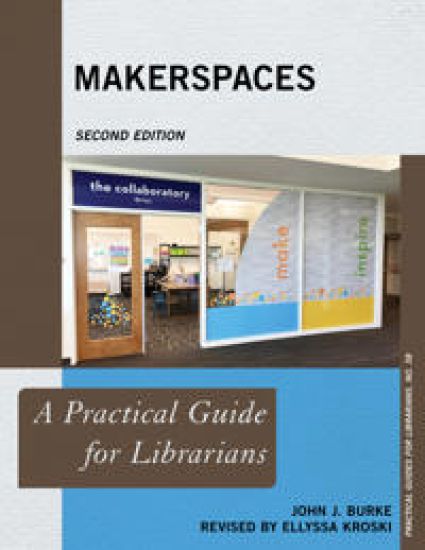
Makerspaces: A Practical Guide for Librarians, Second Edition is an A–Z guidebook jam-packed with resources, advice, and information to help you develop and fund your own makerspace from the ground up. Learn what other libraries are making, building, and doing in their makerspaces and how you can, too. Readers are introduced to makerspace equipment, new technologies, models for planning and assessing projects, and useful case studies that will equip them with the knowledge to implement their own library makerspaces. This expanded second edition features eighteen brand new library makerspace profiles providing advice and inspiration for how to create your own library makerspace, over twenty new images and figures illustrating maker tools and trends as well as library makerspaces in action and new lists of actual grant and funding sources for library makerspaces.
Academic librarians have long sought new ways to reach out to their users and support those users’ research needs. Now, learning management system (LMS) embedded librarianship is partnering with faculty to deliver research assistance for students right in their LMS course sites. This issue of Library Technology Reports describes the LMS environment alongside the larger online resource environment of academic libraries. Topics include:options for adding digital collections and finding tools;methods for creating course-specific content;online tools for communication, collaboration, and citing sources;LMS embedded librarians trends; andthe underlying principles of universal design, instructional design, accessibility, and copyright.
Embedding Librarianship in Learning Management Systems
Beth E. Tumbleson; John J. Burke
Neal-Schuman Publishers Inc
2013
nidottu
Information literacy instruction is best when it is integrated into actual research, and in higher education that means embedding librarianship into the learning management system (LMS). This new How-To-Do-It Manual is geared towards academic librarians already working with classes in an LMS as well as those considering how to begin a pilot. Tumbleson and Burke, who surveyed 280 librarians for information on related activities, also use their own first-hand experience implementing an embedded librarianship program at their university to offer guidance and encouragement. Showing how to start a program that can be adapted and made sustainable, they include information onImplementing a simple pilot program with a librarian and one or two facultyUnderstanding and managing workload9 tips for an effective email solicitation asking faculty to participate10 selling points to attract students to LMS services
The Army Materials and Mechanics Research Center in coop eration with the Materials Science Group of the Department of Chemical Engineering and Materials Science of Syracuse University has been conducting the Annual Sagamore Army Materials Research Conference since 1954. The specific purpose of these conferences has been to bring together scientists and engineers from academic institutions, industry and government who are uniquely qualified to explore in depth a subject of importance to the Department of Defense, the Army and the scientific community. These proceedings entitled, FATIGUE - ENVIRONMENT AND TEMPER ATURE EFFECT, address the overview of temperature and environmental effects of fatigue, room temperature environmental effects, high temperature and environmental effect - mechanisms, high tempera ture and environmental effect - mechanisms, materials and design-engineering applications. We wish to acknowledge the assistance of Messrs. Joseph Bernier and Dan McNaught of the Army Materials and Mechanics Research Center and Helen Brown DeMascio of Syracuse University throughout the stages of the conference planning and finally the publication of the book. The continued active interest and support of these conferences by Dr. E. Wright, Director of the Army Materials and Mechanics Research Center, is appreciated.
Advances in Metal Processing
John J. Burke; Robert Mehrabian; Volker Weiss
Springer-Verlag New York Inc.
2013
nidottu
Syracuse University and the Army Materials and Mechanics Research Center of Watertown, Massachusetts have conducted the Sagamore Army Materials Research Conference since 1954. In ce1ebration of the 25th Anniversary of this conference, these proceedings are dedicated to the founding members of the Sagamore Conferences. They are Prof. Dr. George Sachs, Dr. James L. Martin, Colonel Benjamin S. Mesik, Dr. Reinier Beeuwkes, Mr. Norman L. Reed and Dr. J. D. Lubahn. This vo1ume, ADVANCES IN METAL PROCESSING, addresses Rapid Solidification Processing, Powder Processing and Conso1idation, We1ding and Joining, Thermal and. Mechanica1 Processing, Meta1 Removal and Process Mode1ing. The dedicated assistance of Mr. Joseph M. Bernier of the Army Materials and Mechanics Research Center and He1en Brown DeMascio of Syracuse University throughout the stages of the conference p1anning and fina11y the pub1ication of this book is deep1y appreciated. Syracuse University Syracuse, New York The Editors vii CONTENTS OVERVIEW Materials Processing - A Perspective of the Field 1 M. C. Flemings and R. Mehrabian SESSION I RAPID SOLIDIFICATION PROCESSING B. B. Rath, Moderator Heat Flow Limitations in Rapid Solidification Processing * ...* ...13 R. Mehrabian, S. C. Hsu, C. G. Levi, and S. Kou Laser Processing of Materials ...45 B. H. Kear, E. M. Breinan, and E. R. Thompson Electrohydrodynamic Techniques in Metals 79 Processing ...* . .
St. Teresa of Jesus of the Order of Our Lady of Carmel: Embracing The Life, Relations, Maxims and Foundations Written by the Saint
John J. Burke; Teresa of Jesus
Createspace Independent Publishing Platform
2013
nidottu
Advances in Deformation Processing
John J. Burke; Volker Weiss
Springer-Verlag New York Inc.
2012
nidottu
The Army Materials and Mechanics Research Center has con ducted the Sagamore Army Materials Research Conference in coop eration with the Materials Science Group of the Department of Chemical Engineering and Materials Science of Syracuse University since 1954. The purpose of the conference has been to gather to gether scientists and engineers from academic institutions, in dustry and government who are uniquely qualified to explore in depth a subject of importance to the Army, the Department of Defense and the scientific community. This volume, Advances in Deformation Processing, addresses the areas of Analytical Advances, Workability, Processing to Optimize Properties, Advanced Applications - Materials, and Advanced Applications - Processes. The dedicated assistance of Mr. Joseph Bernier of the Army Materials and Mechanics Research Center throughout the stages of the conference planning and finally the publication of the Sagamore Conference Proceedings is deeply appreciated. The support of Helen Brown DeMascio of Syracuse University in p- paring the final manuscript is acknowledged. The continued active interest and support of these conferences by Dr. A. E. Gorum, Director of the Army Materials and Mechanics Research Center, is appreciated. Syracuse University Syracuse, New York The Editors vii Contents SESSION I INTRODUCTION A. E. Gorum, Moderator Continuum Mechanics and Deformation Processing 1.
Surface Treatments for Improved Performance and Properties
John J. Burke; Volker Weiss
Springer-Verlag New York Inc.
2012
nidottu
The Army Materials and Mechanics Research Center in coop eration with the Materials Science Group of the Department of Chemical Engineering and Materials Science of Syracuse University has been conducting the Annual Sagamore Army Materials Research Conference since 1954. The specific purpose of these conferences has been to bring together over 150 scientists and engineers from academic institutions, industry and government who are uniquely qualified to explore in depth a subject of importance to the Department of Defense, the Army and the scientific community. These proceedings, entitled SURFACE TREATMENTS FOR IM PROVED PERFORMANCE AND PROPERTIES, address the Physical and Chemical Characteristics of Surfaces, Emerging Surface Modi fication Techniques, Surface Structure and Mechanical Proper ties, and Relationships between Properties and Processing for Non-metric Materials. We wish to acknowledge the dedicated assistance of JoseDh M. Bernier of the Army Materials and Mechanics Research Center and Helen Brown DeMascio of Syracuse University throughout the stages of the conference planning and finally the publication of this book. The continued active interest and support of these con ferences by Dr. E. Wright, Director of the Army Materials and Mechanics Research Center, is appreciated. Syracuse University Syracuse, New York The Editors vii CONTENTS SESSION I 1. Surface Modification for Improved Properties. . . . . . .. 3 P. A. Parrish SESSION II PHYSICAL AND CHEMICAL CHARACTERISTICS OF SURFACES P. Ficalora, Moderator 2. Characterization of Surfaces. 19 H. K. Herglotz 3. Reaction Kinetics 51 J. B. Hudson 4. Surfac e Treatments for Enhanced Bonding Between Inorganic Surfaces and Polymers ........ .
Nondestructive Evaluation of Materials
Volker Weiss; John J. Burke
Springer-Verlag New York Inc.
2011
nidottu
The Army Materials and Mechanics Research Center of Water town, Massachusetts in cooperation with the Materials Science Group of the Department of Chemical Engineering and Materials Science of Syracuse University has conducted the Sagamore Army Materials Research Conference since 1954. The main purpose of these conferences has been to gather together over 150 scientists and engineers from academic institutions, industry and government who are uniquely qualified to explore in depth a subject of importance to the Department of Defense, the Army and the scientific community. This volume NONDESTRUCTIVE EVALUATION OF MATERIALS, addresses the areas of x-ray, ultrasonics and other methods of nondestructive testing. We wish to acknowledge the dedicated assistance of Joseph M. Bernier of the Army Materials and Mechanics Research Center and Helen Brown DeMascio of Syracuse University throughout the stages of the conference planning and finally the publication of this book. Their help is deeply appreciated. Syracuse University Syracuse, New York The Editors Contents SESSION I X-RAY S. Heissman, Moderator H. K. Herglotz, Moderator 1. Overview of X-Ray Diffraction Methods for Nondestructive Testing • • • • • • • ••• 1 L. V. Azaroff 2. Detection of Fatigue Damage by X-Rays 21 S. Taira and K. Kamachi 3. A Historical Example of Fatigue Damage • • • • • • • 55 H. K. Herglotz 4. The Application of X-Ray Topography to Materials Science . . . . . . . . . . . . . . . . . . . . 69 S. Weissman 5.
The Army Materials and Mechanics Research Center in coop eration with the Materials Science Group of the Department of Chemical Engineering and Materials Science of Syracuse University has been conducting the Annual Sagamore Army Materials Research Conference since 1954. The specific purpose of these conferences has been to bring together scientists and engineers from academic institutions, industry and government who are uniquely qualified to explore in depth a subject of importance to the Department of Defense, the Army and the scientific community. These proceedings entitled, FATIGUE - ENVIRONMENT AND TEMPER ATURE EFFECT, address the overview of temperature and environmental effects of fatigue, room temperature environmental effects, high temperature and environmental effect - mechanisms, high tempera ture and environmental effect - mechanisms, materials and design-engineering applications. We wish to acknowledge the assistance of Messrs. Joseph Bernier and Dan McNaught of the Army Materials and Mechanics Research Center and Helen Brown DeMascio of Syracuse University throughout the stages of the conference planning and finally the publication of the book. The continued active interest and support of these conferences by Dr. E. Wright, Director of the Army Materials and Mechanics Research Center, is appreciated.
This book is a detailed account of the visits of twenty-one famous writers—four British and seventeen American—who visited Philadelphia. Burke focuses on the literary history of Philadelphia. Contents: Preface; Passing Through; Thomas Moore; Washington Irving; Ralph Waldo Emerson; (Amos) Bronson Alcott; James Fenimore Cooper; Edgar Allan Poe; John Greenleaf Whittier; Charles Dickens; James Russell Lowell; Henry Wadsworth Longfellow; William Makepeace Thackeray; Samuel Langhorne Clemens (Mark Twain); Henry David Thoreau; Emily Dickinson; Walt Whitman; William Dean Howells; Oscar Wilde; Edith Wharton; Theodore Dreiser; William Carlos Williams; Henry James.
Application of Fracture Mechanics to Design
John J. Burke; Volker Weiss
Kluwer Academic/Plenum Publishers
1979
nidottu