Kirjojen hintavertailu – 12 903 724 kirjaa ja 27 kauppaa
Kirjailija
John King Fairbank
Kirjat ja teokset yhdessä paikassa: 7 kirjaa, julkaisuja vuosilta 1952–2006, suosituimpiin kuuluu The Great Chinese Revolution: 1800-1985. Vertaile teosten hintoja ja tarkista saatavuus suomalaisista kirjakaupoista.
John King Fairbank was the West's doyen on China, and this book is the full and final expression of his lifelong engagement with this vast ancient civilization. It remains a masterwork without parallel. The distinguished historian Merle Goldman brings the book up to date, covering reforms in the post-Mao period through the early years of the twenty-first century, including the leadership of Hu Jintao. She also provides an epilogue discussing the changes in contemporary China that will shape the nation in the years to come.
As the Ch’ing government’s Inspector General of the Maritime Customs Service, Robert Hart was the most influential Westerner in China for half a century. These journal entries continue the sequence begun in Entering China’s Service and cover the years when Hart was setting up Customs procedures, establishing a modus operandi with the Ch’ing bureaucracy, and inspecting the treaty ports. They culminate in Hart’s return visit to Europe with the Pin-ch’un Mission and his marriage in Northern Ireland. Richard Smith, John King Fairbank, and Katherine Bruner interleave the segments of Hart’s journals with lively narratives describing the contemporary Chinese scene and recounting Hart’s responses to the many challenges of establishing a Western-style organization within a Chinese milieu.
Examines the transformation of Imperial China to Communist China, discusses the social and cultural changes that have occurred, and looks at modern economic development in China
America s top China watcher, the renowned "pandit" of modern Chinese history, here provides an unrivaled overview of revolutionary China and Chinese American relations. His reviews and critical commentary scrutinize our always fascinated, often puzzled attitude toward this newly emergent superpower. John Fairbank distinguishes two major motifs in recent Chinese American connections: the American expectation of highly profitable trade and investment, which so far have not materialized, and the deep rooted missionary impulse to give the Chinese the best of our culture, which includes our efforts to promote human rights. The possibility of grafting our ideas of individual endeavor and God given prerogatives onto two thousand years of Confucianism with its emphasis on duty and collective harmony seems remote. In contrast, the outlook for mutually enriching economic dealings is much brighter. Yet Fairbank cautions that we are dealing with a huge and disoriented nation struggling to enter the modern world with its own cultural identity intact, and (at least in the current period) with its Communist Party in power. Confucian tenets still prevail: theory and practice are a unity policies are a form of conduct manifesting one s character, and attacks on policy equal attacks on the ruling party. These writings concern China in the mind s eye of America as it is interpreted though the works of American merchants, diplomats, missionaries, and reporters observing China s travail of revolution. For generalist, scholar, and sage alike, "China Watch" offers many insights.
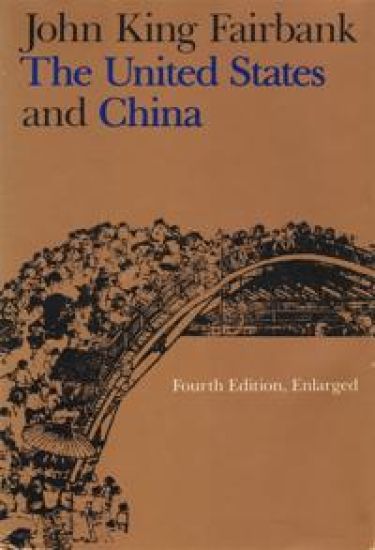
For two generations scholars and general readers have looked to John King Fairbank’s The United States and China for knowledge and insights about China. In this fourth edition, enlarged, he includes a new preface and an epilogue that brings the book up to date through the events of 1982. He has also updated the vast bibliography and both indexes. This book stands almost alone as a history of China, an analysis of Chinese society, and an account of Sino–American relations, all in brief compass. The older portions of the book still sparkle, and they have been refined by the latest scholarship and the author’s own observations in the People’s Republic of China. And many photographs, especially chosen by John and Wilma Fairbank, show a changing land and its inhabitants.
The present confrontation of Communist China and the United States, on which the future of peace in Asia hinges, is merely the latest phase in a continuing historical process--the remaking of China's ancient society under the stimulus of Western contact. How does it happen that a century of foreign trade and missionary evangelism, of modern education and the training of Chinese students in Western ways, has now resulted in a seeming rejection of the West? What has been the real nature of "China's response to the West" during the past century of our contact? This volume gives the first inside account, on so broad a scale, of how China's leaders reacted to the invasion of Western arms and goods, persons and ideas, during the three generations from the Opium War to the rise of the Kuomintang. In 28 chapters, with translations of 65 key documents, the authors trace the stages by which the scholar-officials of the Middle Kingdom were brought to recognize successively the need for Western arms to defend their country, Western technology for making arms, modern science to support technology, its application in modern industry to strengthen the nation, and all the attendant new ideas which led them eventually into great movements for institutional reform, political revolution, and ideological reconstruction. From the famous Commissioner un's first study of Western geography during his anti-opium crusade, through the efforts of Li Hungchang and others at "self-strengthening" by industrialization, down to the critical thought of Dr. Hu Shih and the eclecticism of Sun Yat-sen in the early 20th century, the writings of China's leaders ring the changes on a central theme how to remake their heritage and create a modern nation capable of meeting the West on equal terms. The provincial viceroys, the Reformers of 1898, the Boxers in 1900, the old Empress Dowager, and the eager students studying abroad, each in their own way, all grapple with this absorbing problem. The varied Chinese responses to the West in the formative century here analyzed give us a new insight into the springs of social action among one-fifth of mankind. The companion volume, for the research specialist, provides Notes and Sources, Bibliography, and a Glossary of Chinese names and terms, essential bases for further exploration of this new field.