Kirjojen hintavertailu – 12 903 725 kirjaa ja 27 kauppaa

Kirjailija

John Komlos

Kirjat ja teokset yhdessä paikassa: 13 kirjaa, julkaisuja vuosilta 1995–2024, suosituimpiin kuuluu The Chicago Guide to Your Academic Career. Vertaile teosten hintoja ja tarkista saatavuus suomalaisista kirjakaupoista.

13 kirjaa

Kirjojen julkaisuvuodet: 1995–2024.

The Biological Standard Of Living On Three Continents
The effort of anthropometric historians to unearth the broad patterns of human biological well-being has led to the examination of nearly forgotten, centuries-old records from dusty archives in practically all the continents of the globe. French historians in the Annales tradition were among the first to adopt methods from physical anthropology and from the biological sciences, but the real expansion of the field dates from the pathbreaking work of Richard Steckel and Robert Fogel, which launched the discipline of anthropometric history on American soil Research has confirmed that physical stature is related to nutritional status and therefore to real family income, and thus to the general standard of living. Historians and development economists will find this line of research useful, as it informs us about the standard of living of members of society for whom data on wages are seldom available—women, children, aristocrats, farmers, and slaves. In addition, this research has shown that the biological standard of living may diverge from conventional indicators of welfare during the early stages of industrialization. Thus, per capita income is an ambiguous measure of welfare during some phases of growth, and it must be supplemented with data from other indicators, such as physical stature. The essays in this volume broaden our knowledge of the human effects of the momentous economic changes of the last two centuries, extending analysis to regions for which such information has been lacking, including Russia, Canada, Indonesia, Italy, and Spain.
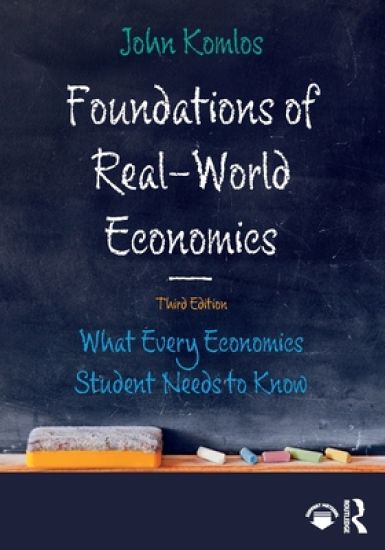
Foundations of Real-World Economics

Foundations of Real-World Economics

John Komlos

TAYLOR FRANCIS LTD
2023
nidottu
The 2008 financial crisis, the rise of Trumpism, and the other populist movements which have followed in their wake have grown out of the frustrations of those hurt by the economic policies advocated by conventional economists for generations. Despite this, textbooks remain frozen in time, continuing to uphold traditional policies as though nothing has happened. Foundations of Real-World Economics demonstrates how misleading it can be to apply oversimplified models of perfect competition to the real world. The math works well on college blackboards but not so well on the Main Streets of America. This volume explores the realities of oligopolies, the real impact of the minimum wage, the double-edged sword of free trade, and other ways in which powerful institutions cause distortions in mainstream models. Bringing together the work of key scholars like Kahneman, Minsky, and Schumpeter, this textbook takes into consideration the inefficiencies that arise when the perfectly competitive model is applied to the real world dominated by multinational oligopolies. The third edition has been updated throughout, bringing in new material on the financial crises, the rise of populism, racism, inequality, climate change, and the Covid-19 pandemic. A must-have for students studying the principles of economics as well as micro- and macroeconomics, this textbook redresses the existing imbalance in economic teaching as John Komlos focuses on the paradigm of humanistic economics.
Foundations of Real-World Economics

Foundations of Real-World Economics

John Komlos

TAYLOR FRANCIS LTD
2023
sidottu
The 2008 financial crisis, the rise of Trumpism, and the other populist movements which have followed in their wake have grown out of the frustrations of those hurt by the economic policies advocated by conventional economists for generations. Despite this, textbooks remain frozen in time, continuing to uphold traditional policies as though nothing has happened. Foundations of Real-World Economics demonstrates how misleading it can be to apply oversimplified models of perfect competition to the real world. The math works well on college blackboards but not so well on the Main Streets of America. This volume explores the realities of oligopolies, the real impact of the minimum wage, the double-edged sword of free trade, and other ways in which powerful institutions cause distortions in mainstream models. Bringing together the work of key scholars like Kahneman, Minsky, and Schumpeter, this textbook takes into consideration the inefficiencies that arise when the perfectly competitive model is applied to the real world dominated by multinational oligopolies. The third edition has been updated throughout, bringing in new material on the financial crises, the rise of populism, racism, inequality, climate change, and the Covid-19 pandemic. A must-have for students studying the principles of economics as well as micro- and macroeconomics, this textbook redresses the existing imbalance in economic teaching as John Komlos focuses on the paradigm of humanistic economics.
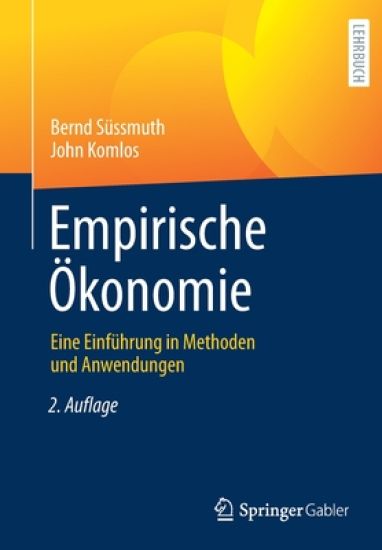
Empirische Ökonomie

Empirische Ökonomie

Bernd Süssmuth; John Komlos

Springer-Verlag Berlin and Heidelberg GmbH Co. KG
2022
nidottu
Das Buch liefert eine moderne und anwendungsorientierte Einführung in ökonometrische Methoden für Studierende der Wirtschaftswissenschaften. Anhand einfacher, origineller Anwendungen aus verschiedenen Gebieten, wie etwa Wirtschaftsgeschichte, Humankapitaltheorie, Politökonomie oder Biologie, werden die Methoden der klassischen Ökonometrie erklärt und veranschaulicht. Damit stellt sich das Buch der Aufgabe, den Studierenden neben den methodischen Fertigkeiten auch Anregung und Motivation zu eigenständigem empirischem Arbeiten zu geben. Da auch grundlegende Konzepte der beschreibenden und schließenden Statistik behandelt werden, sind keine Vorkenntnisse nötig. Die zweite Auflage ist um ein Kapitel sowie einen Index ergänzt. Der InhaltMomentenschätzung auf StichprobenbasisBasiskonzepte der induktiven StatistikEinfaches OLS-RegressionsmodellMultiples OLS-RegressionsmodellMaximum-Likelihood-SchätzungQualitativvariablen-ModelleZeitreihenanalyse
The Biological Standard Of Living On Three Continents
The effort of anthropometric historians to unearth the broad patterns of human biological well-being has led to the examination of nearly forgotten, centuries-old records from dusty archives in practically all the continents of the globe. French historians in the Annales tradition were among the first to adopt methods from physical anthropology and from the biological sciences, but the real expansion of the field dates from the pathbreaking work of Richard Steckel and Robert Fogel, which launched the discipline of anthropometric history on American soil Research has confirmed that physical stature is related to nutritional status and therefore to real family income, and thus to the general standard of living. Historians and development economists will find this line of research useful, as it informs us about the standard of living of members of society for whom data on wages are seldom available—women, children, aristocrats, farmers, and slaves. In addition, this research has shown that the biological standard of living may diverge from conventional indicators of welfare during the early stages of industrialization. Thus, per capita income is an ambiguous measure of welfare during some phases of growth, and it must be supplemented with data from other indicators, such as physical stature. The essays in this volume broaden our knowledge of the human effects of the momentous economic changes of the last two centuries, extending analysis to regions for which such information has been lacking, including Russia, Canada, Indonesia, Italy, and Spain.

Nutrition and Economic Development in the Eighteenth-Century Habsburg Monarchy
John Komlos examines the industrial expansion of Austria from a fresh viewpoint and develops a new model for the industrial revolution. By integrating recent advances in the study of human biology and nutrition as they relate to physical stature, population growth, and levels of economic development, he reveals an intense Malthusian crisis in the Habsburg lands during the second half of the eighteenth century. At that time food shortages brought about by the accelerated population growth of the 1730s forced the government to adopt a reform program that opened the way for the beginning of the industrial revolution in Austria and in the Czech Crownlands. Comparing this "Austrian model" of economic growth to the industrial revolution in Britain, Komlos argues that the model is general enough to explain demographic and economic growth elsewhere in Europe--despite obvious regional differences. The main feature of the model is the interplay between a persistent, even if small, tendency to accumulate capital and a population with an underlying tendency to grow in numbers while remaining subject to Malthusian checks, particularly a limited availability of food. According to Komlos, modern economic growth in Europe began when the food constraint was finally lifted. Originally published in 1989. The Princeton Legacy Library uses the latest print-on-demand technology to again make available previously out-of-print books from the distinguished backlist of Princeton University Press. These editions preserve the original texts of these important books while presenting them in durable paperback and hardcover editions. The goal of the Princeton Legacy Library is to vastly increase access to the rich scholarly heritage found in the thousands of books published by Princeton University Press since its founding in 1905.
The Habsburg Monarchy as a Customs Union

The Habsburg Monarchy as a Customs Union

John Komlos

Princeton University Press
2016
sidottu
This book explores the economic impact of two major mid-nineteenth century reforms: the formation of the customs union between Austria and Hungary and the emancipation of the peasantry. Originally published in 1983. The Princeton Legacy Library uses the latest print-on-demand technology to again make available previously out-of-print books from the distinguished backlist of Princeton University Press. These editions preserve the original texts of these important books while presenting them in durable paperback and hardcover editions. The goal of the Princeton Legacy Library is to vastly increase access to the rich scholarly heritage found in the thousands of books published by Princeton University Press since its founding in 1905.
Principles of Economics for a Post-Meltdown World

Principles of Economics for a Post-Meltdown World

John Komlos

Springer International Publishing AG
2016
nidottu
This brief emphasizes the ways in which introductory economics textbooks incorrectly rely on assumptions about the free market, the rational agent model, market fundamentalism, and standard long-standing assumptions in economics, and in doing so disregard the effects of incomplete and asymmetric information on choice and on allocation, and maintain a general but flawed belief that competitive markets can always provide efficient solutions automatically. In other words, the standard economics principles textbook is anachronistic, they assume that tastes are exogenous, they overlook interdependencies and externalities not only in production but in consumption of goods, and they overlook the fact that path-dependence is a major hindrance to optimization. Mainstream principles of economics textbooks distort our worldview with immense political and cultural consequences. Students of these principles deserve a more complete perspective, and this brief critiques that conventional worldviewand provides an alternative perspective, with an emphasis on free-market economics wherein the human element should be paramount and moral judgments should override market outcomes. In other words, what is important is not GNP as much as the quality of life, not institutions but how people live and fare in them. This brief argues that economics cannot be a science; it has too many ideological aspects, and in many ways conventional textbooks are not providing a true-to-life depiction of the economy. This Brief will be a reference or supplemental text for college and university students enrolled in such applied undergraduate and graduate courses and seminars in economics and economic theory.
Nutrition and Economic Development in the Eighteenth-Century Habsburg Monarchy
John Komlos examines the industrial expansion of Austria from a fresh viewpoint and develops a new model for the industrial revolution. By integrating recent advances in the study of human biology and nutrition as they relate to physical stature, population growth, and levels of economic development, he reveals an intense Malthusian crisis in the Habsburg lands during the second half of the eighteenth century. At that time food shortages brought about by the accelerated population growth of the 1730s forced the government to adopt a reform program that opened the way for the beginning of the industrial revolution in Austria and in the Czech Crownlands. Comparing this "Austrian model" of economic growth to the industrial revolution in Britain, Komlos argues that the model is general enough to explain demographic and economic growth elsewhere in Europe--despite obvious regional differences. The main feature of the model is the interplay between a persistent, even if small, tendency to accumulate capital and a population with an underlying tendency to grow in numbers while remaining subject to Malthusian checks, particularly a limited availability of food. According to Komlos, modern economic growth in Europe began when the food constraint was finally lifted. Originally published in 1989. The Princeton Legacy Library uses the latest print-on-demand technology to again make available previously out-of-print books from the distinguished backlist of Princeton University Press. These editions preserve the original texts of these important books while presenting them in durable paperback and hardcover editions. The goal of the Princeton Legacy Library is to vastly increase access to the rich scholarly heritage found in the thousands of books published by Princeton University Press since its founding in 1905.
The Habsburg Monarchy as a Customs Union

The Habsburg Monarchy as a Customs Union

John Komlos

Princeton University Press
2014
pokkari
This book explores the economic impact of two major mid-nineteenth century reforms: the formation of the customs union between Austria and Hungary and the emancipation of the peasantry. Originally published in 1983. The Princeton Legacy Library uses the latest print-on-demand technology to again make available previously out-of-print books from the distinguished backlist of Princeton University Press. These editions preserve the original texts of these important books while presenting them in durable paperback and hardcover editions. The goal of the Princeton Legacy Library is to vastly increase access to the rich scholarly heritage found in the thousands of books published by Princeton University Press since its founding in 1905.
The Chicago Guide to Your Academic Career

The Chicago Guide to Your Academic Career

John A. Goldsmith; John Komlos; Penny Schine Gold

University of Chicago Press
2001
sidottu
With a perpetually tight job market, the road to an academic career can be a rocky and frustrating one. There are lots of questions, and this book attempts to provide good, frank answers to them. The three authors, with more than 75 years of combined academic experience, talk openly about what is good and what's not so good about academic life. The book provides information on finding a mentor, avoiding the pitfalls when writing a dissertation and negotiating job listings. The authors also discuss tough issues such as departmental politics, dual-career marriages and sexual harassment. There are also short essays that offer advice on financing graduate education, publishing your first book and leaving academia for the corporate world.
The Chicago Guide to Your Academic Career

The Chicago Guide to Your Academic Career

John A. Goldsmith; John Komlos; Penny Schine Gold

University of Chicago Press
2001
nidottu
With a perpetually tight job market, the road to an academic career can be a rocky and frustrating one. There are lots of questions, and this book attempts to provide good, frank answers to them. The three authors, with more than 75 years of combined academic experience, talk openly about what is good and what's not so good about academic life. The book provides information on finding a mentor, avoiding the pitfalls when writing a dissertation and negotiating job listings. The authors also discuss tough issues such as departmental politics, dual-career marriages and sexual harassment. There are also short essays that offer advice on financing graduate education, publishing your first book and leaving academia for the corporate world.
The Biological Standard of Living in Europe and America, 1700–1900
One can think of the average height reached at a particular age by individuals as the historical record of their nutritional experience. Medical research has confirmed that nutritional status - and thus physical stature - is related to food consumption and therefore to family income, and therefore to wages and to prices and therefore to the standard of living. Thus, height can be used as a proxy for these economic variables, even if it is also affected by the population's degree of urbanization and disease experience. Why should we be interested in this line of research? For example, anthropometric research can illuminate the well-being of some members of a society: women, children, aristocrats, subsistence farmers, and slaves, for whom market wages are seldom available. In addition, it has been shown that the biological standard of living can diverge from conventional indicators of well-being during the early stages of industrialization. The essays in this volume explore the well-being of diverse populations in Europe and America in the 18th and 19th centuries. Trends and cycles in height are explored among slaves, indentured servants, students in the West Point Military Academy, in the École Polytechnique (Paris), in The Citadel (Charleston, South Carolina), Carlschule (Stuttgart) as well as in the British and in the Austrian Army.