

Kirjailija
John Linarelli
Kirjat ja teokset yhdessä paikassa: 3 kirjaa, julkaisuja vuosilta 2000–2023, suosituimpiin kuuluu Regulating Public Procurement. Vertaile teosten hintoja ja tarkista saatavuus suomalaisista kirjakaupoista.
3 kirjaa
Kirjojen julkaisuvuodet: 2000–2023.

The Misery of International Law
John Linarelli; Margot E. Salomon; Muthucumaraswamy Sornarajah
Oxford University Press
2018
sidottu
Poverty, inequality, and dispossession accompany economic globalization. Bringing together three international law scholars, this book addresses how international law and its regimes of trade, investment, finance, as well as human rights, are implicated in the construction of misery, and how international law is producing, reproducing, and embedding injustice and narrowing the alternatives that might really serve humanity. Adopting a pluralist approach, the authors confront the unconscionable dimensions of the global economic order, the false premises upon which they are built, and the role of international law in constituting and sustaining them. Combining insights from radical critiques, political philosophy, history, and critical development studies, the book explores the pathologies at work in international economic law today. International law must abide by the requirements of justice if it is to make a call for compliance with it, but this work claims it drastically fails do so. In a legal order structured around neoliberal ideologies rather than principles of justice, every state can and does grab what it can in the economic sphere on the basis of power and interest, legally so and under colour of law. This book examines how international law on trade and foreign investment and the law and norms on global finance has been shaped to benefit the rich and powerful at the expense of others. It studies how a set of principles, in the form of a New International Economic Order (NIEO), that could have laid the groundwork for a more inclusive international law without even disrupting its market-orientation, were nonetheless undermined. As for international human rights law, it is under the terms of global capitalism that human rights operate. Before we can understand how human rights can create more just societies, we must first expose the ways in which they reflect capitalist society and how they assist in reproducing the underlying terms of immiseration that will continue to create the need for human rights protection. This book challenges conventional justifications of economic globalization and eschews false choices. It is not about whether one is "for" or "against" international trade, foreign investment, or global finance. The issue is to resolve how, if we are to engage in trade, investment, and finance, we do so in a manner that is accountable to persons whose lives are affected by international law. The deployment of human rights for their part must be considered against the ubiquity of neoliberal globalization under law, and not merely as a discrete, benevolent response to it.
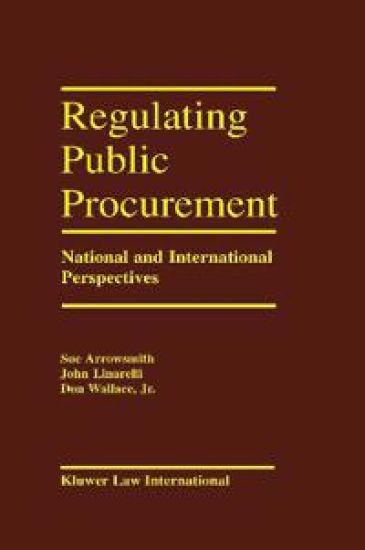
Regulating Public Procurement
Sue Arrowsmith; John Linarelli; Don Wallace Jr.
Kluwer Law International
2000
sidottu
Because of its enormous economic power and susceptibility to corruption, public procurement - the purchase by government of goods and services - has come under increasing regulation as world trade expands. Three international leaders in public procurement law fully explain how the procurement award process must be managed to achieve its goals in global market economy. This work should educate government officials, trade lawyers, and students in how to comply with existing and emerging regulatory schemes as they: select a contractor and plan the contract, with detailed attention to terms, conditions and specifications; allow for national security, national industrial development, and environmental protection; get value for money and avoid waste of public funds; publicize contracts; combat corruption; secure successful completion of contracts; balance pressures to buy from domestic sources with the economic benefits of international competition; harness procurement power to promote social and environmental goals; enforce compliance with public procurement rules; and recognize circumstances under which discretion-based (rather than rules-based) initiatives may be more effective.