Kirjojen hintavertailu – 12 903 724 kirjaa ja 27 kauppaa

Kirjailija

John M. Davis

Kirjat ja teokset yhdessä paikassa: 12 kirjaa, julkaisuja vuosilta 2009–2023, suosituimpiin kuuluu NVLD and Developmental Visual-Spatial Disorder in Children. Vertaile teosten hintoja ja tarkista saatavuus suomalaisista kirjakaupoista.

Nimi esiintyy myös muodoissa: John M Davis

12 kirjaa

Kirjojen julkaisuvuodet: 2009–2023.

NVLD and Developmental Visual-Spatial Disorder in Children

NVLD and Developmental Visual-Spatial Disorder in Children

Jessica Broitman; Miranda Melcher; Amy Margolis; John M. Davis

Springer Nature Switzerland AG
2021
nidottu
This unique volume explores issues related to working with children who have nonverbal learning disability (NVLD). It examines how a child’s psychology – thoughts, feelings, beliefs – affects his or her functioning and learning. In addition, the book addresses how a child’s experiences are processed through individual personality, psychology, culture, environment and economic circumstances, and family dynamics. Using these psychological organizing principles, the book describes how to work most effectively with young patients with NVLD. It offers a new model and definition for understanding NVLD, emphasizing its core deficit of visual-spatial processing. In addition, this book addresses efforts to rename NVLD to developmental visual-spatial disorder (DVSD). It describes the 11 possible subtypes as including a primary deficit in visual-spatial processes and impairment in several additional functional domains, including executive functioning, social/emotional deficits, academic achievement, and motor coordination. The book highlights the need for psychologically minded treatment and provides specific intervention guidelines. It details how to conduct the intake process and create a treatment plan and team and offers practical suggestions for working with a patient’s family members. In addition, the book addresses the importance of working with a consistent psychological theory, such as control mastery theory (CMT). It describes the Brooklyn Learning Center Model for treating NVLD and offers guidelines for interventions to support patients academically. The book provides a comprehensive approach to the neuropsychological assessment of NVLD as well as examples of visual-spatial, sensory perception, executive functioning, academics, social/emotional deficits and motor coordination interventions, and all forms used to gather information from patients. Key areas of coverage include:Definition of nonverbal learning disability (NVLD). Efforts toward inclusion in the Diagnostic and Statistical Manual (DSM) and for renaming it to a developmental visual-spatial disorder (DVSD)Guide to general diagnostic testing and assessment. Developing a treatment plan and team for NVLD patients. NVLD therapy and tutoring priorities. NVLD and Developmental Visual-Spatial Disorder in Children is an essential reference for clinicians, therapists, and other professionals as well as researchers, professors, and graduate students in school and clinical child psychology, special education, speech-language therapy, developmental psychology, pediatrics, social work as well as all interrelated disciplines.
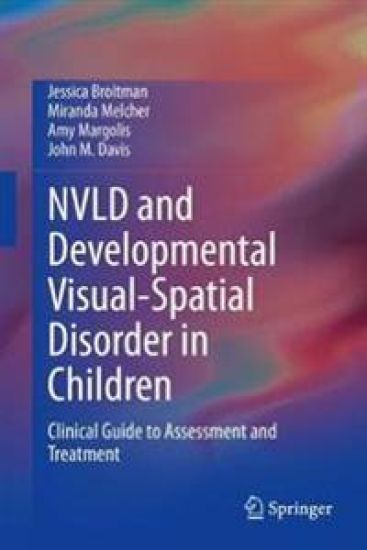
NVLD and Developmental Visual-Spatial Disorder in Children

NVLD and Developmental Visual-Spatial Disorder in Children

Jessica Broitman; Miranda Melcher; Amy Margolis; John M. Davis

Springer Nature Switzerland AG
2020
sidottu
This unique volume explores issues related to working with children who have nonverbal learning disability (NVLD). It examines how a child’s psychology – thoughts, feelings, beliefs – affects his or her functioning and learning. In addition, the book addresses how a child’s experiences are processed through individual personality, psychology, culture, environment and economic circumstances, and family dynamics. Using these psychological organizing principles, the book describes how to work most effectively with young patients with NVLD. It offers a new model and definition for understanding NVLD, emphasizing its core deficit of visual-spatial processing. In addition, this book addresses efforts to rename NVLD to developmental visual-spatial disorder (DVSD). It describes the 11 possible subtypes as including a primary deficit in visual-spatial processes and impairment in several additional functional domains, including executive functioning, social/emotional deficits, academic achievement, and motor coordination. The book highlights the need for psychologically minded treatment and provides specific intervention guidelines. It details how to conduct the intake process and create a treatment plan and team and offers practical suggestions for working with a patient’s family members. In addition, the book addresses the importance of working with a consistent psychological theory, such as control mastery theory (CMT). It describes the Brooklyn Learning Center Model for treating NVLD and offers guidelines for interventions to support patients academically. The book provides a comprehensive approach to the neuropsychological assessment of NVLD as well as examples of visual-spatial, sensory perception, executive functioning, academics, social/emotional deficits and motor coordination interventions, and all forms used to gather information from patients. Key areas of coverage include:Definition of nonverbal learning disability (NVLD). Efforts toward inclusion in the Diagnostic and Statistical Manual (DSM) and for renaming it to a developmental visual-spatial disorder (DVSD)Guide to general diagnostic testing and assessment. Developing a treatment plan and team for NVLD patients. NVLD therapy and tutoring priorities. NVLD and Developmental Visual-Spatial Disorder in Children is an essential reference for clinicians, therapists, and other professionals as well as researchers, professors, and graduate students in school and clinical child psychology, special education, speech-language therapy, developmental psychology, pediatrics, social work as well as all interrelated disciplines.

Aircraft Powerplants: Powerplant Certification, Tenth Edition

Aircraft Powerplants: Powerplant Certification, Tenth Edition

Thomas Wild; John M. Davis

McGraw-Hill Education
2023
nidottu
The most comprehensive guide to aircraft powerplants-fully updated for the latest advances and regulationsThis up-to-date guide contains all the information you need to master the operation and maintenance of aircraft engines and achieve FAA Powerplant certification. The book offers plain-language explanations of all current engine components, mechanics, and technologies. This tenth edition features expanded coverage of turbine engine theory, operational procedures, maintainability, engine systems operation, and propeller systems. You will get new examples, exercises, and practice exam questions as well as revised content to align with 2022 FAA regulations. Hundreds of detailed diagrams and real-world examples throughout illustrate each topic. In addition, an up-to-date solutions manual is available online. Aircraft Powerplants: Powerplant Certification, Tenth Edition covers:Aircraft powerplant classification and progressReciprocating-engine construction and nomenclatureInternal-combustion engine theory and performanceInduction, supercharger, and turbocharger systemsCooling, exhaust, and lubrication systemsBasic fuel systems and carburetorsFuel injection systemsReciprocating-engine ignition and starting systemsOperation, inspection, maintenance, and troubleshooting of reciprocating enginesReciprocating-engine overhaul practicesPrincipal parts, construction, types, and nomenclature of gas-turbine enginesGas-turbine engine theory and jet propulsion principles and efficienciesGas-turbine engine fuels and fuel systemsTurbine-engine lubricants and lubricating systemsIgnition and starting systems of gas-turbine enginesTurbofan, turboprop, and turboshaft enginesGas-turbine operation, inspection, troubleshooting, maintenance, and overhaulPropeller theory, nomenclature, and operationTurbopropellers and control systemsPropeller installation, inspection, and maintenanceEngine indicating, warning, and control systems
Reign of the Dead: The Fall of Jacento

Reign of the Dead: The Fall of Jacento

John M. Davis

Createspace Independent Publishing Platform
2015
nidottu
On May 4th, 1990, Latvia declared the Restoration of Independence from the Soviet Union. One day later, rouges in the Soviet Union Military bent on keeping the union intact released the Mortakin Virus, A weapon of war that had originally been intended to kill. Kill it did. Within the span of a month, the vast majority of our planet's population died off. Problem is, many of the sons of bitches came back within minutes of dying off and they had a hankering for flesh. Humanity was left with less than 1% of its original population, who seemed to be immune to the virus. Fast forward to the year 2014. Those of us who remain have learned to adapt. We live just out of reach and, for the most part, life has taken on a normality. The biters have adapted, too, and a small percentage of them have become alphas. They run faster, fight harder and, worst of all, they have the ability to reason. Alphas make for one hell of an opponent. Eli and Hughes should know. They're two of the world's best at killing the bastards. In a world of airships, cities built atop towers, barges at sea and the harrowing lifestyle of smashing skulls for a living, Eli and Hughes have somehow found the time to enjoy life's pleasures. Get your affairs in order and grab a wooden peacemaker. Reign of the Dead is here
Nonverbal Learning Disabilities in Children

Nonverbal Learning Disabilities in Children

John M. Davis; Jessica Broitman

Springer-Verlag New York Inc.
2011
nidottu
Although it has yet to be recognized by the American Psychiatric Association’s Diagnostic and Statistical Manual (DSM), nonverbal learning disabilities (NVLD) in children are a growing concern. NVLD are receiving increased attention from researchers as well as from clinicians encountering these conditions in their young clients. At the same time, reliable information on effective interventions for NVLD has lagged behind this interest. Nonverbal Learning Disabilities in Children: Bridging the Gap Between Science and Practice offers a well-rounded understanding of NVLD, placing it within the context of other developmental disorders, most notably high-functioning autism and Asperger’s syndrome. The most current genetic, environmental, and neurobiological theories of and research into the causes of NVLD (e.g., the “white matter model”), in-depth diagnostic methods, and quality interventions are examined. Using an evidence-based approach, this groundbreaking volume:Conceptualizes NVLD as a disorder with subtypes. Differentiates between diagnostic criteria for NVLD and Asperger’s Syndrome. Analyzes the co-occurrence of NVLD with other developmental disabilities and psychological disorders. Provides a comprehensive psychoeducational assessment model. Describes efficacious treatments and supports their empirical validation. Offers guidelines for sustaining treatment gains through effective collaboration of school personnel and family members. Nonverbal Learning Disabilities in Children is a must-have reference for researchers, practitioners, and graduate studentsin school and clinical child psychology, education, speech-language therapy, and other disciplines and professions involved in identifying and treating children with NVLD.
Identifying, Assessing, and Treating Dyslexia at School

Identifying, Assessing, and Treating Dyslexia at School

Catherine Christo; John M. Davis; Stephen E. Brock

Springer-Verlag New York Inc.
2010
nidottu
As many as one in four children experiences problems with reading. Dyslexia, the most common learning disability leads to well-documented negative effects on school and, ultimately, adult success. Therefore, it is critical that school professionals provide early and effective assessment and intervention. Identifying, Assessing, and Treating Dyslexia at School equips practitioners with in-depth understanding of the disorder and a wealth of practical information for meeting student needs. This volume: Reviews up-to-date findings on dyslexia – causes, prevalence, and related conditions. Provides research-based tools for identifying and addressing dyslexia. Offers a detailed framework for case finding and screening, diagnostic and psychoeducational assessment as well as age- and grade-appropriate intervention. Explains the roles and responsibilities of school psychologists when it comes to identifying students with dyslexia. Focuses solely on dyslexia, unlike most other books on learning disabilities. As the duties of school psychologists and related education professionals become more complex, recognizing and providing services for students with learning disorders has become progressively more demanding. Identifying, Assessing, and Treating Dyslexia at School offers practitioners an accessible and easy-to-read reference that they will use for years to come.
Identifying, Assessing, and Treating Dyslexia at School

Identifying, Assessing, and Treating Dyslexia at School

Catherine Christo; John M. Davis; Stephen E. Brock

Springer-Verlag New York Inc.
2009
sidottu
As many as one in four children experiences problems with reading. Dyslexia, the most common learning disability leads to well-documented negative effects on school and, ultimately, adult success. Therefore, it is critical that school professionals provide early and effective assessment and intervention. Identifying, Assessing, and Treating Dyslexia at School equips practitioners with in-depth understanding of the disorder and a wealth of practical information for meeting student needs. This volume: Reviews up-to-date findings on dyslexia – causes, prevalence, and related conditions. Provides research-based tools for identifying and addressing dyslexia. Offers a detailed framework for case finding and screening, diagnostic and psychoeducational assessment as well as age- and grade-appropriate intervention. Explains the roles and responsibilities of school psychologists when it comes to identifying students with dyslexia. Focuses solely on dyslexia, unlike most other books on learning disabilities. As the duties of school psychologists and related education professionals become more complex, recognizing and providing services for students with learning disorders has become progressively more demanding. Identifying, Assessing, and Treating Dyslexia at School offers practitioners an accessible and easy-to-read reference that they will use for years to come.