Kirjojen hintavertailu – 12 903 725 kirjaa ja 27 kauppaa

Kirjailija

John McDowell

Kirjat ja teokset yhdessä paikassa: 15 kirjaa, julkaisuja vuosilta 1996–2025, suosituimpiin kuuluu Philosophy and Animal Life. Vertaile teosten hintoja ja tarkista saatavuus suomalaisista kirjakaupoista.

15 kirjaa

Kirjojen julkaisuvuodet: 1996–2025.

Philosophy and Animal Life

Philosophy and Animal Life

Stanley Cavell; Cora Diamond; John McDowell; Ian Hacking; Cary Wolfe

Columbia University Press
2009
pokkari
Philosophy and Animal Life offers a new way of thinking about animal rights, our obligation to animals, and the nature of philosophy itself. Cora Diamond begins with "The Difficulty of Reality and the Difficulty of Philosophy," in which she accuses analytical philosophy of evading, or deflecting, the responsibility of human beings toward nonhuman animals. Diamond then explores the animal question as it is bound up with the more general problem of philosophical skepticism. Focusing specifically on J. M. Coetzee's The Lives of Animals, she considers the failure of language to capture the vulnerability of humans and animals. Stanley Cavell responds to Diamond's argument with his own close reading of Coetzee's work, connecting the human-animal relation to further themes of morality and philosophy. John McDowell follows with a critique of both Diamond and Cavell, and Ian Hacking explains why Cora Diamond's essay is so deeply perturbing and, paradoxically for a philosopher, he favors poetry over philosophy as a way of overcoming some of her difficulties. Cary Wolfe's introduction situates these arguments within the broader context of contemporary continental philosophy and theory, particularly Jacques Derrida's work on deconstruction and the question of the animal. Philosophy and Animal Life is a crucial collection for those interested in animal rights, ethics, and the development of philosophical inquiry. It also offers a unique exploration of the role of ethics in Coetzee's fiction.
Philosophy and Animal Life

Philosophy and Animal Life

Stanley Cavell; Cora Diamond; John McDowell; Ian Hacking; Cary Wolfe

Columbia University Press
2008
sidottu
Philosophy and Animal Life offers a new way of thinking about animal rights, our obligation to animals, and the nature of philosophy itself. Cora Diamond begins with "The Difficulty of Reality and the Difficulty of Philosophy," in which she accuses analytical philosophy of evading, or deflecting, the responsibility of human beings toward nonhuman animals. Diamond then explores the animal question as it is bound up with the more general problem of philosophical skepticism. Focusing specifically on J. M. Coetzee's The Lives of Animals, she considers the failure of language to capture the vulnerability of humans and animals. Stanley Cavell responds to Diamond's argument with his own close reading of Coetzee's work, connecting the human-animal relation to further themes of morality and philosophy. John McDowell follows with a critique of both Diamond and Cavell, and Ian Hacking explains why Cora Diamond's essay is so deeply perturbing and, paradoxically for a philosopher, he favors poetry over philosophy as a way of overcoming some of her difficulties. Cary Wolfe's introduction situates these arguments within the broader context of contemporary continental philosophy and theory, particularly Jacques Derrida's work on deconstruction and the question of the animal. Philosophy and Animal Life is a crucial collection for those interested in animal rights, ethics, and the development of philosophical inquiry. It also offers a unique exploration of the role of ethics in Coetzee's fiction.

The Engaged Intellect

The Engaged Intellect

John McDowell

Harvard University Press
2013
nidottu
The Engaged Intellect collects important essays of John McDowell. Each involves a sustained engagement with the views of an important philosopher and is characterized by a modesty that is partly temperamental and partly methodological. It is typical of McDowell to represent his own best insights either as already to be found in the writings of his heroes (Aristotle, Wittgenstein, Gadamer, and Sellars) or as inevitably emerging from a charitable modification of the views of those (such as Anscombe, Sellars, Davidson, Evans, Rorty, Dreyfus, and Brandom) subjected here to criticism. McDowell therefore develops his own philosophical picture in these pages through a method of indirection. The method is one of intervening in a philosophical dialectic at a characteristic juncture—in which it is difficult to avoid the feeling that further progress is required. McDowell shows how progress is to be achieved by preserving what is most attractive in the views of those he is in conversation with, while whittling away their weaknesses. As he practices this method, what emerges through the volume is the unity of McDowell’s own views. The combination of philosophical breadth with dialectical depth—of intricate argumentative detail with overall philosophical coherence—marks McDowell as one of the most compelling philosophers of our time.
Having the World in View

Having the World in View

John McDowell

Harvard University Press
2013
nidottu
A crucial moment came in the developing split between Anglo-American and continental European philosophers when G. E. Moore and Bertrand Russell rebelled against the “Hegelianism” of their teachers and inaugurated the tradition of “analytic” philosophy. In this new book, John McDowell builds on his much discussed Mind and World—one of the most highly regarded books in contemporary philosophy. McDowell, who has long commanded attention for his fresh approach to issues in contemporary epistemology, philosophy of language, and philosophy of mind, shocked some mainstream analytic philosophers in Mind and World by drawing inspiration not only from analytic philosophers but also from continental philosophers, most notably Hegel. McDowell argues that the roots of some problems plaguing contemporary philosophy can be found in issues that were first discerned by Kant, and that the best way to get a handle on them is to follow those issues as they are reshaped in the writings of Hegel and Sellars. Having the World in View will be a decisive further step toward healing the divisions in contemporary philosophy, by showing how central methods of the two traditions remain deeply entangled and by revealing how philosophers in both camps might still learn from each other.
Preventing Money Laundering and Terrorist Financing

Preventing Money Laundering and Terrorist Financing

Pierre-Laurent Chatain; John McDowell; Cedric Mousset; Paul Allan Schott

World Bank Publications
2009
nidottu
The current financial crisis poses many challenges to all countries and is having a significant impact on economies and societies throughout the world. The need for funds might lower financial institutions' vigilance as to the provenance of those funds. Supervisors also might prudently be focusing on coping with the crisis, affecting their supervision of measures for anti-money laundering and combating the financing of terrorism (AML/CFT). It will take increased efforts to ensure that AML/CFT concerns remain a priority for both banks and their supervisors. Effective supervision is central to the success of a country's AML/CFT system. However, fieldwork in both developed and developing countries has shown an overall low compliance in the supervision of banks and other financial institutions. In fact, supervisory compliance with AML/CFT recommendations is generally lower than the average level of compliance with other recommendations of the Financial Action Task Force (FATF). By providing examples of good practices, ""Preventing Money Laundering and Terrorist Financing"" will help countries improve AML/CFT supervision in the banking sector. This practical guide supports the implementation of international standards established by the FATF and other bodies by providing examples of AML/CFT supervisory regimes in both developed and developing countries, describing the implementation of good practices in AML/CFT supervision and enforcement, and giving practical advice on how a particular jurisdiction might incorporate AML/CFT into its supervisory regime. Designed specifically for bank supervisors, this guide will also be of interest to readers working in the areas of finance, corruption prevention, law, accounting, and corporate governance.
L'Esprit Et Le Monde

L'Esprit Et Le Monde

John McDowell

Librarie Philosophique J. Vrin
2007
nidottu
L'esprit et le monde est un classique de la philosophie contemporaine. Il montre qu'il n'est pas possible de prendre position sur les questions traditionnelles de la philosophie (la relation entre l'esprit et le monde, l'action, la connaissance) sans un travail technique sur des points precis. Conciliant la rigueur des enquetes conceptuelles selon la methode analytique et des vues synthetiques plus coutumieres de la philosophie dite continentale , John McDowell se revendique aussi bien de Wittgenstein que de Gadamer, de Sellars que de Marx, pour proposer une philosophie de la seconde nature , restituant ainsi la philosophie analytique dans l'enjeu, naguere accapare par l'hermeneutique, de la definition de la philosophie comme science de la comprehension .
Meaning, Knowledge, and Reality

Meaning, Knowledge, and Reality

John McDowell

Harvard University Press
2001
nidottu
This is the second volume of John McDowell's selected papers. These nineteen essays collectively report on McDowell's involvement, over more than twenty years, with questions about the interface between the philosophies of language and mind and with issues in general epistemology. Throughout McDowell focuses on questions to do with content: with the nature of content both linguistic and psychological; with what McDowell regards as misguided views about content; and with the form which a proper semantic theory of content should assume.
Mind, Value, and Reality

Mind, Value, and Reality

John McDowell

Harvard University Press
2001
nidottu

Halvin toimitettuna 44,60 €

This volume collects some of John McDowell's influential papers, written at various times over the last two decades. One group of essays deals mainly with issues in the interpretation of the ethical writings of Aristotle and Plato. A second group of papers contains more direct treatments of questions in moral philosophy that arise naturally out of reflection on the Greek tradition. Some of the essays in the second group exploit Wittgensteinian ideas about reason in action, and they open into the third group of papers, which contains readings of central elements in Wittgenstein's difficult later work. A fourth group deals with issues in the philosophy of mind and with questions about personal identity and the special character of first-personal thought and speech.
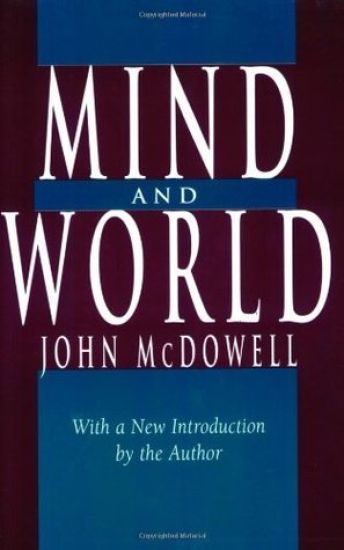
Mind and World

Mind and World

John McDowell

Harvard University Press
1996
nidottu

Halvin toimitettuna 37,70 €

Modern philosophy finds it difficult to give a satisfactory picture of the place of minds in the world. In Mind and World, based on the 1991 John Locke Lectures, one of the most distinguished philosophers writing today offers his diagnosis of this difficulty and points to a cure. In doing so, he delivers the most complete and ambitious statement to date of his own views, a statement that no one concerned with the future of philosophy can afford to ignore. John McDowell amply illustrates a major problem of modern philosophy—the insidious persistence of dualism—in his discussion of empirical thought. Much as we would like to conceive empirical thought as rationally grounded in experience, pitfalls await anyone who tries to articulate this position, and McDowell exposes these traps by exploiting the work of contemporary philosophers from Wilfrid Sellars to Donald Davidson. These difficulties, he contends, reflect an understandable—but surmountable—failure to see how we might integrate what Sellars calls the “logical space of reasons” into the natural world. What underlies this impasse is a conception of nature that has certain attractions for the modern age, a conception that McDowell proposes to put aside, thus circumventing these philosophical difficulties. By returning to a pre-modern conception of nature but retaining the intellectual advance of modernity that has mistakenly been viewed as dislodging it, he makes room for a fully satisfying conception of experience as a rational openness to independent reality. This approach also overcomes other obstacles that impede a generally satisfying understanding of how we are placed in the world.
Handbook on Counseling Youth

Handbook on Counseling Youth

John McDowell; Bob Hostetler

Thomas Nelson Publishers
1996
nidottu
Thoroughly researched, this easy-to-use handbook is designed to help parents, teachers, pastors and youth workers guide today's young people through the minefields of adolescence. From simple challenges to major crises, this book will equip adults to help youth cope with situations involving emotional issues, abuse, addictions, family issues, disorders, sexual issues and much more.