Kirjojen hintavertailu – 12 903 724 kirjaa ja 27 kauppaa
Kirjailija
John Micklethwait
Kirjat ja teokset yhdessä paikassa: 10 kirjaa, julkaisuja vuosilta 2003–2020, suosituimpiin kuuluu The Fourth Revolution: The Global Race to Reinvent the State. Vertaile teosten hintoja ja tarkista saatavuus suomalaisista kirjakaupoista.
This game-changing book originated in an article, written by two of Britain's greatest journalists, that became a viral sensation within hours of publication.
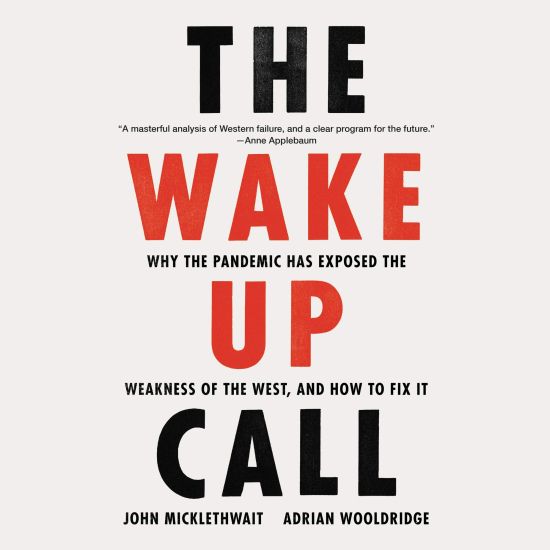
An urgent and informed look at the challenges America and world governments will face in a post Covid-19 world. The Covid-19 pandemic has revealed that governments matter again, that competent leadership is the difference between living and dying. A few governments proved adept at handling the crisis while many others failed. Are Western governments healthy and strong enough to keep their citizens safe from another virulent virus--and protect their economies from collapse? Is global leadership passing from the United States to Asia--and particularly China? The Wake-Up Call addresses these urgent questions. Journalists and longtime collaborators John Micklethwait and Adrian Wooldridge identify the problems Western leaders face, and outline a detailed plan to help them become more vigilant, better prepared, and responsive to disruptive future events. The problems that face us are enormous; as The Wake-Up Call makes clear, governments around the world must re-engineer the way they operate to successfully meet the challenges ahead.
An urgent and informed look at the challenges America and world governments will face in a post Covid-19 world. The Covid-19 pandemic has revealed that governments matter again, that competent leadership is the difference between living and dying. A few governments proved adept at handling the crisis while many others failed. Are Western governments healthy and strong enough to keep their citizens safe from another virulent virus--and protect their economies from collapse? Is global leadership passing from the United States to Asia--and particularly China? The Wake-Up Call addresses these urgent questions. Journalists and longtime collaborators John Micklethwait and Adrian Wooldridge identify the problems Western leaders face, and outline a detailed plan to help them become more vigilant, better prepared, and responsive to disruptive future events. The problems that face us are enormous; as The Wake-Up Call makes clear, governments around the world must re-engineer the way they operate to successfully meet the challenges ahead.
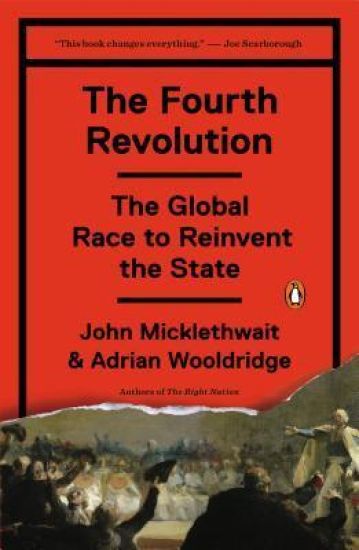
From the bestselling authors of The Right Nation, a visionary argument that our current crisis in government is nothing less than the fourth radical transition in the history of the nation-state Dysfunctional government: It's become a clich , and most of us are resigned to the fact that nothing is ever going to change. As John Micklethwait and Adrian Wooldridge show us, that is a seriously limited view of things. In fact, there have been three great revolutions in government in the history of the modern world. The West has led these revolutions, but now we are in the midst of a fourth revolution, and it is Western government that is in danger of being left behind. Now, things really are different. The West's debt load is unsustainable. The developing world has harvested the low-hanging fruits. Industrialization has transformed all the peasant economies it had left to transform, and the toxic side effects of rapid developing world growth are adding to the bill. From Washington to Detroit, from Brasilia to New Delhi, there is a dual crisis of political legitimacy and political effectiveness. The Fourth Revolution crystallizes the scope of the crisis and points forward to our future. The authors enjoy extraordinary access to influential figures and forces the world over, and the book is a global tour of the innovators in how power is to be wielded. The age of big government is over; the age of smart government has begun. Many of the ideas the authors discuss seem outlandish now, but the center of gravity is moving quickly. This tour drives home a powerful argument: that countries' success depends overwhelmingly on their ability to reinvent the state. And that much of the West--and particularly the United States--is failing badly in its task. China is making rapid progress with government reform at the same time as America is falling badly behind. Washington is gridlocked, and America is in danger of squandering its huge advantages from its powerful economy because of failing government. And flailing democracies like India look enviously at China's state-of-the-art airports and expanding universities. The race to get government right is not just a race of efficiency. It is a race to see which political values will triumph in the twenty-first century--the liberal values of democracy and liberty or the authoritarian values of command and control. The stakes could not be higher.
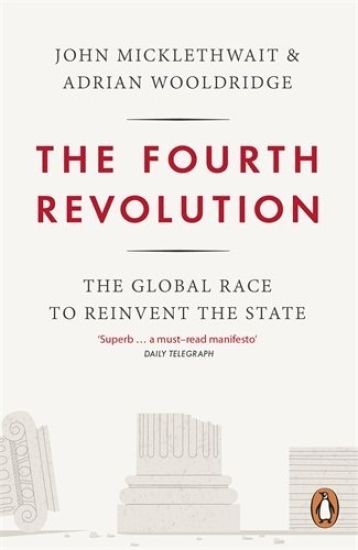
In The Fourth Revolution, John Micklethwait and Adrian Wooldridge ask: what is the state actually for? Their remarkable book describes the three great revolutions in its history, and the fourth which is happening nowIn most of the states of the West, disillusion with government has become endemic. Gridlock in America; anger in much of Europe; cynicism in Britain; decreasing legitimacy everywhere. Most of us are resigned to the fact that nothing is ever going to change. But as John Micklethwait and Adrian Wooldridge show us in this galvanizing book, this is a seriously limited view of things. In response to earlier crises in government, there have been three great revolutions, which have brought about in turn the nation-state, the liberal state and the welfare state. In each, Europe and America have set the example. We are now, they argue, in the midst of a fourth revolution in the history of the nation-state, but this time the Western way is in danger of being left behind. The Fourth Revolution brings the crisis into full view and points towards our future. The authors have enjoyed extraordinary access to influential figures and forces the world over, and the book is a global tour of the innovators. The front lines are in Chinese-oriented Asia, where experiments in state-directed capitalism and authoritarian modernization have ushered in an astonishing period of development. Other emerging nations are producing striking new ideas, from Brazil's conditional cash-transfer welfare system to India's application of mass-production techniques in hospitals. These governments have not by any means got everything right, but they have embraced the spirit of active reform and reinvention which in the past has provided so much of the West's comparative advantage. The race is not just one of efficiency, but one to see which political values will triumph in the twenty-first century: the liberal values of democracy and freedom or the authoritarian values of command and control. The centre of gravity is shifting quickly, and the stakes could not be higher.
The Right Nation is the definitive portrait of the America that few outsiders understand: the America that votes for George Bush, that supports the death penalty and gun rights, that believes in minimal government and long prison sentences, that pulled out of the Kyoto Protocol. America, argue John Micklethwait and Adrian Wooldridge, award winning journalists at The Economist, has always been a conservative country; but over the past 50 years it has built up a radical conservative movement unlike any other country. The authors tell the story of how these radicals took over the Republican Party, and they deconstruct the Bush White House, examining the many influences from neo-conservatism to sun belt entrepreneurialism. This quest takes the authors from young churchgoers in Colorado Springs to gay gun clubs in Massachusetts to black supporters of school vouchers in Milwaukee. And they drive to the heart of a question that is relevant to us all: why does America seem so different?
The Right Nation is not "for" liberals, and it's not "for" conservatives. It's for any of us who want to understand one of the most important forces shaping American life. How did America's government become so much more conservative in just a generation? Compared to Europe-or to America under Richard Nixon-even President Howard Dean would preside over a distinctly more conservative nation in many crucial respects: welfare is gone; the death penalty is deeply rooted; abortion is under siege; regulations are being rolled back; the pillars of New Deal liberalism are turning to sand. Conservative positions have not prevailed everywhere, of course, but this book shows us why they've been so successfully advanced over such a broad front: because the battle has been waged by well-organized, shrewd, and committed troops who to some extent have been lucky in their enemies. John Micklethwait and Adrian Wooldridge, like modern-day Tocquevilles, have the perspective to see this vast subject in the round, unbeholden to forces on either side. They steer The Economist's coverage of the United States and have unrivaled access to resources and-because of the magazine's renown for iconoclasm and analytical rigor-have had open-door access wherever the book's research has led them. And it has led them everywhere: To reckon with the American right, you have to get out there where its centers are and understand the power flow among the brain trusts, the mouthpieces, the organizers, and the foot soldiers. The authors write with wit and skewer whole herds of sacred cows, but they also bring empathy to bear on a subject that sees all too little of it. You won't recognize this America from the far-left's or the far-right's caricatures. Divided into three parts-history, anatomy, and prophecy-The Right Nation comes neither to bury the American conservative movement nor to praise it blindly but to understand it, in all its dimensions, as the most powerful and effective political movement of our age. Chapter OneFROM KENNEBUNKPORT TO CRAWFORD Sir Lewis Namier, the great historian of English politics in the age of George III, once remarked that "English history, and especially English parliamentary history, is made by families rather than individuals." The same could be said of American political history, especially in the age of George I and George II. There is no better introduction to the radical transformation of Republicanism in the past generation-from patrician to populist, from Northeastern to Southwestern, from pragmatic to ideological-than the radical transformation of Republicanism's current leading family, the Bushes. Grandfather PrescottThe Bushes began political life as classic establishment Republicans: WASPs who summered in Kennebunkport, educated their children at boarding schools and the Ivy League and claimed family ties to the British royal family (Queen Elizabeth II is the thirteenth cousin of the first President Bush). George W.'s paternal great-grandfather, Samuel P. Bush, was a steel and railroad executive who became the first president of the National Association of Manufacturers and a founding member of the United States Chamber of Commerce. His maternal great-grandfather, George Herbert Walker, was even grander. The cofounder of W. A. Harriman, Wall Street's oldest private investment bank, Walker's stature was summed up by his twin Manhattan addresses: his office at One Wall Street and his home at One Sutton Place. There was certainly muck beneath this brass: both Walker and Bush had their share of Wall Street shenanigans and cozy government deals, but in the age...
The authors of A Future Perfect provide a close-up look at the history of the joint-stock company and examine its influence on world history, describing the institution's continually evolving forms and how it continues to shape global power. Reprint. 32,500 first printing.
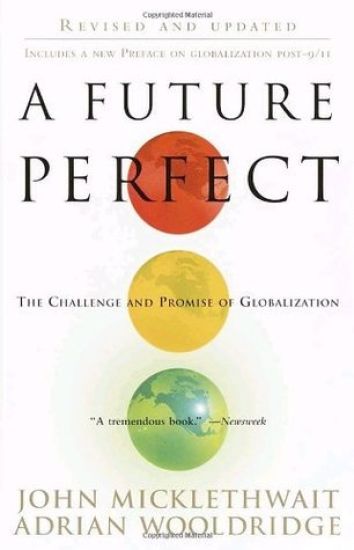
Addressing the major concerns about globalization, the authors defend the emergence of the new world economy, arguing that it will ultimately improve the human condition. Reprint. 25,000 first printing.