

Kirjailija
John Milbank
Kirjat ja teokset yhdessä paikassa: 38 kirjaa, julkaisuja vuosilta 1996–2026, suosituimpiin kuuluu Consent to Being. Vertaile teosten hintoja ja tarkista saatavuus suomalaisista kirjakaupoista.
38 kirjaa
Kirjojen julkaisuvuodet: 1996–2026.
Antonio Rosmini (1797-1855) was a genius who combined science and sanctity. His contribution turns on the theory of the suspended middle of the original relationship between the natural and the supernatural, which he experienced and elaborated. The device of the relationship between the original metaphysical-affective-symbolic structure of the believing conscience and the affective turn in metaphysics, intrinsically linked to his trinitarian ontology, allowed Rosmini to elaborate theories and epistemologies from a unitary perspective in various fields of knowledge. This volume indicates the implications of the unbreakable bond between Rosmini's philosophy and theology in disciplines such as pedagogical science, political science, and juridical science. Following the favorable resolution of the "Rosminian question" the Catholic Church beatified Rosmini in 2007 and in 2018 indicated his theoretical-practical approach as a universal education model to be followed. Through essays by major experts in Rosmini's thought, this curatorship offers an international public a brief, reasoned overview of Rosmini's thinking on these disciplines, finally translated into English, so that this perspective can be understood and explored with particular regard to the possibility of encouraging ecumenical comparison between Rosmini's suspended middle and, for example, that of Radical Orthodoxy.
Antonio Rosmini (1797-1855) was a genius who combined science and sanctity. His contribution turns on the theory of the suspended middle of the original relationship between the natural and the supernatural, which he experienced and elaborated. The device of the relationship between the original metaphysical-affective-symbolic structure of the believing conscience and the affective turn in metaphysics, intrinsically linked to his trinitarian ontology, allowed Rosmini to elaborate theories and epistemologies from a unitary perspective in various fields of knowledge. This volume indicates the implications of the unbreakable bond between Rosmini's philosophy and theology in disciplines such as pedagogical science, political science, and juridical science. Following the favorable resolution of the "Rosminian question" the Catholic Church beatified Rosmini in 2007 and in 2018 indicated his theoretical-practical approach as a universal education model to be followed. Through essays by major experts in Rosmini's thought, this curatorship offers an international public a brief, reasoned overview of Rosmini's thinking on these disciplines, finally translated into English, so that this perspective can be understood and explored with particular regard to the possibility of encouraging ecumenical comparison between Rosmini's suspended middle and, for example, that of Radical Orthodoxy.
'The intersection of theology and poetry is a charged zone of encounter and, if I may say it, discipline. Yet there's a generosity and a lightness to Milbank's verse: a concinnity both within, and within, the now, the lyric moment of generous apprehension, which aligns these taut lyrics with the sensibility of Traherne. "Ripeness rustles," but it is brightness that reigns here, among "alien and yet familiar creatures," a jackdaw, an escaped jaguar in a wood, a white cat in autumn, "beech-mulch" that "sings silently." These radiant poems overflow with creation and gratitude.' -G. C. Waldrep
The Tragedy of Philosophy (Philosophy and Dogma)
Sergij Bulgakov; John Milbank
Angelico Press
2020
sidottu
Halvin toimitettuna 38,20 €
The Tragedy of Philosophy, written during one of the darkest passages of Bulgakov's life, is indispensable to an understanding of the philosophical assumptions informing the mature theological trilogies of his final period. At the book's center lies the idea of a Trinitarian ontology capable of resisting philosophy's militant reductionism.
The Tragedy of Philosophy (Philosophy and Dogma)
Sergij Bulgakov; John Milbank
Angelico Press
2020
pokkari
The Tragedy of Philosophy, written during one of the darkest passages of Bulgakov's life, is indispensable to an understanding of the philosophical assumptions informing the mature theological trilogies of his final period. At the book's center lies the idea of a Trinitarian ontology capable of resisting philosophy's militant reductionism.
Notes on Bergson and Descartes
Charles Péguy; John Milbank
Cascade Books
2019
pokkari
Halvin toimitettuna 36,40 €
Charles Peguy (1873-1914) was a French religious poet, philosophical essayist, publisher, social activist, Dreyfusard, and Catholic convert. There has recently been a renewed recognition of Peguy in France as a thinker of unique significance, a reconsideration inspired in large part by Gilles Deleuze's Difference et repetition, which ranked him with Nietzsche and Kierkegaard. In the English-speaking world, however, access to Peguy has been hindered by a scarcity of translations of his work. This first complete translation of one of his most important prose works, with accompanying interpretive introduction and notes, will introduce English-speaking readers to a new voice, which speaks in a powerful and original way to a modern West in a condition of cultural and spiritual crisis. The immediate circumstance of the writing of this last prose essay, unfinished at the time of Peguy's early death, was the placing of Henri Bergson's philosophical works on the Catholic Index, and Peguy's undertaking to defend his former teacher from his critics, both Catholic and secular. But the subject of Bergson is also a springboard for the exploration of the perennial themes--philosophical, theological, and literary--most central to Peguy's thought. ""Bruce Ward's excellent translation of Charles Peguy is timely and welcome. For the English reader who has only encountered Peguy's translated poetical texts, this book will shed a brilliant new light on a figure of outstanding significance."" --Aaron Riches, Assistant Professor of Theology, Benedictine College, Kansas, author of Ecce Homo: On the Divine Unity of Christ (2016). ""Charles Peguy, a significant thinker in turn-of-the-20th-century France, remains an enigmatic figure in the English-speaking world. Notes on Bergson and Descartes contains Peguy's defense of his former teacher, philosopher Henri Bergson, in an effort to protect the latter from the Catholic Index. Peguy vigorously supported Bergson's insistence on thinking about the most important questions, and the included essays more generally display how Peguy took up in his own way Bergson's efforts to 're-deepen' the heritage of Christianity while exposing the spiritual bleakness of modernity. We are indebted to Ward for translating these important if demanding works, by one of the truly profound men of our time."" --David L. Schindler, Gagnon Professor of Fundamental Theology, John Paul II Institute, The Catholic University of America Bruce K. Ward is Professor of Religious Studies Emeritus of Thorneloe University at Laurentian (Sudbury, Ontario). He is the author of Redeeming the Enlightenment: Christianity and the Liberal Virtues, as well as two books on Dostoevsky, Remembering the End: Dostoevsky as Prophet to Modernity (co-authored with P. Travis Kroeker) and Dostoevsky's Critique of the West: The Quest for the Earthly Paradise.
Charred Root of Meaning
Philipp W Rosemann; John Milbank
William B. Eerdmans Publishing Company
2018
pokkari
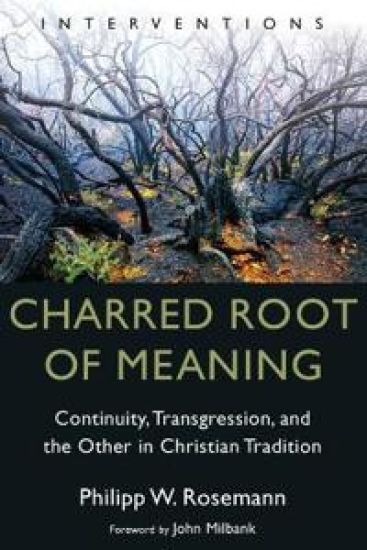
Ecologists tell us that periodic wildfires, though devastating, are necessary to the rhythm of nature. The death of the old allows something new to grow, sometimes straight back from the charred roots. Christian tradition functions much the same way, says Philipp Rosemann. In this book he examines how transgression and destruction are crucial in the foundation and preservation of tradition. Theories of tradition have emphasized the handing-down of identity rather than continuity through difference. Rosemann shows that divine revelation occurs as an irruption that challenges the existing order. The preservation of tradition, he argues, requires that this challenge be periodically repeated. Offering a historical, theological, and philosophical approach to Christian tradition, Charred Root of Meaning shows how transgression and reformation keep the Christian faith alive.

Theory and Theology (provisional title) Edited by John Milbank, Catherine Pickstock and Graham Ward In recent years the field of theology and religious studies has changed out of all recognition; however there is currently no book series which fully reflects the diverse elements of these shifts and tries to produce new syntheses. The most important context here is a move of these disciplines from the margin to the centre. This reflects the increased visibility of religion in the world at large. There has been a perceived failure of secular ideologies, now including liberalism itself and an increased loss of faith in enlightenment humanism. This has left a vacuum which only religions appear to be able to fill. Intellectually there is also a growing sense that religion and culture lie so close together that religion is an unavoidable and fundamental human reality. A further factor is globalisation: religions are able to exploit this phenomenon, especially because in world terms they remain very powerful. At the same time this new circumstance is encouraging an intensified conflict between the competing universal visions of the 'great faiths'. Eminent social scientists like Jurgen Habermas are now using terms like 'post-secularism' to define these new cultural conditions. It is not just within the social sciences that there is a renewed interest in religion. A large group of continential philosophers have become dissatisfied with a purely 'postmodern' approach. These thinkers are increasingly discussing aspects of religion, and include figures such as Zizek, Marion, Chretien, Derrida and Irigaray. In the Ango-Saxon world there have been different but parallel trends in the wake of the exhaustion of the analytic project on the part of some thinkers. Post-analytic philosophy is either more naturalistic or more religious (as can be seen in the debate between Dennett and MacIntyre and Charles Taylor). The novelty of Theory and Theology would be, in the first place, an explicit foregrounding of the new interaction between theology, philosophy, political theory and cultural studies (including religious studies). Despite the theoretical convergence of certain trends, they often in practice do not come together. Th aim of Theory and Theology would be to make this happen, and thereby significantly to advance contemporary theoretical discussion. We would hope that this would become not just a respected but a renowned series. Possible future contributors would include Zizek, Eagleton, Badiou, Charles Taylor, O-T Venard OP, J-Y Lacoste, J-L Chretien and William Desmond. We would expect to work closely with Rebecca Harkin to determine the correct mix of titles, but the first 4 or 5 could be: 1. The Gift in Religion by John Milbank. This book would for the first time offer a complete treatment of the debate on the gift in all its ethnographic, historical, philosophic and theological ramifications. 2. Creation and Evolution by Michael Hanby. This book would offer something very original: a philosophical and theological critique of Darwinism in terms of its presuppositions and consequences, which nonetheless in no ways endorses 'creationism' which it rather sees as a modern phenomenon that colludes with its seeming opponent. 3. Work by John Hughes A thorough re-examination of philosophies and theologies of labour. 4. The Lineage of Soul by Catherine Pickstock. 5. Cultural Ethics: Rethinking Christian Socialism by Graham Ward This study would begin with a genealogy of socialist thought, relating both it Marxist and religious forms to cultural shifts in Christianity and politics dating back to the early modern period. It would then go on to examine its demise under the new cultrual conditions of the 1970's and 80's and explore the new contemporary possibilities at a point when, in the West, postsecualrity encounters forms of postdemocracy, postliberalism and posthumanism.
Contemporary politics is dominated by a liberal creed that champions ‘negative liberty’ and individual happiness. This creed undergirds positions on both the right and the left – free-market capitalism, state bureaucracy and individualism in social life. The triumph of liberalism has had the effect of subordinating human association and the common good to narrow self-interest and short-term utility. By contrast, post-liberalism promotes individual fulfilment and mutual flourishing based on shared goals that have more substantive content than the formal abstractions of liberal law and contract, and yet are also adaptable to different cultural and local traditions. In this important book, John Milbank and Adrian Pabst apply this analysis to the economy, politics, culture, and international affairs. In each case, having diagnosed the crisis of liberalism, they propose post-liberal alternatives, notably new concepts and fresh policy ideas. They demonstrate that, amid the current crisis, post-liberalism is a programme that could define a new politics of virtue and the common good.
Contemporary politics is dominated by a liberal creed that champions ‘negative liberty’ and individual happiness. This creed undergirds positions on both the right and the left – free-market capitalism, state bureaucracy and individualism in social life. The triumph of liberalism has had the effect of subordinating human association and the common good to narrow self-interest and short-term utility. By contrast, post-liberalism promotes individual fulfilment and mutual flourishing based on shared goals that have more substantive content than the formal abstractions of liberal law and contract, and yet are also adaptable to different cultural and local traditions. In this important book, John Milbank and Adrian Pabst apply this analysis to the economy, politics, culture, and international affairs. In each case, having diagnosed the crisis of liberalism, they propose post-liberal alternatives, notably new concepts and fresh policy ideas. They demonstrate that, amid the current crisis, post-liberalism is a programme that could define a new politics of virtue and the common good.
Of this collection, the author says: "Since I come from all over the island of Britain, it is to me my locality in the world, as much as it is my nation. Of the perplexing variety of this region, I try to make sense. Throughout the island I experience landscapes that tend to evaporate, mingling with myths that loom into a persistent reality. The resulting psychogeographies are for me many, though also problematically linked and integrated. This poetic sequence is written in the hope of a true unity of Britain yet to come."
The Suspended Middle: Henri de Lubac and the Renewed Split in Modern Catholic Theology, 2nd Ed.
John Milbank
William B. Eerdmans Publishing Company
2015
nidottu
Halvin toimitettuna 28,90 €
French Jesuit Henri de Lubac (1896-1991) was arguably the most revolutionary yet under-acknowledged theologian of the twentieth century. He proposed that Western theology since the early modern period had lost sight of the key to integrating faith and reason -- namely, the truth that all human beings are naturally oriented toward the supernatural. Originally published in 2005, The Suspended Middle by John Milbank defends and amplifies de Lubac's provocative thesis and rebuts its many critics. In this second edition Milbank has expanded and clarified his argument throughout to take greater account of new critiques of de Lubac. The future of the Christian faith is at stake, says Milbank, as he urges his readers to recover and reinvigorate de Lubac's biblical-theological-philosophical vision.
Theurgy and the Soul
Gregory Shaw; John Milbank; Aaron Riches
Angelico Press
2014
pokkari
Halvin toimitettuna 30,60 €