Kirjojen hintavertailu – 12 903 725 kirjaa ja 27 kauppaa

Kirjailija

John Millington Synge

Kirjat ja teokset yhdessä paikassa: 54 kirjaa, julkaisuja vuosilta 1981–2026, suosituimpiin kuuluu The Aran Islands (Esprios Classics). Vertaile teosten hintoja ja tarkista saatavuus suomalaisista kirjakaupoista.

54 kirjaa

Kirjojen julkaisuvuodet: 1981–2026.

The Playboy of the Western World

The Playboy of the Western World

John Millington Synge

MAPLE PRESS PVT LTD
2011
nidottu
A masterpiece by J. M. Synge, The Playboy of The Western World is set up in an Irish background during the late nineteenth century and led to riots after it was first staged in Dublin. Christy Mahon, a young man claims to kill his father. The villagers are upset at his arrival but nevertheless they enjoy his story about how he drove a loy through his father's head. Mahon emerges into a heroic figure and the barmaid Pegeen falls in love with him, to the dismay of her betrothed, Shawn. The controversial tragicomic play has received a large critical appreciation and still sustains its influential hold over the Irish theatre, even after a century of its first premier.
Shadows

Shadows

John Millington Synge; William Butler Yeats

Oberon Books Ltd
1998
nidottu
A collection of three classic Irish one-act plays, as produced on the RSC's highly successful 1998 tour. Richly passionate, poetic and violent, the plays reveal our fascination with death and transendance. Features the plays Riders to the Sea, The Shadow of the Glen and Purgatory, with an introduction by Declan Kiberd.
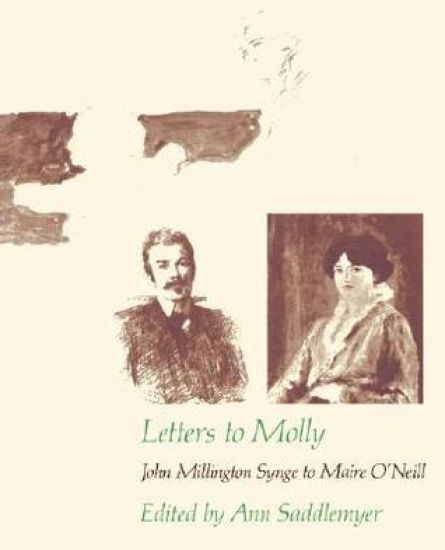
Letters to Molly

Letters to Molly

John Millington Synge

The Belknap Press
1984
nidottu
When John Millington Synge and Molly Allgood fell in love, he was thirty-five, she nineteen. Neither knew that he had Hodgkin’s disease, of which he was to die in three years. Synge had already achieved recognition as a playwright—translations of two of his plays had been performed in Berlin and Prague—and he was codirector, with Yeats and Lady Gregory, of the Irish National Theatre Society. Allgood had started her acting career the year before, in the newly opened Abbey Theatre, with a walk-on part in Synge’s Well of the Saints. She had been promoted from crowd scenes to bit parts to lead roles in Riders to the Sea and The Shadow of the Glen. She was still only a member of the company, however, while Synge was a director, whose codirectors disapproved of fraternization. Synge and Allgood also faced the disapproval of two widowed mothers. Barring an occasional holiday trip or company road tour, they could seldom be alone together, except on secret afternoon meetings for long walks in the country. Hence their hundreds of letters. Molly Allgood’s letters do not survive; they apparently were destroyed when Synge died. But his letters convey her mercurial charm, her openness, her love of life, her impulsiveness, and her temper—as violent as his own. What they convey of him (when he is not reproving her or remonstrating with her, as he does in the early months of their relationship) is the love of nature, the poetic language, the bittersweet irony, the elemental quality of emotion, that we know from the plays. His concern for his craft is seen as he struggles with The Playboy. (“Parts of it are not structurally strong or good. I have been all this time trying to get over weak situations by strong writing, but now I find it won’t do, and I am at my wit’s end.”) Synge was quite unperturbed by the violent outrage and near-riots the play provoked. (“Now we’ll be talked about. We’re an event in the history of the Irish stage,” he wrote cheerily.)As his illness progresses, following operations in 1907 and 1908, there is great poignancy in the gradual abating of references to marriage plans and in the shift of salutation from “Dearest Changeling” to “My dearest child.” After Synge’s death his friends and biographers discreetly avoided mention of Allgood, who under her stage name of Maire O’Neill became one of the leading actresses of the Irish theater and lived until 1952. His letters to her have not been published before, except for the few quoted in Greene and Stephens’s 1959 biography. A primary source for the study of Synge and the Irish theater movement, the letters include poems inspired by Allgood and extensive information about Abbey Theatre business. In addition to a biographical introduction, Ann Saddlemyer has included a map of the Wicklow and Dublin areas and numerous photographs of both Synge and Allgood.

Synge: Complete Plays

Synge: Complete Plays

John Millington Synge

Methuen Drama
1981
nidottu
A re-issue of the collected plays by one of Ireland's most celebrated writers In The Shadow of the Glen an old man tests his wife's commitment by feigning death; Riders to the Sea is inspired by Synge's stay on the Aran Islands and shadows the death of a way of life as a mother sees her sons die before her eyes; The Tinker's Wedding is about a woman's desire for marriage to her tinker husband and is full of Synge's fascination for the tinker breed who had freed themselves from govenment and conventions while giving way to instincts of sexual promsicuity, fighting and drinking; The Well of Saints is set near a holy well known for its cures of blindness and epilepsy and centres on the figure of Martin Doul, who is blind and has two illusions - the first, that he and his wife Mary are a handsome couple and the second, that the visible world is full of wonder and delight; The Playboy of the Western World, in which a young man lies about the death of his father offended audiences when first produced in 1907 on account of its 'immodest' references to Irish womanhood and aroused a prolonged and bitter controversy, which lasted until the author's death in 1909; Deirdre of the Sorrows is Synge's last play, published posthumously and tells the story of a young and beautiful girl, destined to be the bride of an ageing king who elopes with a younger man and after the magical seven years returns only to bring with her the destruction of a city.