Kirjojen hintavertailu – 12 903 725 kirjaa ja 27 kauppaa

Kirjailija

John Missall

Kirjat ja teokset yhdessä paikassa: 6 kirjaa, julkaisuja vuosilta 2015–2025, suosituimpiin kuuluu The Seminole Struggle. Vertaile teosten hintoja ja tarkista saatavuus suomalaisista kirjakaupoista.

6 kirjaa

Kirjojen julkaisuvuodet: 2015–2025.

History of the Third Seminole War

History of the Third Seminole War

Joe Knetsch; John Missall; Mary Lou Missall

Casemate Publishers
2025
nidottu
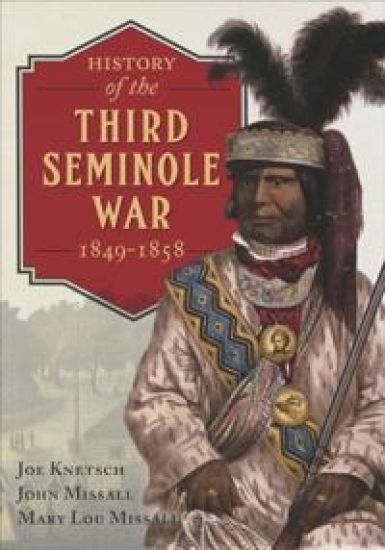
"The authors have done an excellent job bringing this last conflict–one that is often overlooked–to life. And not only that, they have put it into the broader picture of antebellum United States history.” — San Francisco Book Review Spanning a period of over forty years (1817-1858), the three Seminole Wars were America’s longest, costliest, and deadliest Indian wars, surpassing the more famous ones fought in the West. After an uneasy peace following the conclusion of the second Seminole War in 1842, a series of hostile events followed by a string of murders in 1849 and 1850 made confrontation inevitable. The war was also known as Billy Bowlegs' War because Billy Bowlegs (Holata Micco) was the main Seminole leader in this the last Indian war to be fought east of the Mississippi River. Pushed by increasing encroachment into their territory he led a raid near Fort Myers. A series of violent skirmishes ensued. The vastness of the Floridian wilderness and the difficulties of the terrain and climate caused problems for the army, but they had learnt lessons from the second war and amongst other new tactics employed greater use of boats, eventually securing victory through cutting off food supplies. Although there are several books covering the entire Seminole Wars period and excellent works on the First and Second Seminole Wars, the Third Seminole War has long been neglected. This book seeks to fill that void at a time when interest in the Seminole Wars is growing. History of the Third Seminole War is a detailed narrative of the war and its causes, containing numerous firsthand accounts from participants in the war, derived from virtually all the available primary sources, collected over many years. Written in a clear, easy-to-follow style, the work is intended for both a general and scholarly audience and will be of value to those interested in Florida history, American history in general, military history, Native American studies, and nineteenth century subjects. The book will also appeal to Civil War enthusiasts, as many of the officers who served in Florida became leaders in that later conflict.

An Ancient Tale New Told - Volume 2

An Ancient Tale New Told - Volume 2

John Missall

Independently Published
2019
pokkari
The stories told in the plays of William Shakespeare are among the most beloved in all literature. In this unique three-volume set, award-winning author and historian John Missall retells each play in modern prose while retaining Shakespeare's original language for the characters' conversations. The stories closely follow the action of the plays, retaining the Act/Scene structure of the originals. By using little added embellishment and minimal paraphrasing, the author allows the reader to easily understand these timeless dramatic works and appreciate Shakespeare's powerful yet beautiful wording. Volume II: The Histories includes the most familiar works, such as "Henry IV," "Henry V," Henry VI", and "Richard III", along with "King John," "Richard II," and "Henry VIII." Also included is "The Merry Wives of Windsor," so that all the plays featuring the popular Sir John Falstaff will be in one volume. Illustrated with numerous Shakespeare-inspired works of art (print version only), "An Ancient Tale New Told" is the perfect tool for those who would like to become familiar with the greatest works in the English language. From the text: Montjoy, the French herald, arrives with a message to Henry from the King of France. "Thus says my king: Though we seemed dead, we did but sleep. Tell him we could have rebuked him at Harfleur. Now we speak upon our cue, and our voice is imperial. England shall repent his folly, see his weakness, and admire our sufferance. Bid him, therefore, consider of his ransom, which must proportion the losses we have borne, the subjects we have lost, the disgrace we have digested. For our losses, his exchequer is too poor; for the effusion of our blood, the muster of his kingdom too faint a number; and for our disgrace, his own person kneeling at our feet, but a weak and worthless satisfaction." Then, to engender fear in Henry's troops, he says, "To this add defiance, and tell him, for conclusion, he hath betrayed his followers, whose condemnation is pronounced." The French will take no prisoners. Henry is not impressed. "Turn thee back, and tell thy king, I do not seek him now. My people are with sickness much enfeebled; my numbers lessened; and those few I have, almost no better than so many French. Go, therefore, tell thy master here I am; my ransom is this frail and worthless trunk; my army but a weak and sickly guard." Henry may be in a weak position, but he will not be deterred. "Yet, God before, tell him we will come on, though France himself, and such another neighbor, stand in our way. If we may pass, we will; if we be hindered, we shall your tawny ground with your red blood discolor. We would not seek a battle, as we are; nor, as we are, we say, we will not shun it." So informed, Montjoy departs to deliver his message.
The Seminole Wars

The Seminole Wars

John Missall; Mary Lou Missall

University Press of Florida
2018
sidottu
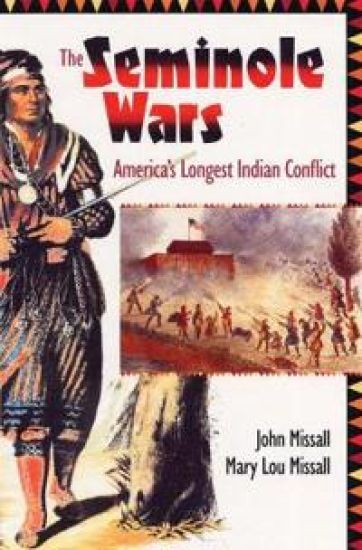
The Seminole Wars were the longest, bloodiest, and most costly of all the Indian wars fought by this nation. Written for a popular audience, this illustrated history is the first book to provide a comprehensive overview of all three wars. John and Mary Lou Missall examine not only the wars that were fought between 1817 and 1858 but also the events leading up to them and their place in American history. In particular it sheds new light on the relationship between the wars, the issue of slavery, and the prevailing attitudes toward Native Americans. While fought in Florida, the Seminole Wars were a major concern to the nation as a whole. In addition to the issue of slavery, a culture of national arrogance and religious fervor fostered an attitude that allowed the conflicts to happen. The first war, led by General Andrew Jackson, was part of an attempt to wrest Florida from Spain and had international repercussions that led to a lengthy congressional investigation. The second, which lasted seven years, took the lives of more than 1,500 soldiers and resulted in the forced removal of more than 3,000 Seminole Indians from Florida and the deaths of countless others. During 1836 and 1837 it was the predominant story in national newspapers, and public support for the war was fueled in part by fear among slaveholders that black Seminoles might inspire a general slave uprising. The third war, fought on the eve of the Civil War, was an attempt to remove the final remnants of the Seminole Nation from their homes in the Everglades. The authors describe the wars as both a military and a moral embarrassment-a sad chapter in American history that has been overshadowed by the Civil War and by Indian wars fought west of the Mississippi. The conflicts were the nation's first guerrilla wars. They offered the country its first opportunity for aggressive territorial expansion and highlighted the dangers of an inflexible government policy. Analyzing events of the wars against larger issues, the authors observe: "It often seems as if the Seminole Nation was the nail being pounded by the hammer of American policy. What interested us most was why the hammer was swung in the first place." Based on original research that makes use of diaries, military reports, and archival newspapers, this work will be of interest to general readers as well as historians of Florida and Native American life and to those who study the antebellum South and the early American Republic.
An Ancient Tale New Told - Volume 1

An Ancient Tale New Told - Volume 1

John Missall

Createspace Independent Publishing Platform
2015
pokkari
The stories told in the plays of William Shakespeare are among the most beloved in all literature. In this unique three-volume set, award-winning author and historian John Missall retells each play in modern prose while retaining Shakespeare's original language for the characters' conversations. The stories closely follow the action of the plays, retaining the Act/Scene structure of the originals. By using little added embellishment and minimal paraphrasing, the author allows the reader to easily understand these timeless dramatic works and appreciate Shakespeare's powerful yet beautiful wording. Volume I: The Tragedies includes the most familiar works, such as "Hamlet," "MacBeth," and "Romeo & Juliet," plus the lesser-known plays, such as "Coriolanus," "Troilus & Cressida," and "Timon of Athens." Illustrated with numerous Shakespeare-inspired works of art (print version only), "An Ancient Tale New Told" is the perfect tool for those who would like to become familiar with the greatest works in the English language. From the text: Hamlet enters the room, deep in thought and not noticing that Ophelia is there. His mind is still on suicide. "To be or not to be: that is the question. Whether 'tis nobler in the mind to suffer the slings and arrows of outrageous fortune, or to take arms against a sea of troubles, and by opposing end them. To die-to sleep. No more; and by a sleep to say we end the heart-ache and the thousand natural shocks that flesh is heir to. 'Tis a consummation devoutly to be wished. To die, to sleep." So why not take one's own life? There's a catch: "To sleep, perchance to dream. Aye, there's the rub. For in that sleep of death what dreams may come when we have shuffled off this mortal coil must give us pause. There's the respect that makes calamity of so long life; for who would bear the whips and scorns of time, the oppressor's wrong, the proud man's contumely contempt], the pangs of despised love, the law's delay, the insolence of office, and the spurns that patient merit of the unworthy takes, when he himself might his quietus settlement] make with a bare bodkin dagger]?" It is the fear of the unknown that keeps us from ending our own lives. "Who would fardels burdens] bear, to grunt and sweat under a weary life, but that the dread of something after death, the undiscovered country from whose bourn borders] no traveler returns, puzzles the will, and makes us rather bear those ills we have, than fly to others that we know not of? Thus conscience does make cowards of us all, and thus the native hue of resolution is sickled over with the pale cast of thought, and enterprises of great pitch and moment with this regard their currents turn awry and lose the name of action."