Kirjailija
John P. Burgess
Kirjat ja teokset yhdessä paikassa: 18 kirjaa, julkaisuja vuosilta 1997–2022, suosituimpiin kuuluu The East German Church and the End of Communism. Vertaile teosten hintoja ja tarkista saatavuus suomalaisista kirjakaupoista.
18 kirjaa
Kirjojen julkaisuvuodet: 1997–2022.
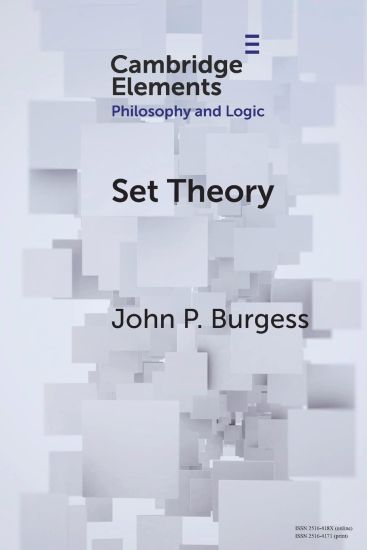
Set theory is a branch of mathematics with a special subject matter, the infinite, but also a general framework for all modern mathematics, whose notions figure in every branch, pure and applied. This Element will offer a concise introduction, treating the origins of the subject, the basic notion of set, the axioms of set theory and immediate consequences, the set-theoretic reconstruction of mathematics, and the theory of the infinite, touching also on selected topics from higher set theory, controversial axioms and undecided questions, and philosophical issues raised by technical developments.
A Pastoral Rule for Today – Reviving an Ancient Practice
John P. Burgess; Jerry Andrews; Joseph D. Small
IVP Academic
2019
nidottu
Halvin toimitettuna 28,20 €
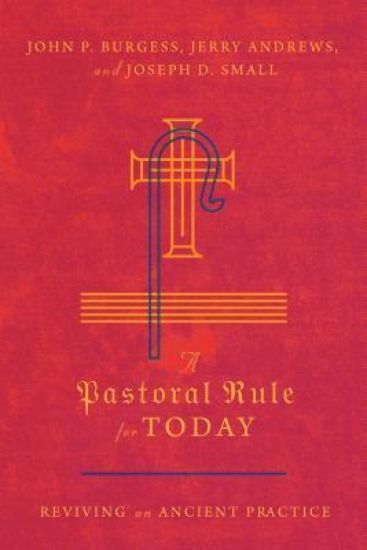
The pastoral office has always been a difficult calling. Today, the pastor is often asked to fulfill multiple roles: preacher, teacher, therapist, administrator, CEO. How can pastors thrive amid such demands? What is needed is a contemporary pastoral rule: a pattern for ministry that both encourages pastors and enables them to focus on what is most important in their pastoral task. This book, coauthored by three experts with decades of practical experience, explains how relying on a pastoral rule has benefited communities throughout the church's history and how such rules have functioned in the lives and work of figures such as Augustine, Calvin, Wesley, and Bonhoeffer. It also provides concrete advice on how pastors can develop and keep a rule that will help both them and their congregations to flourish.
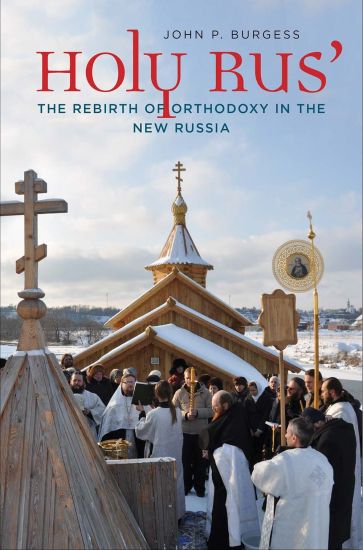
A fascinating, vivid, and on-the-ground account of Russian Orthodoxy’s resurgence “A compelling picture.”—Irina Papkova, Russian Review “Powerful.”—Philip Jenkins, Christian Century A bold experiment is taking place in Russia. After a century of being scarred by militant, atheistic communism, the Orthodox Church has become Russia’s largest and most significant nongovernmental organization. As it has returned to life, it has pursued a vision of reclaiming Holy Rus’: that historical yet mythical homeland of the eastern Slavic peoples; a foretaste of the perfect justice, peace, harmony, and beauty for which religious believers long; and the glimpse of heaven on earth that persuaded Prince Vladimir to accept Orthodox baptism in Crimea in A. D. 988. Through groundbreaking initiatives in religious education, social ministry, historical commemoration, and parish life, the Orthodox Church is seeking to shape a new, post-communist national identity for Russia. In this eye-opening and evocative book, John Burgess examines Russian Orthodoxy’s resurgence from a grassroots level, providing Western readers with an enlightening, inside look at the new Russia.
While we are commonly told that the distinctive method of mathematics is rigorous proof, and that the special topic of mathematics is abstract structure, there has been no agreement among mathematicians, logicians, or philosophers as to just what either of these assertions means. John P. Burgess clarifies the nature of mathematical rigor and of mathematical structure, and above all of the relation between the two, taking into account some of the latest developments in mathematics, including the rise of experimental mathematics on the one hand and computerized formal proofs on the other hand. The main theses of Rigor and Structure are that the features of mathematical practice that a large group of philosophers of mathematics, the structuralists, have attributed to the peculiar nature of mathematical objects are better explained in a different way, as artefacts of the manner in which the ancient ideal of rigor is realized in modern mathematics. Notably, the mathematician must be very careful in deriving new results from the previous literature, but may remain largely indifferent to just how the results in the previous literature were obtained from first principles. Indeed, the working mathematician may remain largely indifferent to just what the first principles are supposed to be, and whether they are set-theoretic or category-theoretic or something else. Along the way to these conclusions, a great many historical developments in mathematics, philosophy, and logic are surveyed. Yet very little in the way of background knowledge on the part of the reader is presupposed.
This is a concise introduction to current philosophical debates about truth. Combining philosophical and technical material, the book is organized around, but not limited to, the view known as deflationism. In clear language, Burgess and Burgess cover a wide range of issues, including the nature of truth, the status of truth-value gaps, the relationship between truth and meaning, relativism and pluralism about truth, and semantic paradoxes from Alfred Tarski to Saul Kripke and beyond. The book provides a rich picture of contemporary philosophical theorizing about truth, one that will be essential reading for philosophy students as well as philosophers specializing in other areas.
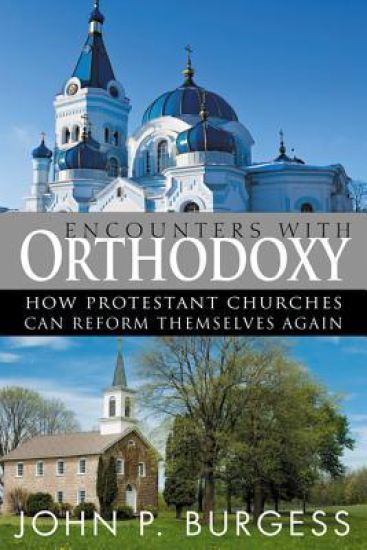
When author and theologian John P. Burgess first travelled to Russia, he was hoping to expand his theological horizons and explore the rebirth of the Orthodox Church since the fall of Communism. But what he found changed some fundamental assumptions about his own tradition of North American Protestantism. In this book, Burgess asks how an encounter with Orthodoxy can help Protestants better see both strengths and weaknesses of their own tradition. In a time in which North American Protestantism is in declinemembership has now fallen to below 50% of the populationRussian Orthodoxy can help Protestants rethink the ways in which they worship, teach, and spread the gospel. Burgess considers Orthodox rituals, icons, saints and miracles, monastic life, and Eucharistic theology and practice. He then explores whether and how Protestants can use elements of Orthodoxy to reform church life.
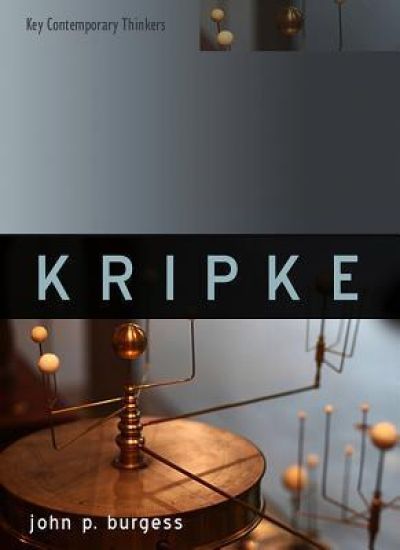
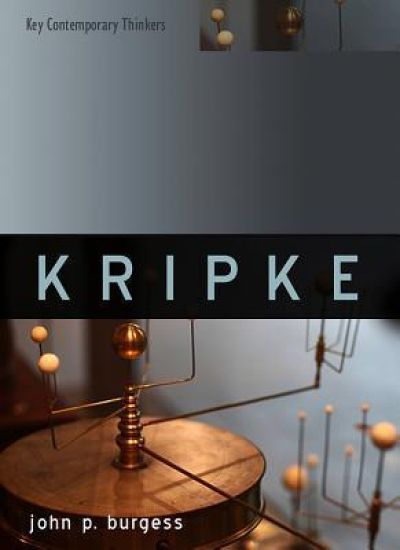
Saul Kripke has been a major influence on analytic philosophy and allied fields for a half-century and more. His early masterpiece, Naming and Necessity, reversed the pattern of two centuries of philosophizing about the necessary and the contingent. Although much of his work remains unpublished, several major essays have now appeared in print, most recently in his long-awaited collection Philosophical Troubles. In this book Kripke’s long-time colleague, the logician and philosopher John P. Burgess, offers a thorough and self-contained guide to all of Kripke’s published books and his most important philosophical papers, old and new. It also provides an authoritative but non-technical account of Kripke’s influential contributions to the study of modal logic and logical paradoxes. Although Kripke has been anything but a system-builder, Burgess expertly uncovers the connections between different parts of his oeuvre. Kripke is shown grappling, often in opposition to existing traditions, with mysteries surrounding the nature of necessity, rule-following, and the conscious mind, as well as with intricate and intriguing puzzles about identity, belief and self-reference. Clearly contextualizing the full range of Kripke’s work, Burgess outlines, summarizes and surveys the issues raised by each of the philosopher’s major publications. Kripke will be essential reading for anyone interested in the work of one of analytic philosophy’s greatest living thinkers.
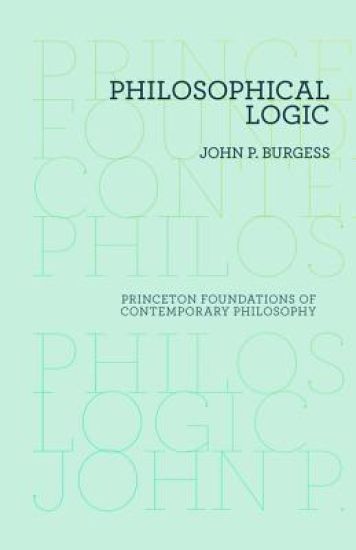
Philosophical Logic is a clear and concise critical survey of nonclassical logics of philosophical interest written by one of the world's leading authorities on the subject. After giving an overview of classical logic, John Burgess introduces five central branches of nonclassical logic (temporal, modal, conditional, relevantistic, and intuitionistic), focusing on the sometimes problematic relationship between formal apparatus and intuitive motivation. Requiring minimal background and arranged to make the more technical material optional, the book offers a choice between an overview and in-depth study, and it balances the philosophical and technical aspects of the subject. The book emphasizes the relationship between models and the traditional goal of logic, the evaluation of arguments, and critically examines apparatus and assumptions that often are taken for granted. Philosophical Logic provides an unusually thorough treatment of conditional logic, unifying probabilistic and model-theoretic approaches. It underscores the variety of approaches that have been taken to relevantistic and related logics, and it stresses the problem of connecting formal systems to the motivating ideas behind intuitionistic mathematics. Each chapter ends with a brief guide to further reading. Philosophical Logic addresses students new to logic, philosophers working in other areas, and specialists in logic, providing both a sophisticated introduction and a new synthesis.
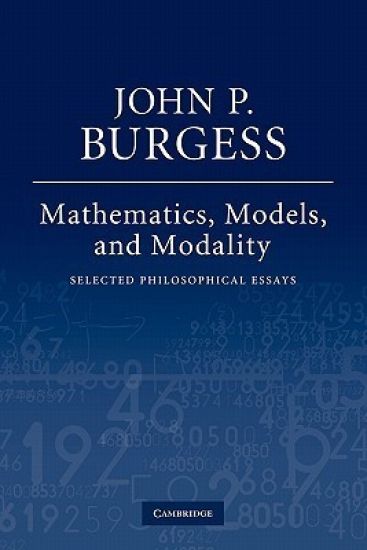
John Burgess is the author of a rich and creative body of work which seeks to defend classical logic and mathematics through counter-criticism of their nominalist, intuitionist, relevantist, and other critics. This selection of his essays, which spans twenty-five years, addresses key topics including nominalism, neo-logicism, intuitionism, modal logic, analyticity, and translation. An introduction sets the essays in context and offers a retrospective appraisal of their aims. The volume will be of interest to a wide range of readers across philosophy of mathematics, logic, and philosophy of language.
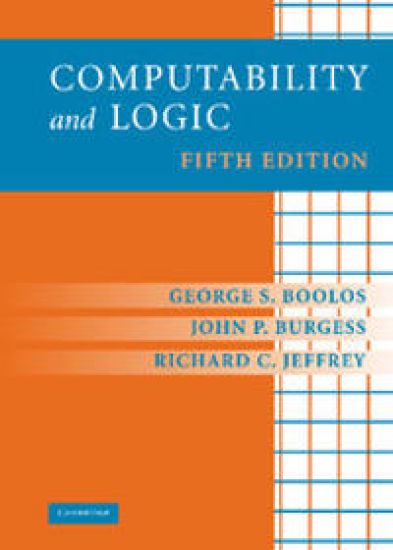
Computability and Logic
George S. Boolos; John P. Burgess; Richard C. Jeffrey
Cambridge University Press
2007
sidottu
Computability and Logic has become a classic because of its accessibility to students without a mathematical background and because it covers not simply the staple topics of an intermediate logic course, such as Godel's incompleteness theorems, but also a large number of optional topics, from Turing's theory of computability to Ramsey's theorem. This 2007 fifth edition has been thoroughly revised by John Burgess. Including a selection of exercises, adjusted for this edition, at the end of each chapter, it offers a simpler treatment of the representability of recursive functions, a traditional stumbling block for students on the way to the Godel incompleteness theorems. This updated edition is also accompanied by a website as well as an instructor's manual.
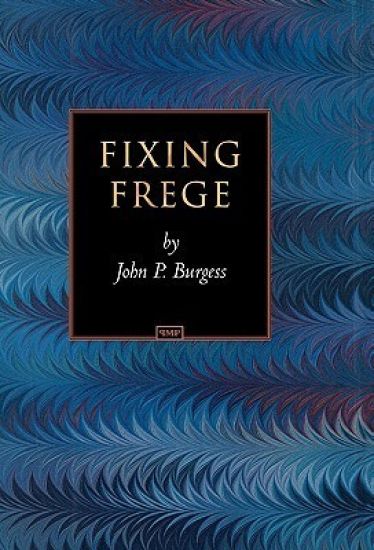
The great logician Gottlob Frege attempted to provide a purely logical foundation for mathematics. His system collapsed when Bertrand Russell discovered a contradiction in it. Thereafter, mathematicians and logicians, beginning with Russell himself, turned in other directions to look for a framework for modern abstract mathematics. Over the past couple of decades, however, logicians and philosophers have discovered that much more is salvageable from the rubble of Frege's system than had previously been assumed. A variety of repaired systems have been proposed, each a consistent theory permitting the development of a significant portion of mathematics. This book surveys the assortment of methods put forth for fixing Frege's system, in an attempt to determine just how much of mathematics can be reconstructed in each. John Burgess considers every proposed fix, each with its distinctive philosophical advantages and drawbacks. These systems range from those barely able to reconstruct the rudiments of arithmetic to those that go well beyond the generally accepted axioms of set theory into the speculative realm of large cardinals. For the most part, Burgess finds that attempts to fix Frege do less than advertised to revive his system. This book will be the benchmark against which future analyses of the revival of Frege will be measured.
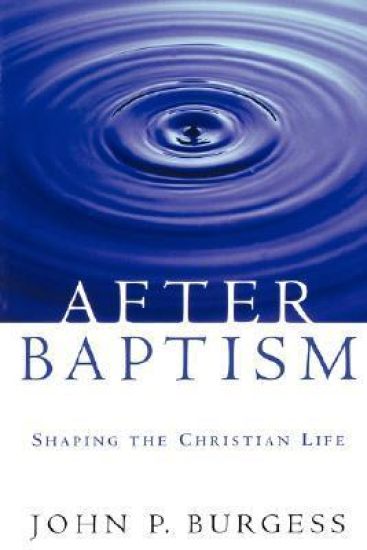
John Burgess explores the distinctive qualities of Christian identity by demonstrating how baptism, the Eucharist, and the Commandments are basic points of orientation for Christians. He challenges the church and its members to identify and claim key practices and disciplines of faith to deepen baptismal identity and give the Christian life solid form today. His work ultimately seeks to stimulate pastors, educators, and church leaders to encourage the church to practice ways of life together that will lead to a more faithful living of the Christian faith.
Numbers and other mathematical objects are exceptional in having no locations in space or time or relations of cause and effect. This makes it difficult to account for the possibility of the knowledge of such objects, leading many philosophers to embrace nominalism, the doctrine that there are no abstract entities, and to embark on ambitious projects for interpreting mathematics so as to preserve the subject while eliminating its objects. A Subject With No Object cuts through a host of technicalities that have obscured previous discussions of these projects, and presents clear, concise accounts, with minimal prerequisites, of a dozen strategies for nominalistic interpretation of mathematics, thus equipping the reader to evaluate each and to compare different ones. The authors also offer critical discussion, rare in the literature, of the aims and claims of nominalistic interpretation, suggesting that it is significant in a very different way from that usually assumed.
"John Burgess has written a book of immense help to the church in this time of great conflict and division. It is wise, probing, and highly readable. . . . A combination of authentic piety and remarkable scholarship characterize this book, which is full of concrete suggestions for persons and and congregations. --Douglas W. Oldenburg, Moderator, 210th General Assembly, Presbyterian Church (USA) and President of Columbia Theological Seminary
The East German Church and the End of Communism
John P. Burgess
Oxford University Press Inc
1998
sidottu
Burgess addresses the role of religion in the massive political changes that took place in Eastern Europe in 1989, focusing particularly on the role played by the East German Church in that country's bloodless revolution.
Numbers and other mathematical objects are exceptional in having no locations in space or time or relations of cause and effect. This makes it difficult to account for the possibility of the knowledge of such objects, leading many philosophers to embrace nominalism, the doctrine that there are no such objects, and to embark on ambitious projects for interpreting mathematics so as to preserve the subject while eliminating its objects. A Subject With No Object cuts through a host of technicalities that have obscured previous discussions of these projects, and presents clear, concise accounts, with minimal prerequisites, of a dozen strategies for nominalistic interpretation of mathematics, thus equipping the reader to evaluate each and to compare different ones. The authors also offer critical discussion, rare in the literature, of the aims and claims of nominalistic interpretation, suggesting that it is significant in a very different way from that usually assumed.