
Kirjailija
John Q. Easton
Kirjat ja teokset yhdessä paikassa: 8 kirjaa, julkaisuja vuosilta 2010–2023, suosituimpiin kuuluu Creating Research-Practice Partnerships in Education. Vertaile teosten hintoja ja tarkista saatavuus suomalaisista kirjakaupoista.
Nimi esiintyy myös muodoissa: John Q Easton
8 kirjaa
Kirjojen julkaisuvuodet: 2010–2023.
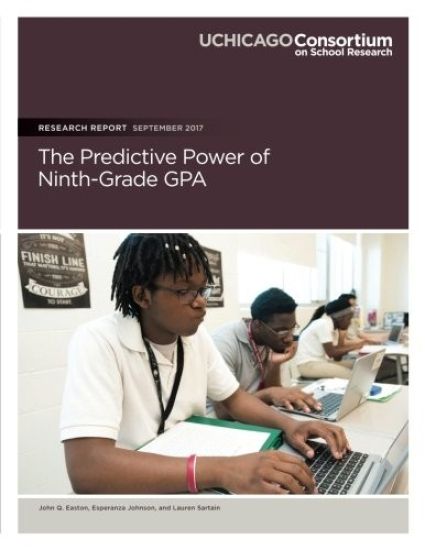
The Predictive Power of Ninth-Grade GPA
Esperanza Johnson; Lauren Sartain; John Q. Easton
Consortium on Chicago School Research
2017
nidottu
As parents and teachers know, and research has demonstrated, ninth grade is a critical year for students. It is when students' high school habits and mindsets are formed and their ninth- through twelfth-grade trajectory begins to take shape. This study provides evidence that students' course performance in ninth grade is strongly related to grades later in high school, as well as the likelihood that they graduate from high school and pursue post-secondary education. The report shows that grades are a better predictor of future academic success than test scores. This suggests that students who have strong freshman grades are likely to do well academically in the future. These findings indicate that policymakers and practitioners can generally trust grades as a good indicator of skill and knowledge acquisition and academic success. The report also shows trends and patterns in freshman grades. Ninth-grade GPA in CPS has been increasing over the last ten years, with far fewer students earning Fs. However, significant gaps remain by gender and race. For example, male students have lower GPAs than female students, and Black students have lower GPAs than students of other races. These gaps are consequential and point to opportunities for policy and practice to deliberately address them, similar to the recent focus on reducing "achievement gaps" in test scores.
Creating Research-Practice Partnerships in Education
William R. Penuel; Daniel J. Gallagher; John Q. Easton
Harvard Educational Publishing Group
2017
sidottu
Creating Research-Practice Partnerships in Education is an invaluable resource for educators and researchers seeking to develop long-term collaborations in which educators and researchers work together to study and solve pressing problems of practice. Drawing on a wide range of examples, the authors describe the purposes for which partnerships may be organized, the forms that these endeavors may take, challenges that they typically face, and strategies for overcoming those challenges. The book includes tools and routines for working together as well as strategies for ensuring equity of participation on both sides. One of the most pressing concerns in education today is bringing research evidence to bear on problems of educational improvement. Research-practice partnerships (RPPs) are drawing new attention as a way to bridge gaps between research and practice. Drawing on the authors’ extensive experience in working with RPPs, this book is a practical and insightful guide for those embarking on or engaged in these complex and promising endeavors.
Creating Research-Practice Partnerships in Education
William R. Penuel; Daniel J. Gallagher; John Q. Easton
Harvard Educational Publishing Group
2017
nidottu
Creating Research-Practice Partnerships in Education is an invaluable resource for educators and researchers seeking to develop long-term collaborations in which educators and researchers work together to study and solve pressing problems of practice. Drawing on a wide range of examples, the authors describe the purposes for which partnerships may be organized, the forms that these endeavors may take, challenges that they typically face, and strategies for overcoming those challenges. The book includes tools and routines for working together as well as strategies for ensuring equity of participation on both sides. One of the most pressing concerns in education today is bringing research evidence to bear on problems of educational improvement. Research-practice partnerships (RPPs) are drawing new attention as a way to bridge gaps between research and practice. Drawing on the authors’ extensive experience in working with RPPs, this book is a practical and insightful guide for those embarking on or engaged in these complex and promising endeavors.
What Matters for Staying On-Track and Graduating in Chicago Public High Schools: A Close Look at Course Grades, Failures, and Attendance in the Freshm
John Q. Easton; Elaine Allensworth
Consortium on Chicago School Research
2013
nidottu
Ccsr: A New Model for the Role of Research in Supporting Urban School Reform
John Q. Easton; Penny Bender Sebring; Melissa Roderick
Consortium on Chicago School Research
2012
nidottu
Organizing Schools for Improvement
Anthony S. Bryk; Penny Bender Sebring; Elaine Allensworth; John Q. Easton; Stuart Luppescu
University of Chicago Press
2010
sidottu
In 1988 the Chicago public school system decentralized, granting parents and communities significant resources and authority to reform their schools in dramatic ways. To track the effects of this bold experiment, the authors of "Organizing Schools for Improvement" collected a wealth of data on elementary schools in Chicago. They identified one hundred elementary schools that had substantially improved, and one hundred that had not, over a seven-year period. What had the successful schools done to accelerate student learning? The authors of this illuminating book identify a comprehensive set of practices and conditions that were key factors for improvement, including school leadership, the professional capacity of the faculty and staff, and a student-centered learning climate. In addition, they analyze the impact of social dynamics, including crime, critically examining the inextricable link between schools and their communities. Putting their data onto a more human scale, they also chronicle the stories of two neighboring schools with very different trajectories. The lessons gleaned from this groundbreaking study will be invaluable for anyone involved with urban education.
Organizing Schools for Improvement
Anthony S. Bryk; Penny Bender Sebring; Elaine Allensworth; John Q. Easton; Stuart Luppescu
University of Chicago Press
2010
nidottu
In 1988 the Chicago public school system decentralized, granting parents and communities significant resources and authority to reform their schools in dramatic ways. To track the effects of this bold experiment, the authors of "Organizing Schools for Improvement" collected a wealth of data on elementary schools in Chicago. They identified one hundred elementary schools that had substantially improved, and one hundred that had not, over a seven-year period. What had the successful schools done to accelerate student learning? The authors of this illuminating book identify a comprehensive set of practices and conditions that were key factors for improvement, including school leadership, the professional capacity of the faculty and staff, and a student-centered learning climate. In addition, they analyze the impact of social dynamics, including crime, critically examining the inextricable link between schools and their communities. Putting their data onto a more human scale, they also chronicle the stories of two neighboring schools with very different trajectories. The lessons gleaned from this groundbreaking study will be invaluable for anyone involved with urban education.