
Kirjailija
John Quincy Adams
Kirjat ja teokset yhdessä paikassa: 179 kirjaa, julkaisuja vuosilta 1810–2026, suosituimpiin kuuluu Poems of Religion and Society. With Notices of His Life and Character by John Davis and T. H. Benton.. Vertaile teosten hintoja ja tarkista saatavuus suomalaisista kirjakaupoista.
179 kirjaa
Kirjojen julkaisuvuodet: 1810–2026.



An Answer to Pain's Rights of man. By John Adams, Esq.
John Quincy Adams
Gale Ecco, Print Editions
2018
sidottu
The 18th century was a wealth of knowledge, exploration and rapidly growing technology and expanding record-keeping made possible by advances in the printing press. In its determination to preserve the century of revolution, Gale initiated a revolution of its own: digitization of epic proportions to preserve these invaluable works in the largest archive of its kind. Now for the first time these high-quality digital copies of original 18th century manuscripts are available in print, making them highly accessible to libraries, undergraduate students, and independent scholars. Delve into what it was like to live during the eighteenth century by reading the first-hand accounts of everyday people, including city dwellers and farmers, businessmen and bankers, artisans and merchants, artists and their patrons, politicians and their constituents. Original texts make the American, French, and Industrial revolutions vividly contemporary.++++The below data was compiled from various identification fields in the bibliographic record of this title. This data is provided as an additional tool in helping to insure edition identification: ++++Bodleian Library (Oxford)N030406Letters originally published in the 'Columbian Sentinal', a Boston newspaper. London: reprinted for Owen Picadilly; and sold by Symonds and Parsons, 1793. 2],34p.; 12

Observations on Paine's Rights of man, in a Series of Letters, by Publicola
John Quincy Adams
Gale Ecco, Print Editions
2018
sidottu
The 18th century was a wealth of knowledge, exploration and rapidly growing technology and expanding record-keeping made possible by advances in the printing press. In its determination to preserve the century of revolution, Gale initiated a revolution of its own: digitization of epic proportions to preserve these invaluable works in the largest archive of its kind. Now for the first time these high-quality digital copies of original 18th century manuscripts are available in print, making them highly accessible to libraries, undergraduate students, and independent scholars. Delve into what it was like to live during the eighteenth century by reading the first-hand accounts of everyday people, including city dwellers and farmers, businessmen and bankers, artisans and merchants, artists and their patrons, politicians and their constituents. Original texts make the American, French, and Industrial revolutions vividly contemporary.++++The below data was compiled from various identification fields in the bibliographic record of this title. This data is provided as an additional tool in helping to insure edition identification: ++++Huntington LibraryN041752Publicola = John Quincy Adams. Originally published in the 'Columbian centinel', June and July, 1791, and attributed at that time to John Quincy Adams's father, John Adams. Glasgow: printed by A. Duncan and R. Chapman. Sold by Brash and Reid, 1792] 48p.; 8

Observations on Paine's Rights of man, in a Series of Letters, by Publicola. Third Edition
John Quincy Adams
Gale Ecco, Print Editions
2018
sidottu
The 18th century was a wealth of knowledge, exploration and rapidly growing technology and expanding record-keeping made possible by advances in the printing press. In its determination to preserve the century of revolution, Gale initiated a revolution of its own: digitization of epic proportions to preserve these invaluable works in the largest archive of its kind. Now for the first time these high-quality digital copies of original 18th century manuscripts are available in print, making them highly accessible to libraries, undergraduate students, and independent scholars. Delve into what it was like to live during the eighteenth century by reading the first-hand accounts of everyday people, including city dwellers and farmers, businessmen and bankers, artisans and merchants, artists and their patrons, politicians and their constituents. Original texts make the American, French, and Industrial revolutions vividly contemporary.++++The below data was compiled from various identification fields in the bibliographic record of this title. This data is provided as an additional tool in helping to insure edition identification: ++++British LibraryT041755Publicola = John Quincy Adams. Edinburgh: printed and sold by J. Dickson, J. and J. Fairbairn, and all the booksellers of Scotland, 1792?] 48p.; 8
This work has been selected by scholars as being culturally important, and is part of the knowledge base of civilization as we know it. This work was reproduced from the original artifact, and remains as true to the original work as possible. Therefore, you will see the original copyright references, library stamps (as most of these works have been housed in our most important libraries around the world), and other notations in the work. This work is in the public domain in the United States of America, and possibly other nations. Within the United States, you may freely copy and distribute this work, as no entity (individual or corporate) has a copyright on the body of the work. As a reproduction of a historical artifact, this work may contain missing or blurred pages, poor pictures, errant marks, etc. Scholars believe, and we concur, that this work is important enough to be preserved, reproduced, and made generally available to the public. We appreciate your support of the preservation process, and thank you for being an important part of keeping this knowledge alive and relevant.
This work has been selected by scholars as being culturally important, and is part of the knowledge base of civilization as we know it. This work was reproduced from the original artifact, and remains as true to the original work as possible. Therefore, you will see the original copyright references, library stamps (as most of these works have been housed in our most important libraries around the world), and other notations in the work. This work is in the public domain in the United States of America, and possibly other nations. Within the United States, you may freely copy and distribute this work, as no entity (individual or corporate) has a copyright on the body of the work. As a reproduction of a historical artifact, this work may contain missing or blurred pages, poor pictures, errant marks, etc. Scholars believe, and we concur, that this work is important enough to be preserved, reproduced, and made generally available to the public. We appreciate your support of the preservation process, and thank you for being an important part of keeping this knowledge alive and relevant.

Build Upon the Rock: Letters of John Quincy Adams to His Son on the Bible and Its Teachings
John Quincy Adams
Createspace Independent Publishing Platform
2018
nidottu
In 1809, President James Madison appointed John Quincy Adams as America's first ambassador to Russia. Leaving his oldest son behind in America, Mr. Adams-sensible of his spiritual obligation to his son-began to write a series of letters to help provide basic guidance to his son concerning his son's spiritual disciplines, the importance of Bible study, and it basic teachings. Though written with their oldest son-George-in mind, Mr. Adams fully intended that these nine letters also be kept and collected for the benefit of "brothers and sisters." Originally published in 1850, the Letters of John Quincy Adams are now once again available in this special presentation edition.

Baptists - The only thorough Religious Reformers is an unchanged, high-quality reprint of the original edition of 1876. Hansebooks is editor of the literature on different topic areas such as research and science, travel and expeditions, cooking and nutrition, medicine, and other genres. As a publisher we focus on the preservation of historical literature. Many works of historical writers and scientists are available today as antiques only. Hansebooks newly publishes these books and contributes to the preservation of literature which has become rare and historical knowledge for the future.

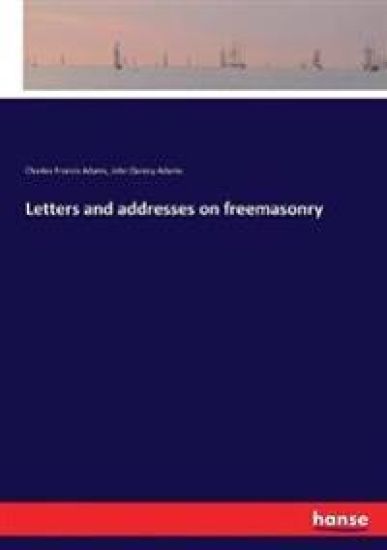
Letters and addresses on freemasonry
Charles Francis Adams; John Quincy Adams
Hansebooks
2017
pokkari
Letters and addresses on freemasonry is an unchanged, high-quality reprint of the original edition of 1875. Hansebooks is editor of the literature on different topic areas such as research and science, travel and expeditions, cooking and nutrition, medicine, and other genres. As a publisher we focus on the preservation of historical literature. Many works of historical writers and scientists are available today as antiques only. Hansebooks newly publishes these books and contributes to the preservation of literature which has become rare and historical knowledge for the future.
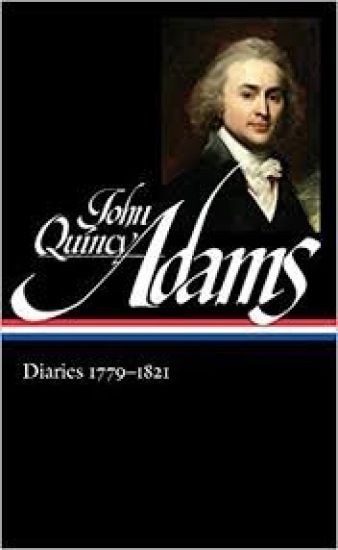
For the 250th anniversary of John Quincy Adams's birth, a landmark new selected edition of an American masterpiece: the incomparable self-portrait of a man and his times from the Revolution to the coming of the Civil War. The diary of John Quincy Adams is one of the most extraordinary works in American literature. Begun in 1779 at the age of twelve and kept more or less faithfully until his death almost 70 years later, and totaling some fifteen thousand closely-written manuscript pages, it is both an unrivaled record of historical events and personalities from the nation's founding to the antebellum era and a masterpiece of American self-portraiture, tracing the spiritual, literary, and scientific interests of an exceptionally lively mind. Now, for the 250th anniversary of Adams's birth, Library of America and historian David Waldstreicher present a two-volume reader's edition of diary selections based for the first time on the original manuscripts, restoring personal and revealing passages suppressed in earlier editions. Volume I begins during the American Revolution, with Adams's first entry, as he prepares to embark on a perilous wartime voyage to Europe with his father, diplomat John Adams, and records his early impressions of Franklin and Jefferson and of Paris on the eve of revolution; it details his abbreviated but eventful years of study at Harvard and his emergence into the world of politics in his own right, as American minister to the Netherlands and to Prussia, and then as a U. S. senator from Massachusetts; and it reveals a young man at war with his passions, before finding love with the remarkable Louisa Catherine Johnson. In passages that form a kind of real-world War and Peace, the diary follows the young married couple to St. Petersburg, where as U. S. minister Adams is a witness to Napoleon's invasion of Russia. Its account of the negotiations at Ghent to end the War of 1812, where Adams leads the American delegation, is the perhaps the most detailed and dramatic picture of a diplomatic confrontation ever recorded. Volume 1 concludes with his elevation as Secretary of State under James Monroe, as he takes the fore in a fractious cabinet and emerges as the principal architect of what will become known as the Monroe Doctrine. LIBRARY OF AMERICA is an independent nonprofit cultural organization founded in 1979 to preserve our nation’s literary heritage by publishing, and keeping permanently in print, America’s best and most significant writing. The Library of America series includes more than 300 volumes to date, authoritative editions that average 1,000 pages in length, feature cloth covers, sewn bindings, and ribbon markers, and are printed on premium acid-free paper that will last for centuries.

Experiences of the Higher Christian Life in the Baptist Denomination
John Quincy Adams
Hansebooks
2017
pokkari
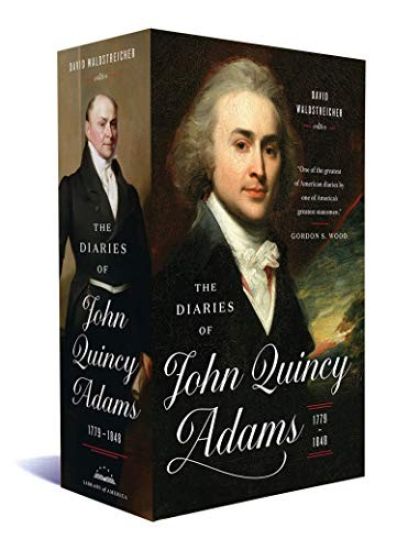
For the 250th anniversary of John Quincy Adams's birth, a landmark newselectededition of an American masterpiece:the incomparable self-portrait of a man and his times from the Revolution tothe coming of the Civil War. The diary of John Quincy Adams is one of the most extraordinary works in American literature. Begun in 1779 at the age of twelve and kept more or less faithfully until his death almost 70 years later, and totaling some fifteen thousand closely-written manuscript pages, it is both an unrivaled record of historical events and personalities from the nation's founding to the antebellum era and a masterpiece of American self-portraiture, tracing the spiritual, literary, and scientific interests of an exceptionally lively mind. Now, for the 250th anniversary of Adams's birth, Library of America and historian David Waldstreicher present a two-volume reader's edition of diary selections based for the first time on the original manuscripts, restoring personal and revealing passages suppressed in earlier editions. Volume I begins during the American Revolution, with Adams's first entry, as he prepares to embark on a perilous wartime voyage to Europe with his father, diplomat John Adams, and records his early impressions of Franklin and Jefferson and of Paris on the eve of revolution; it details his abbreviated but eventful years of study at Harvard and his emergence into the world of politics in his own right, as American minister to the Netherlands and to Prussia, and then as a U. S. senator from Massachusetts; and it reveals a young man at war with his passions, before finding love with the remarkable Louisa Catherine Johnson. In passages that form a kind of real-world War and Peace, the diary follows the young married couple to St. Petersburg, where as U. S. minister Adams is a witness to Napoleon's invasion of Russia. Its account of the negotiations at Ghent to end the War of 1812, where Adams leads the American delegation, is the perhaps the most detailed and dramatic picture of a diplomatic confrontation ever recorded. Volume 1 concludes with his elevation as Secretary of State under James Monroe, as he takes the fore in a fractious cabinet and emerges as the principal architect of what will become known as the Monroe Doctrine. Volume 2 opens with the political maneuverings within and outside Monroe's cabinet to become his successor, a process that culminates in Adams's election to the presidency by the House of Representatives after the deadlocked four-way contest of 1824. Even as Adams takes the oath of office, rivals Henry Clay, his Secretary of State, John C. Calhoun, his vice president, and an embittered Andrew Jackson, eye the election of 1828. The diary records in candid detail his frustration as his far-sighted agenda for national improvement founders on the rocks of internecine political factionalism, conflict that results in his becoming only the second president, with his father, to fail to secure reelection. After a short-lived retirement, Adams returns to public service as a Congressman from Massachusetts, and for the last seventeen years of his life he leads efforts to resist the extension of slavery and to end the notorious "gag rule" that stifles debate on the issue in Congress. In 1841 he further burnishes his reputation as a scourge of the Slave Power by successfully defending African mutineers of the slave ship Amistad before the Supreme Court. The diary achieves perhaps its greatest force in its prescient anticipation of the Civil War and Emancipation, an "object," as Adams described it during the Missouri Crisis, "vast in its compass, awful in its prospects, sublime and beautiful in its issue." LIBRARY OF AMERICA is an independent nonprofit cultural organization founded in 1979 to preserve our nation's literary heritage by publishing, and keeping permanently in print, America's best and most significant writing. The Library of America series includes more than 300 volumes to date, authoritative editions that average 1,000 pages in length, feature cloth covers, sewn bindings, and ribbon markers, and are printed on premium acid-free paper that will last for centuries.

Narrative of the Life of John Quincy Adams, When in Slavery, and Now as a Freeman
John Quincy Adams
Createspace Independent Publishing Platform
2016
nidottu