Kirjojen hintavertailu – 12 870 586 kirjaa ja 27 kauppaa

Kirjailija

John R. Taylor

Kirjat ja teokset yhdessä paikassa: 25 kirjaa, julkaisuja vuosilta 1996–2025, suosituimpiin kuuluu Orson Welles. Vertaile teosten hintoja ja tarkista saatavuus suomalaisista kirjakaupoista.

Nimi esiintyy myös muodoissa: John R Taylor

25 kirjaa

Kirjojen julkaisuvuodet: 1996–2025.

Linguistic Categorization

Linguistic Categorization

John R. Taylor

Oxford University Press
2003
nidottu
This text provides an introduction to the field of cognitive linguistics. It explores the far-reaching implications of Eleanor Rosch's seminal work on categorization and prototype theory, extending the application of prototype theory from lexical semantics to morphology, syntax and phonology.
Cognitive Grammar

Cognitive Grammar

John R. Taylor

Oxford University Press
2002
nidottu
'Cognitive Grammar' is a theory of language which has been developing since the late 1970's. Underlying the theory is the assumption that language is inherently symbolic in nature and that a language provides its speakers with a set of resources for relating phonological structures with semantic structures. John R. Taylor introduces the theory of Cognitive Grammar, placing it in the context of current theoretical debates about the nature of linguistic knowledge, and relating it to more general trends in 'cognitive' linguistics. The central concepts of the theory are explained in clear, non-technical language, and are applied to in-depth discussions of a range of topics in semantics, syntax, morphology, and phonology. Suggestions for further applications of the theory are contained in the numerous study questions which accompany each of the main chapters.
Possessives in English

Possessives in English

John R. Taylor

Oxford University Press
2001
nidottu
The possessive morpheme in English occurs in a variety of constructions - prenominal possessives (the man's hat, the plane's arrival), postnominal possessives (a friend of mine), -ing nominalizations (without my saying so), and possessive compounds (a girls' school). What does this morpheme actually mean, what is its syntactic category, what is its semantic contribution to the expressions in which it occurs, and how can various restrictions on its use be accounted for? Dr Taylor proposes a unitary account of the possessive morpheme. He takes as his theoretical framework Cognitive Grammar, as developed over the past 15 years by Ronald Langacker and others. In the earlier chapters of the book he introduces and motivates the conceptual apparatus of the theory, and in later chapters he develops a coherent account of the full range of possessive constructions in English. A special feature of the book is that it offers a wide-ranging critique of both traditional and more recent accounts of possessive expressions. Focusing particularly on Government and Binding theory, the author highlights the profound conceptual differences underlying the two theoretical approaches represented by GB and Cognitive Grammar, while also observing some points of convergence between them.

Introduction to Error Analysis, second edition

Introduction to Error Analysis, second edition

John R. Taylor

University Science Books,U.S.
1997
nidottu

Halvin toimitettuna 89,90 €

This best-selling text by John Taylor, now released in itssecond edition, introduces the study of uncertainties to lowerdivision science students. Assuming no prior knowledge, theauthor introduces error analysis through the use of familiarexamples ranging from carpentry to well-known historicexperiments. Pertinent worked examples, simple exercisesthroughout the text, and numerous chapter-ending problems combineto make the book ideal for use in physics, chemistryandengineering lab courses. This book has been translated into nine languagesand has more adoptions than we can count.
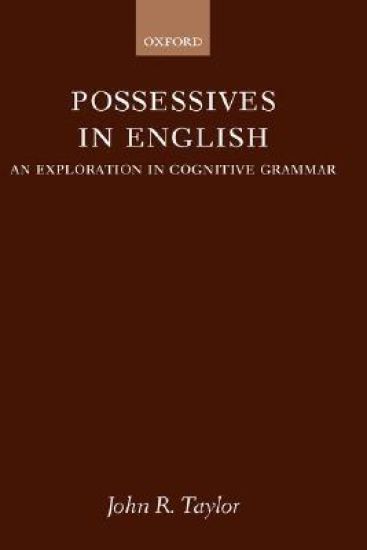
Possessives in English

Possessives in English

John R. Taylor

Clarendon Press
1996
sidottu
This book is about a single morpheme - the possessive morpheme - in English. Often realized as 's, it occurs in a variety of constructions (the man's hat, a friend of mine, without my saying so, a girls' school). What does the morpheme actually mean? What category does it belong to? What is its contribution to the meaning of the expression in which it occurs? And how can we account for the various restrictions on its use? Dr Taylor proposes a unitary account of the morpheme, within the theoretical framework of Cognitive Grammar. In the earlier chapters he introduces and explains the conceptual apparatus of the theory, and in the later chapters he develops a coherent account of the full range of possessive constructions. A special feature of this book is that it also provides a wide-ranging critique of alternative, and especially Government and Binding accounts of possessive expression, highlighting the profound conceptual differences between the contrasting approaches as well as some of the points of convergence.