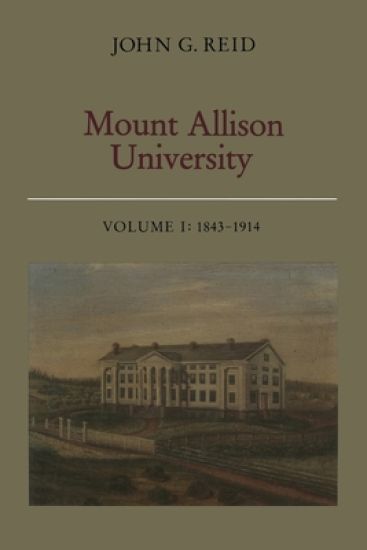
This two-volume work examines the history of Mount Allison University and its antecedent secondary schools from the earliest years to 1963. Mount Allison’s evolution is considered not only for its own internal dynamics but also in the context of the social, economic, and intellectual history of Canada’s Maritime provinces. Volume 1 covers the years up until the beginning of the First World War. The Mount Alliance Wesleyan Academy for boys was opened in Sackville, News Brunswick, in 1843, four years after its foundation had been proposed by the local merchant Charles Frederick Allison. Although it was a Methodist institution, its students came from several religious denominations. In 1854, a branch academy for female students was opened, and eight years later the degree-granting college that ultimately became known as Mount Allison University. Although the college remained for many years the smallest of the three institutions in terms of student numbers, it grew steadily and gradually assumed primacy. From 1872 onwards, its courses were open to women as well as men. This far-reaching concession had antecedents both in the previous arrangements at Mount Allison, where even in 1854 the female branch of the academy had been conceived with the idea of imposing rigorous intellectual standards on its pupils, and in the United States where Wesleyan University (a Methodist institution with which Mount Allison had close ties) had recently admitted women. Elsewhere in Canada and in the British Empire women had a more protracted struggle. Thus it was a Mount Allison student who, in 1875, because the first woman to be awarded a Bachelor’s degree in the British Empire. Fuelled by industrial development in the Maritime region, the last two decades of the nineteenth century were a period of rapid expansion for Mount Allison. The university’s importance as a centre for music and the fine arts both in the Maritimes and in the country as a whole developed; schools of engineering and domestic science were also founded. At the same time, modern trends in religious thought and the problems of industrialization were creating strains, and the social gospel and the impulse for reform began to take hold. Mount Allison experienced problems common to most Canadian denominational colleges and continued the struggle to cope with scholarly and scientific developments in such a way as to maintain its dual commitment to Christianity and to intellectual vigour in teaching and scholarship. As the period of expansion ended early in the twentieth century, both the university and the world were facing even more serious problems. Amid it all, Mount Allison had to grapple with a crisis of identity: to become a large university, or to remain a small denominational college. Or were there other alternatives?