

Kirjailija
John Ruskin
Kirjat ja teokset yhdessä paikassa: 1 233 kirjaa, julkaisuja vuosilta 1849–2026, suosituimpiin kuuluu The Harbours of England. with Thirteen Illustrations by J. M. W. Turner, R.A. Edited by T. J. Wise.. Vertaile teosten hintoja ja tarkista saatavuus suomalaisista kirjakaupoista.
1 233 kirjaa
Kirjojen julkaisuvuodet: 1849–2026.

The King of the Golden River: The Black Brothers
John Ruskin
Createspace Independent Publishing Platform
2018
nidottu
The King of the Golden River or The Black Brothers: A Legend of Stiria by John Ruskin. The King of the Golden River or The Black Brothers: A Legend of Stiria by John Ruskin was originally written in 1841 for the twelve-year-old Effie (Euphemia) Gray, whom Ruskin later married. It was published in book form in 1851, and became an early Victorian classic which sold out three editions. In the "Advertisement to the First Edition", which prefaces it, it is called a fairy tale, one, it might be added, that illustrates the triumph of love, kindness, and goodness over evil; however, it could also be characterised as a fable, a fabricated origin myth and a parable. "The King of the Golden River" is a delightful fairy tale told with all Ruskin's charm of style, his appreciation of mountain scenery, and with his usual insistence upon drawing a moral. None the less, it is quite unlike his other writings. All his life long his pen was busy interpreting nature and pictures and architecture, or persuading to better views those whom he believed to be in error, or arousing, with the white heat of a prophet's zeal, those whom he knew to be unawakened. There is indeed a good deal of the prophet about John Ruskin. Though essentially an interpreter with a singularly fine appreciation of beauty, no man of the nineteenth century felt more keenly that he had a mission, and none was more loyal to what he believed that mission to be.
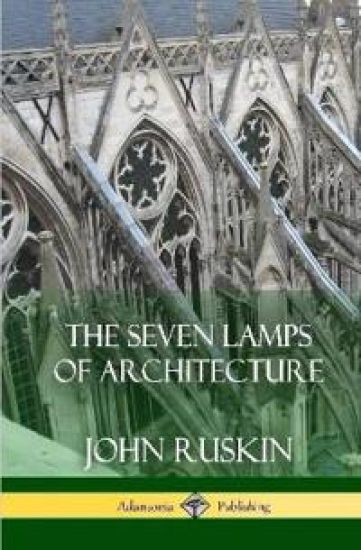
Ruskin's respected treatise on architectural methods and style is presented here complete, with all of the original edition's images. Written and published in the 1840s, this book sees John Ruskin set out his architectural beliefs. A man of deep religiosity, Ruskin was convinced that Gothic architecture was at the very height of beauty and achievement in building design. Even during his prime, Ruskin's opponents felt his staunch, traditionalist take on architecture confining. Despite Ruskin's now-outdated views, this book acts as a detailed history of architecture as it stood in the mid-19th century. The Seven Lamps of the title describe principles which Ruskin viewed essential in building: Sacrifice, Truth, Power, Beauty, Life, Memory, and Obedience. We find within illustrations of structures and flourishes which Ruskin admires most. His opinions on certain newer designs of the industrial era, and the painstaking restoration of ancient artworks, may be summed up in a single word: desecration.
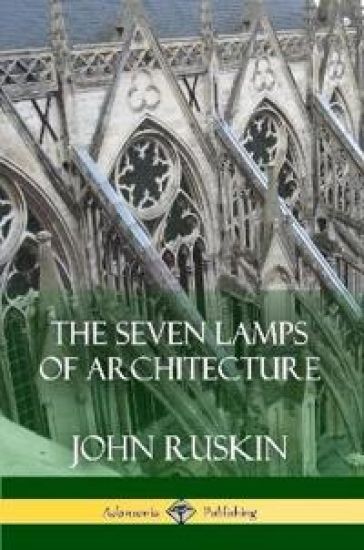
Ruskin's respected treatise on architectural methods and style is presented here complete, with all of the original edition's images. Written and published in the 1840s, this book sees John Ruskin set out his architectural beliefs. A man of deep religiosity, Ruskin was convinced that Gothic architecture was at the very height of beauty and achievement in building design. Even during his prime, Ruskin's opponents felt his staunch, traditionalist take on architecture confining. Despite Ruskin's now-outdated views, this book acts as a detailed history of architecture as it stood in the mid-19th century. The Seven Lamps of the title describe principles which Ruskin viewed essential in building: Sacrifice, Truth, Power, Beauty, Life, Memory, and Obedience. We find within illustrations of structures and flourishes which Ruskin admires most. His opinions on certain newer designs of the industrial era, and the painstaking restoration of ancient artworks, may be summed up in a single word: desecration.

The Elements of Drawing in Three Letters to Beginners by John Ruskin with Illustrations Drawn by the Author. It may perhaps be thought, that in prefacing a Manual of Drawing, I ought to expatiate on the reasons why drawing should be learned; but those reasons appear to me so many and so weighty, that I cannot quickly state or enforce them. With the reader's permission, as this volume is too large already, I will waive all discussion respecting the importance of the subject, and touch only on those points which may appear questionable in the method of its treatment. In the first place, the book is not calculated for the use of children under the age of twelve or fourteen. I do not think it advisable to engage a child in any but the most voluntary practice of art. If it has talent for drawing, it will be continually scrawling on what paper it can get; and should be allowed to scrawl at its own free will, due praise being given for every appearance of care, or truth, in its efforts. It should be allowed to amuse itself with cheap colours almost as soon as it has sense enough to wish for them.
Reproduction of the original: The Seven Lamps of Architecture by John Ruskin
Reproduction of the original: The Stones of Venice by John Ruskin
Reproduction of the original: The Stones of Venice by John Ruskin

Reproduction of the original: Modern Painters by John Ruskin

Reproduction of the original: Aratra Pentelici by John Ruskin
Reproduction of the original: Frondes Agrestes by John Ruskin

Reproduction of the original: Aratra Pentelici by John Ruskin
Reproduction of the original: Modern Painters by John Ruskin
Reproduction of the original: Modern Painters by John Ruskin
Reproduction of the original: The King of the Golden River by John Ruskin
Reproduction of the original: The King of the Golden River by John Ruskin
Reproduction of the original: The Crown of Wild Olive by John Ruskin