Kirjojen hintavertailu – 12 859 819 kirjaa ja 27 kauppaa

Kirjailija

John Staddon

Kirjat ja teokset yhdessä paikassa: 10 kirjaa, julkaisuja vuosilta 2012–2024, suosituimpiin kuuluu The New Behaviorism. Vertaile teosten hintoja ja tarkista saatavuus suomalaisista kirjakaupoista.

10 kirjaa

Kirjojen julkaisuvuodet: 2012–2024.

Scientific Method

Scientific Method

John Staddon

TAYLOR FRANCIS LTD
2024
sidottu
This expanded second edition of Scientific Method shows how science works, fails to work or pretends to work by looking at examples from physics, biomedicine, psychology, sociology and economics. Scientific Method aims to help curious readers understand the idea of science, not by learning a list of techniques but through examples both historical and contemporary. Staddon affirms that if the reader can understand successful studies as well as studies that appear to be scientific but are not, they will become a better judge of the “science” in circulation today. To this end, this new edition includes a new chapter, What is Science?, which points out that science, like any human activity, has its own set of values, with truth being the core. Other new chapters focus on the emergence of AI and machine learning, science and diversity, and behavioral economics. The book also includes textual features such as bullet-points and text boxes on topical issues. Scientific Method is essential reading for students and professionals trying to make sense of the role of science in society, and of the meaning, value and limitations of scientific methodology.

Scientific Method

Scientific Method

John Staddon

TAYLOR FRANCIS LTD
2024
nidottu

Halvin toimitettuna 60,80 €

This expanded second edition of Scientific Method shows how science works, fails to work or pretends to work by looking at examples from physics, biomedicine, psychology, sociology and economics. Scientific Method aims to help curious readers understand the idea of science, not by learning a list of techniques but through examples both historical and contemporary. Staddon affirms that if the reader can understand successful studies as well as studies that appear to be scientific but are not, they will become a better judge of the “science” in circulation today. To this end, this new edition includes a new chapter, What is Science?, which points out that science, like any human activity, has its own set of values, with truth being the core. Other new chapters focus on the emergence of AI and machine learning, science and diversity, and behavioral economics. The book also includes textual features such as bullet-points and text boxes on topical issues. Scientific Method is essential reading for students and professionals trying to make sense of the role of science in society, and of the meaning, value and limitations of scientific methodology.
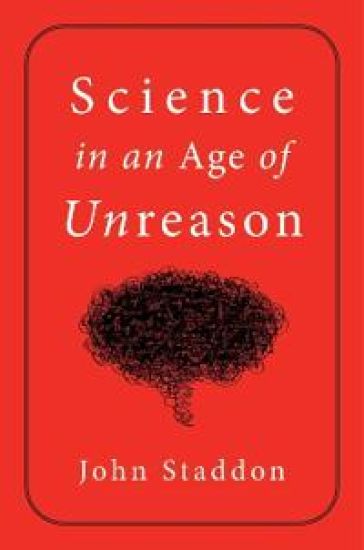
Science in an Age of Unreason

Science in an Age of Unreason

John Staddon

REGNERY PUBLISHING INC
2022
sidottu
Science is undergoing an identity crisis! A renown psychologist and biologist diagnoses our age of wishful, magical thinking and blasts out a clarion call for a return to reason and the search for objective knowledge and truth. Fans of Matt Ridley and Nicholas Wade will adore this trenchant meditation and call to action. Science is in trouble. Real questions in desperate need of answers—especially those surrounding ethnicity, gender, climate change, and almost anything related to ‘health and safety’—are swiftly buckling to the fiery societal demands of what ought to be rather than what is. These foregone conclusions may be comforting, but each capitulation to modernity’s whims threatens the integrity of scientific inquiry. Can true, fact-based discovery be redeemed? In Science in an Age of Unreason, legendary professor of psychology and biology, John Staddon, unveils the identity crisis afflicting today’s scientific community, and provides an actionable path to recovery. With intellectual depth and literary flair, Staddon answers pressing questions, including:Is science, especially the science of evolution, a religion? Can ethics be derived from science at all? How sound is social science, particularly surrounding today’s most controversial topics? How can passions be separated from facts? Informed by decades of expertise, Science in an Age of Unreason is a clarion call to rebirth academia as a beacon of reason and truth in a society demanding its unconditional submission.
The New Behaviorism

The New Behaviorism

John Staddon

Routledge
2021
nidottu
This ground-breaking book presents a brief history of behaviorism, along with a critical analysis of radical behaviorism, its philosophy and its applications to social issues. This third edition is much expanded and includes a new chapter on experimental method as well as longer sections on the philosophy of behaviorism. It offers experimental and theoretical examples of a new approach to behavioral science. It provides an alternative philosophical and empirical foundation for a psychology that has rather lost its way. The mission of the book is to help steer experimental psychology away from its current undisciplined indulgence in "mental life" toward the core of science, which is an economical description of nature: parsimony, explain much with little. The elementary philosophical distinction between private and public events, even biology, evolution and animal psychology are all ignored by much contemporary cognitive psychology. The failings of radical behaviorism as well as a philosophically defective cognitive psychology point to the need for a new theoretical behaviorism, which can deal with problems such as "consciousness" that have been either ignored, evaded or muddled by existing approaches. This new behaviorism provides a unified framework for the science of behavior that can be applied both to the laboratory and to broader practical issues such as law and punishment, the health-care system, and teaching.
The New Behaviorism

The New Behaviorism

John Staddon

Routledge
2021
sidottu
This ground-breaking book presents a brief history of behaviorism, along with a critical analysis of radical behaviorism, its philosophy and its applications to social issues. This third edition is much expanded and includes a new chapter on experimental method as well as longer sections on the philosophy of behaviorism. It offers experimental and theoretical examples of a new approach to behavioral science. It provides an alternative philosophical and empirical foundation for a psychology that has rather lost its way. The mission of the book is to help steer experimental psychology away from its current undisciplined indulgence in "mental life" toward the core of science, which is an economical description of nature: parsimony, explain much with little. The elementary philosophical distinction between private and public events, even biology, evolution and animal psychology are all ignored by much contemporary cognitive psychology. The failings of radical behaviorism as well as a philosophically defective cognitive psychology point to the need for a new theoretical behaviorism, which can deal with problems such as "consciousness" that have been either ignored, evaded or muddled by existing approaches. This new behaviorism provides a unified framework for the science of behavior that can be applied both to the laboratory and to broader practical issues such as law and punishment, the health-care system, and teaching.
Scientific Method

Scientific Method

John Staddon

Routledge
2017
nidottu
This book shows how science works, fails to work, or pretends to work, by looking at examples from such diverse fields as physics, biomedicine, psychology, and economics. Social science affects our lives every day through the predictions of experts and the rules and regulations they devise. Sciences like economics, sociology and health are subject to more ‘operating limitations’ than classical fields like physics or chemistry or biology. Yet, their methods and results must also be judged according to the same scientific standards. Every literate citizen should understand these standards and be able to tell the difference between good science and bad. Scientific Method enables readers to develop a critical, informed view of scientific practice by discussing concrete examples of how real scientists have approached the problems of their fields. It is ideal for students and professionals trying to make sense of the role of science in society, and of the meaning, value, and limitations of scientific methodology in the social sciences.
Scientific Method

Scientific Method

John Staddon

Routledge
2017
sidottu
This book shows how science works, fails to work, or pretends to work, by looking at examples from such diverse fields as physics, biomedicine, psychology, and economics. Social science affects our lives every day through the predictions of experts and the rules and regulations they devise. Sciences like economics, sociology and health are subject to more ‘operating limitations’ than classical fields like physics or chemistry or biology. Yet, their methods and results must also be judged according to the same scientific standards. Every literate citizen should understand these standards and be able to tell the difference between good science and bad. Scientific Method enables readers to develop a critical, informed view of scientific practice by discussing concrete examples of how real scientists have approached the problems of their fields. It is ideal for students and professionals trying to make sense of the role of science in society, and of the meaning, value, and limitations of scientific methodology in the social sciences.
The Englishman

The Englishman

John Staddon

The University of Buckingham Press
2016
nidottu
"Although I have been basically an academic for most of my life, the way I got there has taken some surprising turns." An unsuspected ancestry, playing in WW2 London, comical schooldays, and a spell in colonial Africa are just a few of the childhood moments described in John Staddon's memoir The Englishman. This is not just another transatlantic autobiography from a British working-class kid who made his name in the USA. It's a witty and entertaining romp through the subject he has made his own. By way of his wide-ranging interests in biology, artificial intelligence, economics, philosophy and behavioural neuroscience, John Staddon introduces and explores his most important work on how animals learn. He discusses the exciting field of behavioural psychobiology, explains theoretical research on choice and interval timing and debates so-called superstition in the learned behaviour of pigeons, rats, fish - and people. The Englishman is an entertaining life story interwoven with expansive thoughts on the fascinating field of behavioural psychology.
Unlucky Strike

Unlucky Strike

John Staddon; David Hockney

The University of Buckingham Press
2014
nidottu
Remember fifty years ago when everyone smoked? Since tobacco found its way into Europe in the sixteenth century, smoking has been a controversial issue. Fifty years ago, almost everyone smoked, and fifty years before that, smokers were in the doghouse; up until the early twentieth century, cigarettes were illegal in a number of U. S. states. Needless to say, smoking has always been a ready source of revenue. It has also been a source of health concerns, both real and imagined. This mixture of pleasure, money and risk that comes with the act of smoking means that it's rarely treated fairly by politicians, health professionals or the public. Nowadays, tough anti-smoking laws are to be obeyed in most corners of the globe. The misinformation about, and unreasoning hostility directed at, smoking and smokers is one of the major concerns of this book. After all, smoking has no public cost. Isn't it just the individual smokers who are at risk? Prompted by this burgeoning fascination, Staddon looks further into the facts. And the more he looks, the weaker the case against smoking as a public health issue becomes. Is ETS really dangerous to children? And if so, how can science prove it? And if smoking has no public cost and the medical case for third-party harm is weak, why are smokers still being victimised? In this provocative, thought-provoking book, Staddon is determined to uncover the truth about smoking. But the truth's not always pretty.
The Malign Hand of the Markets: The Insidious Forces on Wall Street that are Destroying Financial Markets – and What We Can Do About it
WHAT’S THE MATTER WITH WALL STREET? And How Do We Fix It? Even after the global financial meltdown of 2008, economists have clung to Adam Smith’s “Invisible Hand” theory of an always selfregulating market that benefits private and public interests alike. But Duke University professor John Staddon is here to tell that there’s also another, darker force at work on Wall Street—a “Malign Hand” that guides all human interactions, including our finances. Combining psychology, behavioral economics, and other sciences, Staddon’s explosive new theory reveals the underlying principles behind the economic crisis, exposing the invisible mechanisms that drive our markets today. You’ll learn how we can:Prevent market bubbles from buildingDistinguish voluntary from involuntary market risk and regulate them differentlySimplify and restore Glass-SteagallUnderstand market mechanisms through Darwinian dynamicsModerate boom and bust cycles and make financial markets sustainableUsing economic theory, global market trends, and psychological research, Staddon’s electrifying book is both analytical and prescriptive—with a number of possible solutions to our most pressing economic concerns. You’ll learn about the wrong assumptions that underlie our present system, basic rules for managing risk, and the real reasons behind the market’s greatest successes and biggest disasters. You’ll hear surprising insights into the delicate relationship between Wall Street and Washington—with assessments of the bailouts, the Dodd-Frank bill, and other attempts at financial regulation. Best of all, you’ll discover realistic solutions that can stop the boom-and-bust cycle once and for all. Compelling, controversial, and remarkably thorough, The Malign Hand of the Markets will change the way we plan our future, manage our finances, and build our fortunes.