

Kirjailija
John Strauss
Kirjat ja teokset yhdessä paikassa: 7 kirjaa, julkaisuja vuosilta 2010–2025, suosituimpiin kuuluu And So . . .. Vertaile teosten hintoja ja tarkista saatavuus suomalaisista kirjakaupoista.
7 kirjaa
Kirjojen julkaisuvuodet: 2010–2025.

Another old guy who thinks he has something interesting to say? Well, maybe. I have had an interesting life though, a mix of stuff leading to becoming a psychiatrist and a professor at Yale. But other things too, part of a life more generally. Being a worker for the gas company on a team digging up decaying pipelines where the gas tainted earth has a horrible smell. And even more about life generally, hitchhiking for over 10,000 miles around the central and west of the US and around Western Europe, often an incredible experience where you get in the front seat of a car with someone you've never met and you both start to talk about what you're doing here, what your life is like, and what you're looking for. The amazing experience of learning to be a doctor and encountering all those people who are dealing with being what we call "patients." A year spent studying with the developmental psychologist Jean Piaget in Geneva Switzerland, many many months in that incredible city Paris, among other things, learning to speak, write, and publish in that language, French, which can be so beautiful that even when the woman on the bus wants to get off and says La porte, still vous plait ("the door please") it can sound like the beginning of an aria from La Boheme. But all these are not just experiences, they are ways of being in contact with an incredible diversity of people and a huge diversity of ways of being. And now the experience of getting older and in my 90's more feeble and seeing the world in a still different way, from a different perspective.


Something particularly powerful happened to the author the first time he went to France in 1952 at the age of twenty. It was a kind of liberation, like for a drop of water finding its optimal shape. It was not by any means trouble-free, yet being in France over the years was always liberating, helping him be himself. In this process, his efforts to learn the beauties of the French language played a major role. This book was a part of those efforts, as a way to help learning French, yes, but also in finding what felt to be the optimal shape of his identity.

How do you truly understand what it means to be a person, any person, a person struggling with mental illness? The author explores that difficult question in this "autobiography of sorts", not only from his perspective as a psychiatrist, but as someone whose mother was afflicted with a long-standing severe mental illness, and as someone with dedicated interest in both the sciences and the humanities. Early in his career, Dr. Strauss contributed the "multiaxial" structure to a diagnostic manual for psychiatry in an effort to include the many aspects of human functioning in psychiatric thinking. He showed with his colleague William Carpenter that people with schizophrenia can get better, and he has written extensively on how people with severe psychiatric disorders experience their lives and act to contribute to the processes of their own improvement. Using the lens of his medical training and years spent treating patients, as well as stories and perspectives gained from the various experiences in his life more generally - such as time spent hitchhiking for three months and 9000 miles around the US, extended periods in Paris working and writing with French friends including noted psychiatrists and a clown who works in an adult palliative care center - this autobiography serves to combine these into an approach towards understanding people and mental health as a human science, an approach that uses the rigors of medicine along with an appreciation of the depth and complexity of everyday life.

How do you truly understand what it means to be a person, any person, a person struggling with mental illness? The author explores that difficult question in this "autobiography of sorts", not only from his perspective as a psychiatrist, but as someone whose mother was afflicted with a long-standing severe mental illness, and as someone with dedicated interest in both the sciences and the humanities. Early in his career, Dr. Strauss contributed the "multiaxial" structure to a diagnostic manual for psychiatry in an effort to include the many aspects of human functioning in psychiatric thinking. He showed with his colleague William Carpenter that people with schizophrenia can get better, and he has written extensively on how people with severe psychiatric disorders experience their lives and act to contribute to the processes of their own improvement. Using the lens of his medical training and years spent treating patients, as well as stories and perspectives gained from the various experiences in his life more generally - such as time spent hitchhiking for three months and 9000 miles around the US, extended periods in Paris working and writing with French friends including noted psychiatrists and a clown who works in an adult palliative care center - this autobiography serves to combine these into an approach towards understanding people and mental health as a human science, an approach that uses the rigors of medicine along with an appreciation of the depth and complexity of everyday life.
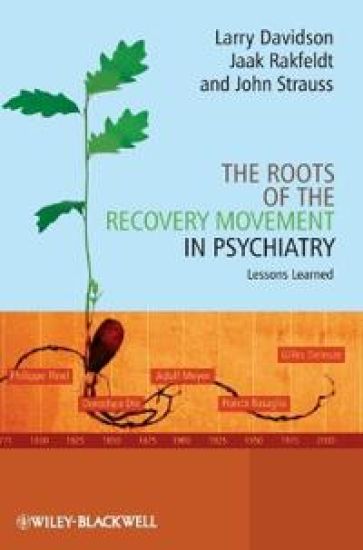
The Roots of the Recovery Movement in Psychiatry
Larry Davidson; Jaak Rakfeldt; John Strauss
John Wiley Sons Inc
2010
sidottu
As the global psychiatric community enters a new era of transformation, this book explores lessons learned from previous efforts with the goal of “getting it right” this time. In response to the common refrain that we know about and ‘do’ recovery already, the authors set the recovery movement within the conceptual framework of major thinkers and achievers in the history of psychiatry, such as Philippe Pinel, Dorothea Dix, Adolf Meyer, Harry Stack Sullivan, and Franco Basaglia. The book reaches beyond the usual boundaries of psychiatry to incorporate lessons from related fields, such as psychology, sociology, social welfare, philosophy, political economic theory, and civil rights. From Jane Addams and the Settlement House movement to Martin Luther King, Jr., and Gilles Deleuze, this book identifies the less well-known and less visible dimensions of the recovery concept and movement that underlie concrete clinical practice. In addition, the authors highlight the limitations of previous efforts to reform and transform mental health practice, such as the de-institutionalization movement begun in the 1950s, in the hope that the field will not have to repeat these same mistakes. Their thoughtful analysis and valuable advice will benefit people in recovery, their loved ones, the practitioners who serve them, and society at large. Foreword by Fred Frese, Founder of the Community and State Hospital Section of the American Psychological Association and past president of the National Mental Health Consumers' Association