Kirjojen hintavertailu – 12 859 828 kirjaa ja 27 kauppaa

Kirjailija

John Tyndall

Kirjat ja teokset yhdessä paikassa: 314 kirjaa, julkaisuja vuosilta 1867–2026, suosituimpiin kuuluu Researches on Diamagnetism and Magne-crystallic Action. Vertaile teosten hintoja ja tarkista saatavuus suomalaisista kirjakaupoista.

314 kirjaa

Kirjojen julkaisuvuodet: 1867–2026.

Heat Considered as a Mode of Motion

Heat Considered as a Mode of Motion

John Tyndall

Cambridge University Press
2014
pokkari
Professor of natural philosophy at the Royal Institution between 1853 and 1887, the physicist and mountaineer John Tyndall (1820–93) passionately sought to share scientific understanding with the Victorian public. A lucid and highly regarded communicator, he lectured on such topics as heat, light, magnetism and electricity. In this collection of twelve lectures, first published in 1863, Tyndall discusses the general properties of heat and its associated physical processes, such as convection, conduction and radiation. He presents concepts so that they are intelligible to non-specialists, and helpful illustrations of laboratory equipment accompany his descriptions of experiments and phenomena. Throughout, he explains the research and discoveries of renowned scientists, including Sir Humphry Davy, Julius von Mayer, James Prescott Joule, and Hermann von Helmholtz. Several of Tyndall's other publications, from his lectures on sound to his exploration of alpine glaciers, are also reissued in this series.

Contributions to Molecular Physics in the Domain of Radiant Heat
Professor of natural philosophy for the Royal Institution between 1853 and 1887, the physicist John Tyndall (1820–93) passionately sought to share scientific understanding with the Victorian public. Reissued here is the collected research he contributed to the Philosophical Transactions of the Royal Society and other journals. Published in 1872, it complements Tyndall's Heat Considered as a Mode of Motion (1863), which is also reissued in this series. Here each memoir is preceded by a short summary, explaining what he discovered and his reasons for embarking on the investigations in question. Accompanying the detailed descriptions of experimental methods are illustrations of the scientific apparatus used. Tyndall also shows how his work built upon previous research, acknowledging the insights of distinguished scientists such as William Herschel and Macedonio Melloni. In particular, he discusses at length his academic debates with Heinrich Gustav Magnus.
Sound

Sound

John Tyndall

Cambridge University Press
2014
pokkari
Professor of natural philosophy at the Royal Institution between 1853 and 1887, the British physicist and mountaineer John Tyndall (1820–93) passionately sought to share scientific understanding with the Victorian public. A lucid and highly regarded communicator, he lectured on such topics as heat, light, magnetism and electricity. In this collection of eight lectures, first published in 1867, Tyndall explains numerous acoustic phenomena for a non-specialist audience. Emphasising the practical nature of scientific enquiry, he describes experiments throughout and includes many illustrations of laboratory equipment. The lectures discuss the general properties of sound, how it travels, how noise and music differ, how gas flames can produce musical notes, and much more. Several of Tyndall's other publications, from his work on radiant heat to his exploration of alpine glaciers, are also reissued in this series.
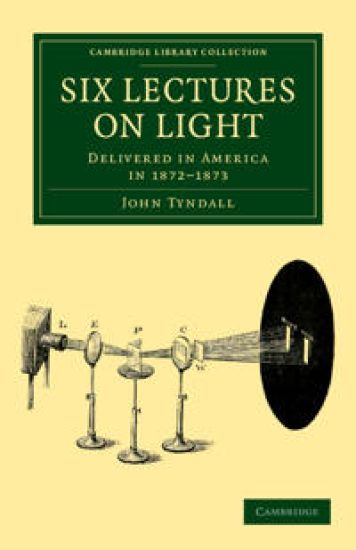
Six Lectures on Light

Six Lectures on Light

John Tyndall

Cambridge University Press
2011
pokkari
Born in Leighlinbridge in Ireland, John Tyndall (1820–93) was a brilliant nineteenth-century experimental physicist and gifted science educator. He worked initially as a draughtsman, then spent a year teaching at an English school before attending the University of Marburg to study physics and chemistry. Tyndall carried out important research on magnetism, light and bacteriology. Among his many significant achievements, he demonstrated the greenhouse effect in Earth's atmospheric gases using absorption spectroscopy. He was a skilled and entertaining educator and as Professor of Natural Philosophy at the Royal Institution he gave many public lectures and demonstrations of science. Published in 1873, this book features six accessible lectures on light. They explore a wide range of ideas in a non-technical way, from basic scientific theories through magnetism and light scattering, to analytical spectroscopy. The book ends with a series of essays on special topics, and includes a detailed index.
New Fragments

New Fragments

John Tyndall

Cambridge University Press
2011
pokkari
Born in Leighlinbridge in Ireland, John Tyndall (1820–93) was a brilliant nineteenth-century experimental physicist and gifted science educator. He worked initially as a draughtsman, then spent a year teaching at an English school before attending the University of Marburg to study physics and chemistry. Tyndall carried out important research on magnetism, light and bacteriology. Among his many significant achievements, he demonstrated the greenhouse effect in Earth's atmospheric gases using absorption spectroscopy. He was a skilled and entertaining educator and as Professor of Natural Philosophy at the Royal Institution he gave many public lectures and demonstrations of science. In this engaging potpourri of essays published in 1893, Tyndall's prose enlivens subjects as diverse as the life of Louis Pasteur, observing the Sabbath, the prevention of phthisis (tuberculosis), personal experiences of Alpine mountaineering, and the science of rainbows.
Hours of Exercise in the Alps

Hours of Exercise in the Alps

John Tyndall

Cambridge University Press
2011
pokkari
John Tyndall (1820–93) was a prominent physicist, particularly noted for his studies of thermal radiation and the atmosphere. He was a prolific writer and lecturer, who was able to bring experimental physics to a wide audience. While researching his 1860 work, The Glaciers of the Alps, he became a proficient climber, and this work, first published in 1871, combines climbing expeditions in Switzerland with comments on glaciation and geology. It was extremely popular, with a second edition in the same year, and German and American editions in 1872. He was one of a group of noted Alpinists of the period, making the first ascent of the Weisshorn in Switzerland and finally conquering the Matterhorn in 1868, three years after its first ascent. This account of Victorian climbing expeditions makes fascinating reading, and shows the length an experimental scientist was prepared to go in search of knowledge.
Climbing the Weisshorn - A Historical Account of a Mountaineer's Attempt to Climb One of the Highest Peaks in the Alps
This antiquarian book contains a historical account of a mountaineer's attempt to climb one of the highest peaks in the alps, the Weisshorn. Full of thrilling tales and fascinating anecdotes of mountaineering derring-do, this text offers a unique insight into mountaineering, and will be of considerable value to the discerning mountaineer, as well as those with an interest in the development of the practice. John Tyndall (1820 - 1893) was a seminal nineteenth century physicist whose initial esteem amongst the scientific community arose from his study of diamagnetism. Subsequent to this he made discoveries in infrared radiation and the physical properties of air. Many antiquarian book such as this are increasingly rare and expensive, and it is with this in mind that we are republishing this volume now in an affordable, modern edition, complete with a new prefatory biography of the author.