Kirjojen hintavertailu – 12 903 725 kirjaa ja 27 kauppaa

Kirjailija

John Zysman

Kirjat ja teokset yhdessä paikassa: 4 kirjaa, julkaisuja vuosilta 1984–2015, suosituimpiin kuuluu Governments, Markets, and Growth. Vertaile teosten hintoja ja tarkista saatavuus suomalaisista kirjakaupoista.

4 kirjaa

Kirjojen julkaisuvuodet: 1984–2015.

Can Green Sustain Growth?

Can Green Sustain Growth?

John Zysman; Mark Huberty

Stanford University Press
2015
pokkari
Green growth has proven to be politically popular, but economically elusive. Can Green Sustain Growth? asks how we can move from theoretical support to implementation, and argues that this leap will require radical experimentation. But systemic change is costly, and a sweeping shift cannot be accomplished without political support, not to mention large-scale cooperation between business and government. Insightful and timely, this book brings together eight original, international case studies to consider what we can learn from the implementation of green growth strategies to date. This analysis reveals that coalitions for green experimentation emerge and survive when they link climate solutions to specific problems with near-term benefits that appeal to both environmental and industrial interests. Based on these findings, the volume delivers concrete policy recommendations for the next steps in the necessary shift toward sustainable prosperity.
Can Green Sustain Growth?

Can Green Sustain Growth?

John Zysman; Mark Huberty

Stanford University Press
2013
sidottu
Green growth has proven to be politically popular, but economically elusive. Can Green Sustain Growth? asks how we can move from theoretical support to implementation, and argues that this leap will require radical experimentation. But systemic change is costly, and a sweeping shift cannot be accomplished without political support, not to mention large-scale cooperation between business and government. Insightful and timely, this book brings together eight original, international case studies to consider what we can learn from the implementation of green growth strategies to date. This analysis reveals that coalitions for green experimentation emerge and survive when they link climate solutions to specific problems with near-term benefits that appeal to both environmental and industrial interests. Based on these findings, the volume delivers concrete policy recommendations for the next steps in the necessary shift toward sustainable prosperity.
The Politics of Greed

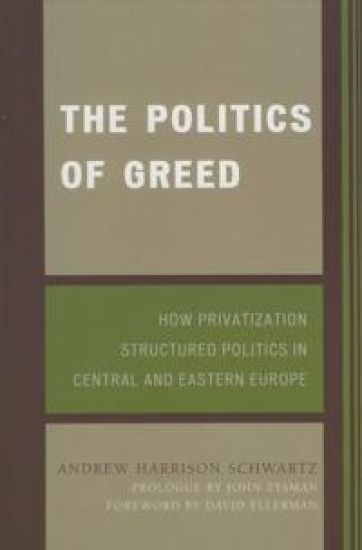
The Politics of Greed

Andrew Harrison Schwartz; John Zysman; David Ellerman

Rowman Littlefield Publishers
2006
nidottu
With the dissolution of the Soviet Empire, it seemed that market capitalism had triumphed and that democracy might replace authoritarian regimes. Economic reformers in the former Eastern Bloc rushed to liberalize prices and transfer state assets to private hands. They assumed that private owners in a market setting would have no choice but to behave rationally—that is, to invest in restructuring privatized enterprises so as to maximize profits. They also assumed that these owners would perceive a stable institutional environment as conducive to economic success and thus become a powerful lobby in favor of the rule of law, paving the way for democracy. The post-communist reality turned out to be very different. Private owners found that in a weak state with limited laws and regulations and ineffective corporate governance structures, it was more lucrative to steal enterprise assets and exploit opportunities for arbitrage than to restructure enterprises. The lesson learned is that not all forms of private ownership are the same. As this book's in-depth political history of privatization in Central and Eastern Europe demonstrates, the way that assets are privatized matters, both with respect to national economic performance and the successful development of the rule of law. Andrew Harrison Schwartz had unprecedented access to high-level Czech government officials during the Czech Republic's privatization process. This book is the result of the unique insights he gained and the innovative analytical framework he subsequently developed—ownership regime theory—which for the first time places ownership structures at the center of political transition analysis. Engaging and important, The Politics of Greed applies ownership regime theory to a broad range of post-communist privatization cases, including those of the Czech Republic, Poland, Hungary, Russia, and Ukraine.
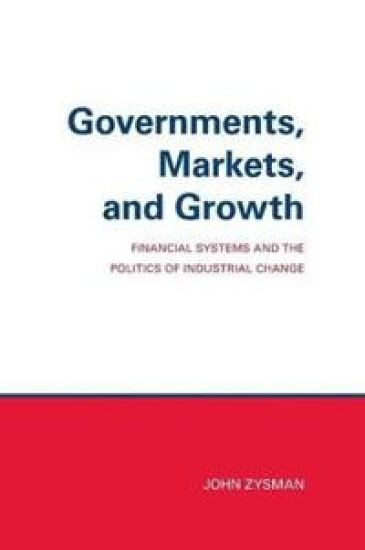
Governments, Markets, and Growth

Governments, Markets, and Growth

John Zysman

Cornell University Press
1984
pokkari
The deterioration in the economic performance of the advanced industrial democracies during the 1970s provoked an intense debate about the role of government in economic adjustment and growth. In Governments, Markets, and Growth, John Zysman makes a significant contribution to our understanding of these critical international issues by demonstrating that there is a direct relationship between a nation's financial system and its government's ability to restart the growth engine. Professor Zysman argues that there are three distinct types of financial systems, each with different consequences for the political ties between financial markets, industry, and government. Zysman tests his argument by analyzing and comparing the patterns of industrial adjustment in five advanced nations. He contrasts the differing strategies of industrial adjustments primarily in France and Great Britain, but also in Japan, West Germany, and the United States. Governments, Markets, and Growth will be invaluable to the international banking and business community, a wide variety of government officials, and students of political science, economics, and business administration.