Kirjojen hintavertailu – 12 903 739 kirjaa ja 27 kauppaa

Kirjailija

Jolyon Connell

Kirjat ja teokset yhdessä paikassa: 5 kirjaa, julkaisuja vuosilta 2012–2018, suosituimpiin kuuluu The Connell Guide To Charles Dickens's Great Expectations. Vertaile teosten hintoja ja tarkista saatavuus suomalaisista kirjakaupoista.

5 kirjaa

Kirjojen julkaisuvuodet: 2012–2018.

The Connell Guide To Charles Dickens's Great Expectations

The Connell Guide To Charles Dickens's Great Expectations

John Sutherland; Jolyon Connell

Connell Guides
2012
pokkari
Great Expectations is one of the best-selling Victorian novels of our time. No Dickens work, with the exception of A Christmas Carol, has been adapted more for both film and television. It has been as popular with critics as it has with the public. In 1937, George Bernard Shaw called the novel Dickens's "most compactly perfect book". John Lucas describes it as "the most perfect and the most beautiful of all Dickens's novels", Angus Wilson as "the most completely unified work of art that Dickens ever produced". Great Expectations has been so successful partly because it's an exciting story. Dickens always had a keen eye on the market and subscribed to Wilkie Collins's advice: "make 'em laugh, make 'em cry, above all make 'em wait." From the violent opening scene on the marshes to the climax of Magwitch's attempted escape on the Thames, the story is full of suspense, mystery and drama. But while these elements of Great Expectations have ensured its popularity, it is also a novel which, as this guide will seek to show, raises profound questions not just about the nature of Victorian society but about the way human relationships work and the extent to which people are shaped by their childhoods and the circumstances in which they grow up.
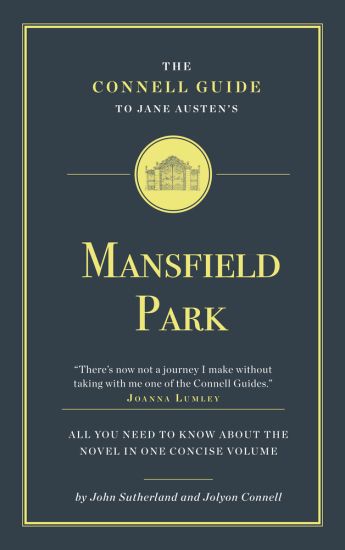
The Connell Guide to Jane Austen's Mansfield Park

The Connell Guide to Jane Austen's Mansfield Park

John Sutherland; Jolyon Connell

Connell Guides
2018
pokkari
Few novels have divided critics more than Mansfield Park. It has been fiercely argued over for more than 200 years, and with good reason: it is open to radically different interpretations. At its broadest, it is a novel about the condition of England, setting up an opposition, as the Austen biographer Claire Tomalin has put it, between someone with strongly held religious and moral principles who will not consider a marriage that is not based on true feeling, and is revolted by sexual immorality, and "a group of worldly, highly cultivated, entertaining and well-to-do young people who pursue pleasure without regard for religious or moral principles". Many have dismissed the heroine, Fanny Price, as a mere picture of goodness, but the author of this guide, John Wiltshire, one of the most respected and original of modern Austen critics, dismisses this argument. "The still, principled fulcrum of moral right, celebrated and excoriated by earlier critics," he says, is now "understood to be a trembling, unstable entity", an "erotically driven and conflicted figure". Indeed, in part at least, this is a novel about female desire - the plot revolves around the passionate feelings of two young women, Fanny and Maria. The argument that it is a straightforward defence of the conservative way of life is hard to sustain; it is more plausibly seen as questioning the whole patriarchal basis of society, and in particular the extent to which women were trapped by a system over which they had no control. Far from being devoid of irony, it is now frequently, and perhaps rightly, thought of as the most ironic of all Austen's novels.
The Connell Guide To Jane Austen's Emma

The Connell Guide To Jane Austen's Emma

John Sutherland; Jolyon Connell

Connell Guides
2012
pokkari
"A heroine whom no-one but myself will much like," the author famously proclaimed. In fact, in any league of likeability Miss Woodhouse is streets ahead of Miss Fanny - the ostentatiously "meek" heroine of Mansfield Park. Meek Emma is not. Indeed it is her sense of absolute sovereignty over her little world of Highbury - her right, as she presumes, to dispose of the marriage choices of those in her circle - which brings her to grief. And that grief, by the familiar course of the heroine's moral education in Austen's fiction, makes her, through remorse and repentance, a mature woman capable of forming correct judgements. Not least about whom Miss Woodhouse herself will marry. Emma, of all the six great novels, is the one which conforms most closely to Austen's famous formula that "three or four families in a country village is the very thing to work on". Emma is, by general agreement, the "quietest" of the novels. Some have complained that there is not enough of a story in it, but others, as this guide shows, have found the plot in Emma the most successful Austen achieved. It is, for example, unusual among the sextet in playing a cunning trick on the reader who - unless they are sharp (sharper certainly than Miss Woodhouse) - may well be deluded as to which eligible young (or less than young) man the heroine will end up spending the rest of her life with. Or whether, given her frequently uttered distaste for marriage, she will end up the only unwed of the six heroines at the end of it all.
The Connell Guide To F. Scott Fitzgerald's The Great Gatsby

The Connell Guide To F. Scott Fitzgerald's The Great Gatsby

John Sutherland; Jolyon Connell

Connell Guides
2012
pokkari
When The Great Gatsby was first published, in 1925, reviews were mixed. H. L. Mencken called it "no more than a glorified anecdote". L. P. Hartley, author of The Go-Between, thought Fitzgerald deserved "a good shaking": "The Great Gatsby is evidently not a satire; but one would like to think that Mr Fitzgerald's heart is not in it, that it is a piece of mere naughtiness." Yet, gradually the book came to be seen as one of the greatest - if not the greatest - of American novels. Why? What is it that makes this story of a petty hoodlum so compelling? Why has a novel so intimately rooted in its own time "lasted" into ours? What is it that posterity, eight decades later, finds so fascinating in this chronicle of the long-gone "Jazz Age", flappers, speakeasies and wild parties? It is, after all, scarcely a novel at all, more a long short story. But it has a power out of all proportion to its length. It is beautifully written, making it feel even shorter than it is, and is full of haunting imagery. It is also, perhaps, the most vivid literary evocation of the "Great American Dream", about which it is profoundly sceptical, as it is about dreams generally. In the end, however, as D. H. Lawrence would put it, it is "on the side of life". Gatsby's dream may be impossible, so much so that the book can end in no other way than with his death, but up to a point he is redeemed by it and by the tenacity with which he clings to it. It is this that makes the novel so moving and so haunting.
The Connell Guide To Thomas Hardy's Tess of the D'Ubervilles

The Connell Guide To Thomas Hardy's Tess of the D'Ubervilles

Cedric Watts; Jolyon Connell

Connell Guides
2012
pokkari
Few novels have caused more of a stir than Tess of the d'Urbervilles. In England, the Duchess of Abercorn stated that she divided her dinner-guests according to their view of Tess. If they deemed her "a little harlot", she put them in one group; if they said "Poor wronged innocent!", she put them in another. It is a telling illustration of the novel's word-of-mouth success. The Daily News wittily claimed that "pessimism (we had almost said Tessimism) is popular and fashionable". Fan-mail arrived: Hardy said that his mail from readers even included confessional letters from various wives who, like Tess, had gained premarital sexual experience but, unlike her, had not told their husbands of it. Hardy's fame was now so great that he was a frequent guest at fashionable dinner parties. In 1892 he recorded that Tess's fame had spread round the world and that translations were multiplying, "its publication in Russia exciting great interest". Controversy generated publicity. Publicity generated prosperity. Sales of Tess far surpassed those of any of Hardy's previous works, and between 1900 and 1930 was reprinted "some forty times in England alone". In addition to making Hardy famous and rich, the scandalous Tess attracted, and has continued to attract, an extraordinary range of critical opinion. Victorian reviewers, humanists, neo-Marxists, deconstructionists, cultural materialists, new historicists: everyone has had something to say about the novel. This book, drawing on the best of these critics, shows why, for all its faults, it has such power, and explains the angry and uncompromising vision of the world contained within its pages.