Kirjailija
Jonathan D. Spence
Kirjat ja teokset yhdessä paikassa: 17 kirjaa, julkaisuja vuosilta 1979–2025, suosituimpiin kuuluu Ts`ao Yin and the K`ang-hsi Emperor. Vertaile teosten hintoja ja tarkista saatavuus suomalaisista kirjakaupoista.
17 kirjaa
Kirjojen julkaisuvuodet: 1979–2025.
In this highly praised book, Jonathan D. Spence recounts the story of Ts'ao Yin, hereditary bondservant to the Manchu emperors. Ts'ao Yin, whose great-grandfather was captured and enslaved by the Manchus and whose descendent wrote Dream of the Red Chamber, China's most famous novel, becomes the focal point of a fascinating study that sheds light on the social and political life of the early Manchu period. This edition of Ts'ao Yin and the K'ang-hsi Emperor has a new introduction by Jonathan D. Spence. "A brilliant synthesis of biographical, social, economic and institutional history,this book is a 'life and times' in the best sense of the term. It uses Ts'ao Yin's career to illuminate the Chinese governmental institutions in which he served between 1674 and 1712, and these institutions to explain the twists and turns of his own progress. . . . This masterly work is clearly a 'must' for all those who are interested in the long and eventful reign of the K'ang-hsi Emperor, which . . . still remains one of the most fascinating and rewarding periods in Chinese history."—C. R. Boxer, Journal of Asian History "A significant portrait of a family, a society, and part of an age."—Wang Gungwu, Journal of Asian Studies "[A] remarkably fine history of seventeenth- and eighteenth-century Chinese social and political institutions. . . . Rewarding as well as delightful reading."—E-tu Zen Sun, Journal of the American Oriental Society "A complex, intelligent work. . . . What it meant to be textile commissioner, salt censor, imperial host, imperial informant, general member of the upper class—all of this, in all its industrial, financial, administrative, and cultural implications—comes to life."—Joseph R. Levenson, American Historical Review
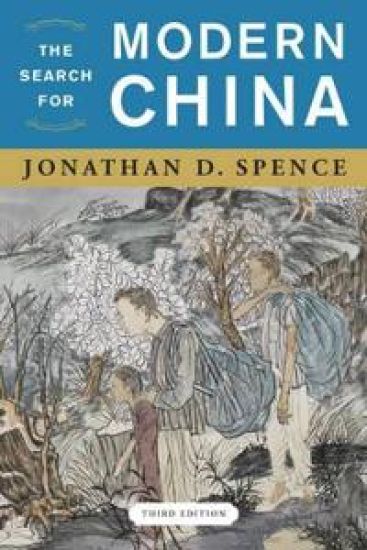
The Search for Modern China
Jonathan D. Spence; Janet Chen
WW NORTON CO
2025
nidottu
Halvin toimitettuna 81,40 €
The Search for Modern China originated in a legendary course at Yale taught by the late Jonathan Spence and has been the best-selling text for students and teachers of modern Chinese history ever since. Janet Chen (Princeton University), a leading scholar and expert in social and cultural history, updates The Search for Modern China for a new generation. Incorporating insights from recent scholarship throughout, she has also streamlined the text to make it more student-friendly while maintaining the spellbinding narrative.
This text, the classic introduction to modern China for students and general readers, emerged from Spence’s highly successful introductory course at Yale, in which he traced the beginnings of modern China to internal developments beginning in the early 17th century. Strong on social and political history, as well as Chinese culture and its intersections with politics, this paperback is a longstanding leader in the survey course on modern China.
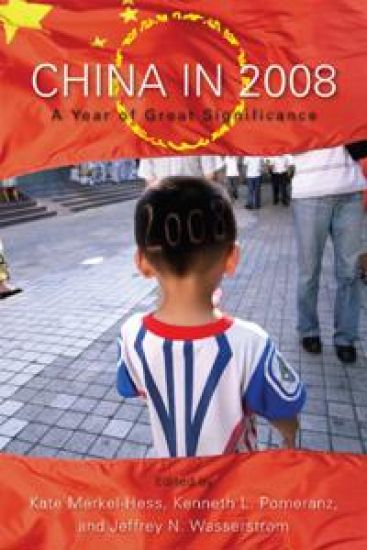
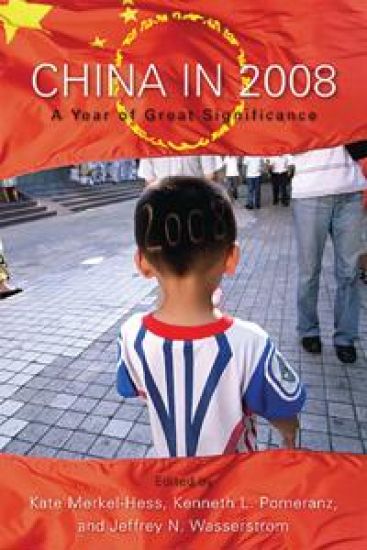
The Beijing Olympics ensured that the world would be watching China in 2008, and the year turned out to be the most tumultuous and traumatic for the Chinese since the massive Tiananmen uprising of 1989. Crippling winter storms, riots in Tibet, the devastating Sichuan earthquake, and many other dramatic events—including the PRC edging out the United States to become the country with the most Internet users—grabbed international headlines. This innovative book, based on postings from the China Beat (the noted group blog/electronic magazine based at the University of California, Irvine) as well as works from other leading publications and completely new material, showcases the as-it-happened reports and commentaries of a mix of distinguished academics, high-profile journalists, and freelance writers, and up-and-coming young China specialists. China in 2008 takes the unique approach of bringing the timeliness of the blogosphere into book form, expanding and reflecting thoughtfully on stories in the news while retaining the eclectic, opinionated, and engaging feel of the China Beat. It will be invaluable reading for everyone with a keen interest in China today. Contributions by: Pallavi Aiyar, David Bandurski, Geremie R. Barmé, Nicole Barnes, Daniel Beekman, Susan Brownell, Pär Cassel, Leslie T. Chang, Yong Chen, Maura Elizabeth Cunningham, Xujun Eberlein, Kathryn Edgerton-Tarpley, Mary S. Erbaugh, James Farrer, Caroline Finlay, Howard W. French, Pierre Fuller, Anna Greenspan, Amy Hanser, Peter Hessler, Jeremiah Jenne, Paul R. Katz, Miri Kim, Richard Kraus, Haiyan Lee, Donald S. Lopez Jr., David Luesink, Liang Luo, Charlene E. Makley, Kate Merkel-Hess, Stephen Mihm, James Miles, Pankaj Mishra, Rana Mitter, Julia K. Murray, Timothy S. Oakes, Alex Pasternack, Kenneth L. Pomeranz, David Porter, Shakhar Rahav, Benjamin L. Read, Caroline Reeves, Eric Setzekorn, Angilee Shah, Xia Shi, Steve Smith, Donald S. Sutton, Paola Voci, Nicolai Volland, Jeffrey N. Wasserstrom, Timothy B. Weston, Guobin Yang, and Lijia Zhang.
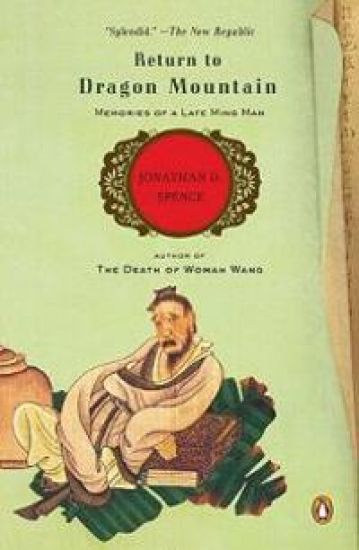
Return to Dragon Mountain: Memories of a Late Ming Man
Jonathan D. Spence
PENGUIN BOOKS
2008
nidottu
"Splendid . . . One could not imagine a better subject than Zhan Dai for Spence." (The New Republic) Celebrated China scholar Jonathan Spence vividly brings to life seventeenth-century China through this biography of Zhang Dai, recognized as one of the finest historians and essayists of the Ming dynasty. Born in 1597, Zhang Dai was forty-seven when the Ming dynasty, after more than two hundred years of rule, was overthrown by the Manchu invasion of 1644. Having lost his fortune and way of life, Zhang Dai fled to the countryside and spent his final forty years recounting the time of creativity and renaissance during Ming rule before the violent upheaval of its collapse. This absorbing tale of Zhang Dai's life illuminates the transformation of a culture and reveals how China's history affects its place in the world today.
A renowned expert on Chinese history turns his considerable talent and experience to the life of China's greatest modern leader--the enigmatic, mythologized, often maligned, and still-revered architect of Chinese Communism and the modern Chinese state. Reprint.
Shortly before noon on October 28, 1728, as General Yue Zhongqi, governor-general of the provinces of Shaanxi and Sichuan, surrounded by his retainers, is being carried in his sedan chair back to his office in Xian, a strangely dressed man runs toward him and tries to present him with a letter. General Yue orders the man to be seized. The letter is addressed to "The Commander in chief deputed by Heaven." When he gets to his office, Yue tells his staff to leave him alone. He tears open the envelope and reads the first few lines. It is as he guessed and feared. The contents of the letter are undiluted treason. Treason by the Book investigates the attempted rebellion that "Summer Calm," the writer of the letter, was trying to persuade Yue Zhongqi to lead. Jonathan Spence, now regarded as the leading historian of China writing in English, has recovered the evidence of the case and reconstructed its course in a book of complete originality that has the pace and twists of a thriller. At its center in Beijing sits the enigmatic figure of Yongzheng, third of the Manchu emperors, ruthlessly gathering information; issuing precise, demanding, and absolute instructions; constantly surprising those who serve him. It is one of Spence's most brilliant depictions. Yongzheng is surrounded by a host of civil servants, generals, scholars, and courtiers who in their interaction during the case allow us an extraordinarily detailed picture of the way in which the Chinese state was run. It was astonishingly modern -- complex, efficient, highly centralized. Yongzheng and his officials could track down rumors and investigate dissent with a thoroughness that would impress those running twentieth-century police states. They expected to control not just actions and expressions but minds too: in a recantation of which Stalin would have been proud, Zeng Jing, the central figure in the conspiracy, comes to realize his errors and likens himself to "an ant who cannot see the size of the sky." What he cannot foresee is how the emperor will choose to defy those who surround him when his fate is decided. Yongzheng pursues the traitors, uncovering lead after lead, and Spence is never more than a few paces behind him, recovering the lives and thoughts of those caught up, sometimes unwittingly, in the conspiracy. Against a background of lament for the passing of the Ming dynasty, the low and the great are paraded equally before us, until at the end we come to the true identity of the mysterious figure who called himself Wang Shu, from whom everything originated and who died penniless by the roadside. It is an outstanding piece of scholarly reconstruction, and one of the most astonishing of all Jonathan Spence's books.
Explores the West's views of China over the course of seven centuries, from Marco Polo's depiction to that of Franz Kafka
Whether read for its powerful account of the largest uprising in human history, or for its foreshadowing of the terrible convulsions suffered by twentieth-century China, or for the narrative power of a great historian at his best, God's Chinese Son must be read. At the center of this history of China's Taiping rebellion (1845-64) stands Hong Xiuquan, a failed student of Confucian doctrine who ascends to heaven in a dream and meets his heavenly family: God, Mary, and his older brother, Jesus. He returns to earth charged to eradicate the "demon-devils," the alien Manchu rulers of China. His success carries him and his followers to the heavenly capital at Nanjing, where they rule a large part of south China for more than a decade. Their decline and fall, wrought by internal division and the unrelenting military pressures of the Manchus and the Western powers, carry them to a hell on earth. Twenty million Chinese are left dead.
The spirit of adventure is at the heart of Jonathan Spence's widely acclaimed scholarship on the modern history of China. This vitality, fleshed out with deep research and attired in elegant style, has drawn countless readers to subjects otherwise approachable only by experts. Through eight books, from the story of the early eighteenth century Manchu bondservant Ts'ao Yin to his magisterial history, The Search for Modern China, Spence has made the excitement of intellectual discovery palpable for us all. In the course of his fruitful career Spence has written many shorter pieces as well, and the best of these are collected for the first time in Chinese Roundabout. Here the reader will meet Arcadio Huang, the Chinese linguist and Christian convert who moves from south China to Enlightenment Paris, marries a French woman, and in conversations with Montesquieu becomes the likely source for the Persian Letters. The poignant story of Huang's hard-won success and final defeat by poverty and disease illustrates the perils of crossing cultures. Spence's delight in intellectual risk animates his Shakespearean approach to the life of the great Qing emperor in "The Seven Ages of K'ang-hsi." Spence's great learning informs an authoritative essay on China's tragic experience with opium. Following the social process of addiction from the cultivation of poppies and the processing of the drug through its introduction by the British into China, its widespread distribution and consumption by Chinese, and the public struggle to suppress opium use, Spence explores issues of historical and contemporary interest. In an equally substantial piece he focuses on the cultural dimensions of food in Qing China, illuminating the marginal diet of a peasantry constantly threatened by famine as well as the grand banquets of the literati and the imperial household. In the work of 25 years, Spence has established himself as a brilliant interpreter of modern Chinese history. His books—among them the recent national bestseller The Search for Modern China—exhibit uncommon imagination, unobtrusive learning, verve, and elegance. These same qualities animate the essays gathered here.
This lively and elegant book by the acclaimed historian Jonathan D. Spence reconstructs an extraordinary episode in the early intercourse between Europe and China. It is the story of John Hu, a lowly but devout Chinese Catholic, who in 1722 accompanied a Jesuit missionary on a journey to France--a journey that ended with Hu's confinement in a lunatic asylum. At once a triumph of historical detective work and a gripping narrative, The Question of Hu deftly probes the collision of tw ocultures, with their different definitions of faith, madness, and moral obligation.
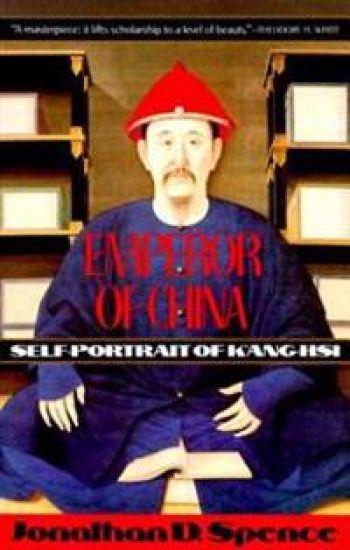
Emperor of China: Self-portrait of K'ang-Hsi: Self-Portrait of K'ang-Hsi
Jonathan D. Spence
Knopf Doubleday Publishing Group
1988
nidottu
A remarkable re-creation of the life of K'ang-hsi, emperor of the Manchu dynasty from 1661-1772, assembled from documents that survived his reign. Illustrations, notes, bibliography, index.
From the renowned historian and author of The Death of Woman Wang, a vivid and gripping account of the 16th-century missionary s remarkable sojourn to Ming China In 1577, the Jesuit Priest Matteo Ricci set out from Italy to bring Christian faith and Western thought to Ming dynasty China. To capture the complex emotional and religious drama of Ricci's extraordinary life, Jonathan Spencerelates his subject's experiences with several images that Ricci himself created four images derived from the events in the Bible and others from a book on the art of memory that Ricci wrote in Chinese and circulated among members of the Ming dynasty elite. A rich and compelling narrative about a fascinating life, The Memory Palace of Matteo Ricci is also a significant work of global history, juxtaposing the world of Counter-Reformation Europe with that of Ming China."
From Ming to Ch'ing
Jonathan D. Spence; Jerry Dennerline; Hilary J. Beattie; Ian McMorran; Morris Rossabi
Yale University Press
1981
pokkari
The collapse of the Ming dynasty and the takeover of China by Manchu rulers in the 1640s were of crucial importance in the late history of China. But because traditional Chinese sources arbitrarily divide the century at the change of dynasty in 1644, it has been difficult to form a clear picture of the transition. The nine essays in this book will contribute significantly toward understanding the complexity of change and continuity over the span of time leading up to and resulting from the tumult of the mid-1600s.“The fullest introduction in English to the Ming-Ch’ing transition.”—Tom Fisher, Pacific Affairs“No other recent work compares with its scope, and no older work can stand up to the introduction of its new materials and perspectives.”—Library Journal“[This book] makes a valuable contribution to Ming-Ch’ing studies and should be required reading for anyone interested in the two dynasties.”—James B. Parsons, American Historical Review
From "the best known and most talented historian of China writing in English today" (Los Angeles Times), an examination of a diverse collection of Western foreigners who attempted "to change China" "To change China" was the goal of foreign missionaries, soldiers, doctors, teachers, engineers, and revolutionaries for more than three hundred years. But the Chinese, while eagerly accepting Western technical advice, clung steadfastly to their own religious and cultural traditions. As a new era of relations between China and the United States begins, the tales in this volume will serve as cautionary histories for businessmen, diplomats, students, or any other foreigners who foolishly believe that they can transform this vast, enigmatic country.
"Spence shows himself at once historian, detective, and artist. . . . He makes history howl." (The New Republic) Award-winning author Jonathan D. Spence paints a vivid picture of an obscure place and time: provincial China in the seventeenth century. Life in the northeastern county of T'an-ch'eng emerges here as an endless cycle of floods, plagues, crop failures, banditry, and heavy taxation. Against this turbulent background a tenacious tax collector, an irascible farmer, and an unhappy wife act out a poignant drama at whose climax the wife, having run away from her husband, returns to him, only to die at his hands. Magnificently evoking the China of long ago, The Death of Woman Wang also deepens our understanding of the China we know today.