Kirjojen hintavertailu – 12 859 827 kirjaa ja 27 kauppaa

Kirjailija

Jonathan Daly

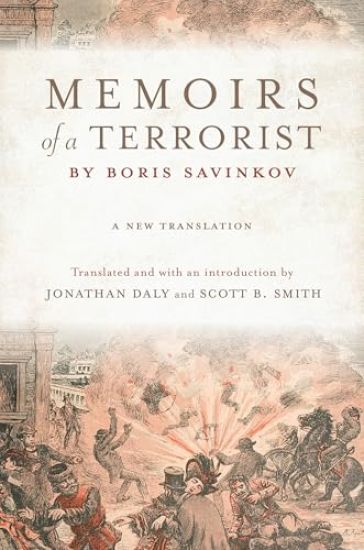
Kirjat ja teokset yhdessä paikassa: 21 kirjaa, julkaisuja vuosilta 1998–2026, suosituimpiin kuuluu Memoirs of a Terrorist by Boris Savinkov. Vertaile teosten hintoja ja tarkista saatavuus suomalaisista kirjakaupoista.

21 kirjaa

Kirjojen julkaisuvuodet: 1998–2026.

The Man Who Knew Russia

The Man Who Knew Russia

Jonathan Daly

STANFORD UNIVERSITY PRESS
2026
sidottu
Richard Pipes was a longtime Harvard University professor, historian of Imperial and Soviet Russia, and influential Soviet expert during the Cold War. A towering figure in his field, Pipes produced work that shaped the study of Russian and Soviet history, and he influenced U. S. foreign policy as a public intellectual and political advisor, including as a member of the National Security Council during the Reagan administration. At the same time, Pipes was a controversial figure; his tendency to swim against the intellectual tide and challenge consensus views alienated some colleagues and angered others. In this biography, Daly cuts through the controversy surrounding Pipes to present a nuanced portrait of his life, thinking, and the philosophical and ethical principles that underpinned his work. Placing Pipes' scholarship and political career in the context of Russian studies, U. S.-Soviet relations, and the Cold War, Daly elucidates Pipes' impact, and argues that his broad learning, keen historical judgment, and humanistic approach permitted him to attain a deep understanding of Russia's historical and contemporary development that continues to resonate today.
The Rise of Western Power

The Rise of Western Power

Jonathan Daly

Bloomsbury Academic
2021
sidottu
In this second edition of The Rise of Western Power, Jonathan Daly retains the broad sweep of his introduction to the history of Western civilization as well as introducing new material into every chapter, enhancing the book’s global coverage and engaging with the latest historical debates. The West's history is one of extraordinary success: no other region, empire, culture, or civilization has left so powerful a mark upon the world. Daly charts the West’s achievements—representative government, the free enterprise system, modern science, and the rule of law—as well as its misdeeds: two World Wars, the Holocaust, imperialistic domination, and the Atlantic slave trade. Taking us through a series of revolutions, he explores the contributions of other cultures and civilizations to the West’s emergence, weaving in historical, geographical, and cultural factors. The new edition also contains more material on themes such as the environment and gender, and additional coverage of India, China and the Islamic world. Daly’s engaging narrative is accompanied by timelines, maps and further reading suggestions, along with a companion website featuring study questions, over 100 primary sources and 60 historical maps to enable further study.

The Rise of Western Power

The Rise of Western Power

Jonathan Daly

Bloomsbury Academic
2021
nidottu
In this second edition of The Rise of Western Power, Jonathan Daly retains the broad sweep of his introduction to the history of Western civilization as well as introducing new material into every chapter, enhancing the book’s global coverage and engaging with the latest historical debates. The West's history is one of extraordinary success: no other region, empire, culture, or civilization has left so powerful a mark upon the world. Daly charts the West’s achievements—representative government, the free enterprise system, modern science, and the rule of law—as well as its misdeeds: two World Wars, the Holocaust, imperialistic domination, and the Atlantic slave trade. Taking us through a series of revolutions, he explores the contributions of other cultures and civilizations to the West’s emergence, weaving in historical, geographical, and cultural factors. The new edition also contains more material on themes such as the environment and gender, and additional coverage of India, China and the Islamic world. Daly’s engaging narrative is accompanied by timelines, maps and further reading suggestions, along with a companion website featuring study questions, over 100 primary sources and 60 historical maps to enable further study.
How Europe Made the Modern World

How Europe Made the Modern World

Jonathan Daly

Bloomsbury Academic
2019
sidottu
One thousand years ago, a traveler to Baghdad or the Chinese capital Kaifeng would have discovered a vast and flourishing city of broad streets, spacious gardens, and sophisticated urban amenities; meanwhile, Paris, Rome, and London were cramped and unhygienic collections of villages, and Europe was a backwater. How, then, did it rise to world preeminence over the next several centuries? This is the central historical conundrum of modern times. How Europe Made the Modern World draws upon the latest scholarship dealing with the various aspects of the West’s divergence, including geography, demography, technology, culture, institutions, science and economics. It avoids the twin dangers of Eurocentrism and anti-Westernism, strongly emphasizing the contributions of other cultures of the world to the West's rise while rejecting the claim that there was nothing distinctive about Europe in the premodern period. Daly provides a concise summary of the debate from both sides, whilst also presenting his own provocative arguments. Drawing on a wide range of primary and secondary sources, and including maps and images to illuminate key evidence, this book will inspire students to think critically and engage in debates rather than accepting a single narrative of the rise of the West. It is an ideal primer for students studying Western Civilization and World History courses.
How Europe Made the Modern World

How Europe Made the Modern World

Jonathan Daly

Bloomsbury Academic
2019
nidottu
One thousand years ago, a traveler to Baghdad or the Chinese capital Kaifeng would have discovered a vast and flourishing city of broad streets, spacious gardens, and sophisticated urban amenities; meanwhile, Paris, Rome, and London were cramped and unhygienic collections of villages, and Europe was a backwater. How, then, did it rise to world preeminence over the next several centuries? This is the central historical conundrum of modern times. How Europe Made the Modern World draws upon the latest scholarship dealing with the various aspects of the West’s divergence, including geography, demography, technology, culture, institutions, science and economics. It avoids the twin dangers of Eurocentrism and anti-Westernism, strongly emphasizing the contributions of other cultures of the world to the West's rise while rejecting the claim that there was nothing distinctive about Europe in the premodern period. Daly provides a concise summary of the debate from both sides, whilst also presenting his own provocative arguments. Drawing on a wide range of primary and secondary sources, and including maps and images to illuminate key evidence, this book will inspire students to think critically and engage in debates rather than accepting a single narrative of the rise of the West. It is an ideal primer for students studying Western Civilization and World History courses.
Pillars of the Profession

Pillars of the Profession

Jonathan Daly

BRILL
2018
sidottu
Richard Pipes and Marc Raeff were two of the most prolific and influential historians of Russia that America ever produced. They met at Harvard in 1946 and went on, for most of the following six decades, to debate history, share ideas, comment on each other's work, and inspire one another intellectually. In Pillars of the Profession: The Correspondence of Richard Pipes and Marc Raeff, Jonathan Daly presents the 158 letters these scholars and friends exchanged from 1948 until 2007. Thoughtful introductory and concluding essays, detailed annotations, a wealth of photographs and other illustrations, a chronology of major events, and four maps make this volume an important addition to Russian historiography.
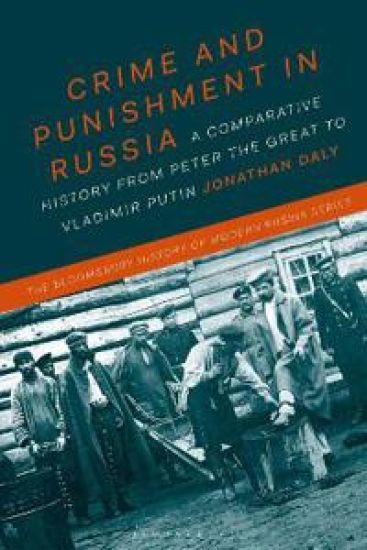
Crime and Punishment in Russia

Crime and Punishment in Russia

Jonathan Daly

Bloomsbury Academic
2018
sidottu
Crime and Punishment in Russia surveys the evolution of criminal justice in Russia during a span of more than 300 years, from the early modern era to the present day. Maps, organizational charts, a list of important dates, and a glossary help the reader to navigate key institutional, legal, political, and cultural developments in this evolution. The book approaches Russia both on its own terms and in light of changes in Europe and the wider West, to which Russia's rulers and educated elites continuously looked for legal models and inspiration. It examines the weak advancement of the rule of the law over the period and analyzes the contrasts and seeming contradictions of a society in which capital punishment was sharply restricted in the mid-1700s, while penal and administrative exile remained heavily applied until 1917 and even beyond. Daly also provides concise political, social, and economic contextual detail, showing how the story of crime and punishment fits into the broader narrative of modern Russian history. This is an important and useful book for all students of modern Russian history as well as of the history of crime and punishment in modern Europe.
Crime and Punishment in Russia

Crime and Punishment in Russia

Jonathan Daly

Bloomsbury Academic
2018
nidottu
Crime and Punishment in Russia surveys the evolution of criminal justice in Russia during a span of more than 300 years, from the early modern era to the present day. Maps, organizational charts, a list of important dates, and a glossary help the reader to navigate key institutional, legal, political, and cultural developments in this evolution. The book approaches Russia both on its own terms and in light of changes in Europe and the wider West, to which Russia's rulers and educated elites continuously looked for legal models and inspiration. It examines the weak advancement of the rule of the law over the period and analyzes the contrasts and seeming contradictions of a society in which capital punishment was sharply restricted in the mid-1700s, while penal and administrative exile remained heavily applied until 1917 and even beyond. Daly also provides concise political, social, and economic contextual detail, showing how the story of crime and punishment fits into the broader narrative of modern Russian history. This is an important and useful book for all students of modern Russian history as well as of the history of crime and punishment in modern Europe.
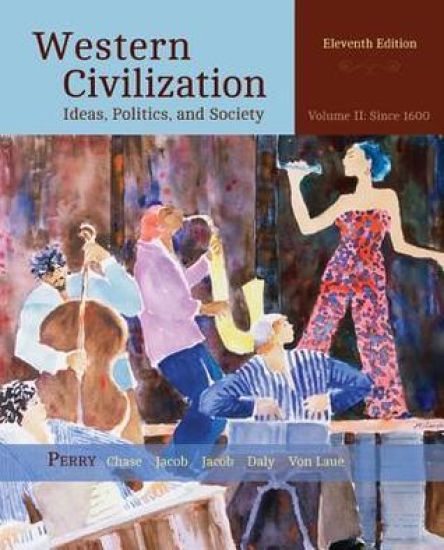
Western Civilization

Western Civilization

Marvin Perry; Myrna Chase; James Jacob; Margaret Jacob; Jonathan Daly; Theodore Von Laue

Wadsworth Publishing Co Inc
2015
nidottu
WESTERN CIVILIZATION: IDEAS, POLITICS, AND SOCIETY, Eleventh Edition, offers an in-depth introduction to political, cultural, and intellectual history. Readers appreciate the book's accessible writing style as well as its brevity, clarity, and careful selection of content. Updated with more recent scholarship, the eleventh edition retains many popular features that help readers absorb and understand the material, including comparative timelines, full-color art essays, and profile and primary source boxes in each chapter.
Western Civilization

Western Civilization

Marvin Perry; Myrna Chase; James Jacob; Margaret Jacob; Jonathan Daly; Theodore Von Laue

Wadsworth Publishing Co Inc
2015
nidottu
WESTERN CIVILIZATION: IDEAS, POLITICS, AND SOCIETY, Since 1400, Eleventh Edition, offers an in-depth introduction to political, cultural, and intellectual history. Readers appreciate the book's accessible writing style as well as its brevity, clarity, and careful selection of content. Updated with more recent scholarship, the eleventh edition retains many popular features that help readers absorb and understand the material, including comparative timelines, full-color art essays, and profile and primary source boxes in each chapter.
Western Civilization

Western Civilization

Marvin Perry; Myrna Chase; James Jacob; Margaret Jacob; Jonathan Daly; Theodore Von Laue

Wadsworth Publishing Co Inc
2015
nidottu
WESTERN CIVILIZATION: IDEAS, POLITICS, AND SOCIETY, Eleventh Edition, offers an in-depth introduction to political, cultural, and intellectual history. Readers appreciate the book's accessible writing style as well as its brevity, clarity, and careful selection of content. Updated with more recent scholarship, the eleventh edition retains many popular features that help readers absorb and understand the material, including comparative timelines, full-color art essays, and profile and primary source boxes in each chapter.
Historians Debate the Rise of the West
How and why did Europe rise to world pre-eminence? Providing an overview of this central historical conundrum of modern times, Historians Debate the Rise of the West enables students to grasp major scholars’ evaluations of the biggest picture of all: how Western civilization fits into modern world history. Most historians who write in this area subscribe to a combination of interpretations set forward by scholars of the field, like David Landes, Jared Diamond or Kenneth Pomeranz. But it is often difficult to understand the position they are coming from, and for readers to understand clearly how Europe made the transition from merely one of many developing civilizations to the world’s first industrial power. In this volume, Jonathan Daly introduces us to the main interpretations of Europe’s rise that have been proposed over the past half-century and presents the views of these historians and schools of scholarship, advocating for each point of view and letting each author speak for him or herself through the inclusion of brief textual selections. Also included are interesting biographical details for each scholar, as well as a list of further reading for each chapter and a collection of maps. An ideal introduction for students of world history.
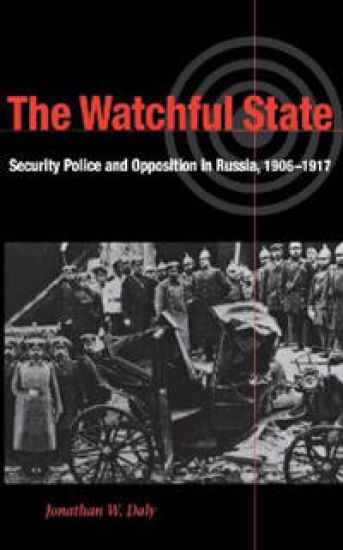
The Watchful State

The Watchful State

Jonathan Daly

Northern Illinois University Press
2004
sidottu
Why did the imperial Russian government fail to prevent revolution in 1917? Were its security policies flawed? This broadly researched study of Russia's security police investigates the government's efforts to maintain order as it struggled against political opposition and threats of violence during the last decade before the Revolution. Historian Jonathan Daly brings to life the men who, often with reformist intentions, took on the task of defending Russia against political dissent and revolution from within. The Watchful State reveals how the security police matched wits with revolutionary activists under Russia's first constitutional government, from 1906 until the collapse of order in 1917. The secret police kept a watchful eye on a large number of the radical political activists who threatened the state order. Such constant scrutiny enabled the secret police frequently to disrupt plots against the government, to set snares to trap conspirators, and to hold the workers' movement within bounds. The security police rarely harassed liberal and moderate activists during the constitutional era, though the regular police administration was not so restrained. The two institutions of law enforcement worked together, forming a security system with one primary goal: to thwart antigovernment forces seeking to undermine the political status quo. Countless times, Russia narrowly escaped breakdowns of order, thanks to the intervention of the police who thwarted political assassinations, troop mutinies, and urban unrest. Yet security police activities were not without cost to the established order. As the educated public expanded and an awareness of civil society grew, tolerance for secretive and often intrusive security apparatus waned. In its battle against its revolutionary adversaries, the late imperial government lost the broader struggle for the hearts and minds of Russians.