Kirjailija
Jonathan Littell
Kirjat ja teokset yhdessä paikassa: 11 kirjaa, julkaisuja vuosilta 2008–2025, suosituimpiin kuuluu Hyväntahtoiset. Vertaile teosten hintoja ja tarkista saatavuus suomalaisista kirjakaupoista.
11 kirjaa
Kirjojen julkaisuvuodet: 2008–2025.
"Neudobnoe mesto" - eto sovmestnyj proekt publitsista Dzhonatana Littella i fotografa Antuana d'Agaty o Babem jare, istoricheskoj pamjati i voennykh prestuplenijakh Rossii v Ukraine v 2000-kh. Rukopis knigi byla zakonchena za dva dnja do napadenija Rossii na Ukrainu. V nojabre 2022-go Littell vernulsja k tekstu, chtoby perepisat ego v sootvetstvii s novoj realnostju, v kotoroj uzhe sluchilas Bucha, okkupatsija Mariupolja i kazhdyj den stanovitsja izvestno o vse novykh prestuplenijakh rossijskikh voennykh v Ukraine. Dzhonatan Littell - avtor romana "Blagovolitelnitsy". V novoj knige on zadaet tjazhelye voprosy o dramatichnykh sobytijakh XX (a teper i XXI) veka. A fotografii Antuana d'Agaty iz legendarnogo agentstva Magnum prevraschajut chtenie "Neudobnogo mesta" v immersivnyj opyt.
"Hvis du er født i et land eller en tid der ingen kommer for å drepe din kone eller dine barn, og heller ikke noen kommer for å be deg drepe andres koner og barn, så takk din Gud og gå i fred. Men hold alltid fast ved denne tanken: Du har kanskje vært heldigere enn meg, men du er ikke et bedre menneske." Hovedpersonen i De velvillige. "årets viktigste og beste roman ... en slående sterk prestasjon." Ane Farsethås, Morgenbladet
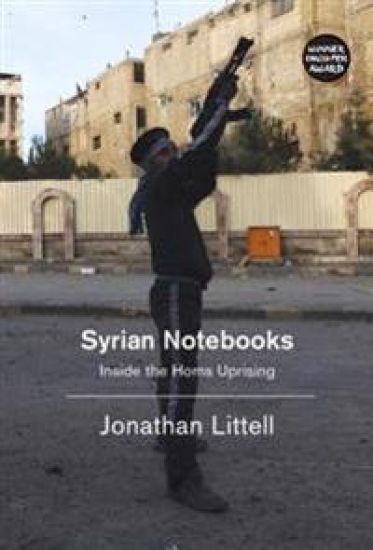
"We fight for our religion, for our women, for our land, and lastly to save our skin. As for them, they're only fighting to save their skin." In 2012, Jonathan Littell traveled to the heart of the Syrian uprising, smuggled in by the Free Syrian Army to the historic city of Homs. For three weeks, he watched as neighborhoods were bombed and innocent civilians murdered. His notes on what he saw on the ground speak directly of horrors that continue today in the ongoing civil war. Amid the chaos, Littell bears witness to the lives and the hopes of freedom fighters, of families caught within the conflict, as well as of the doctors who attempt to save both innocents and combatants who come under fire. As government forces encircle the city, Littell charts the first stirrings of the fundamentalist movement that would soon hijack the revolution. Littell's notebooks were originally the raw material for the articles he wrote upon his return for the French daily Le Monde. Published nearly immediately afterward in France, Syrian Notebooks has come to form an incomparable close-up account of a war that still grips the Middle East-a classic of war reportage.
The Prix Goncourt-winning author of the scandalous The Kindly Ones returns with four new novellas that offer startlingly fresh depictions of age-old obsessions: sex and love, desiring and gazing, and the memories that take a lifetime to process. In The Fata Morgana Books, Littell crafts unique narrative voices by letting sensual feelings take the fore, whether the slippery promise of silk underwear, the dizzy intensity of abstract art, the languid torpor of a French beach, the shock of a bull's goring horn, or the warmth of a fondled breast. The connections between events are left obscure, yet these novellas are as striking as a gust of frigid air, presenting a skewed reality in which the reader is drawn forward to figure out who, or what, is telling the story, and why. Narrated by what may be hermaphrodites or ghosts, wanders or wonders, Littell's masterful, effortless sentences carry these stories that illuminate the shadowy depths of solitude, reflection, longing, and lust. "In Quarters" is a Proustian ghost story, or maybe a memory, or a dream. Narrated by a man who may or may not exist, it follows him through a sprawling mansion where he cares for a sick child, though he has forgotten whether or not the boy is his, while stealing food from other's plates and having sex with a beautiful young woman. When he travels to a provincial city, the young woman reappears--or does she? Repeated brushes with shadowy men with umbrellas offer a hint of menace that forms the backbone of this strange tale. "Story About Nothing" follows a man who cannot remember his birthday "or even the sign under which I was born" as he experiences transgenderism, a pornographic tape given to him by a mysterious stranger, and a Hemingway-esque series of bullfights under the hot Spanish sun. As Littell takes his narrator through a series of affairs, each more ephemeral then the last, it becomes clear that this is a story about the transience of sex, the way that desire evaporates in satiation and then reappears when two strangers share a long look over a strong drink. Anchored by striking images--a lime sorbet, children diving off of high rocks--Littell's tale becomes a trip through desire that is not soon forgotten. Commanding in spite of their vagueness, beguilingly easy to read but full of depth and mystery, these novellas explore the in-between spaces: between thoughts, between bodies, between hungers and their satisfactions, between eyes and the things they look at.
Dr Max Aue is a family man and owner of a lace factory in post-war France. He was an observer and then a participant in Nazi atrocities on the Eastern Front, he was present at the siege of Stalingrad, at the death camps, and finally caught up in the overthrow of the Nazis and the nightmarish fall of Berlin.
"Simply astounding. . . . The Kindly Ones is unmistakably the work of a profoundly gifted writer." -- TimeA literary prize-winner that has been an explosive bestseller all over the world, Jonathan Littell's The Kindly Ones has been called "a brilliant Holocaust novel. . . a world-class masterpiece of astonishing brutality, originality, and force," (Michael Korda, The Daily Beast). Destined to join the pantheon of classic epics of war such as Tolstoy's War and Peace and Vasily Grossman's Life and Fate, The Kindly Ones offers a profound and gripping experience of the horrors of World War II and the Holocaust. A former Nazi officer, Dr. Maximilien Aue has reinvented himself, many years after the war, as a middle-class family man and factory owner in France. An intellectual steeped in philosophy, literature, and classical music, he is also a cold-blooded assassin and the consummate bureaucrat. Through the eyes of this cultivated yet monstrous man we experience in disturbingly precise detail the horrors of the Second World War and the Nazi genocide of the Jews. Eichmann, Himmler, G ring, Speer, Heydrich, H ss--even Hitler himself--play a role in Max's story. An intense and hallucinatory historical epic, The Kindly Ones is also a morally challenging read. It holds a mirror up to humanity--and the reader cannot look away.
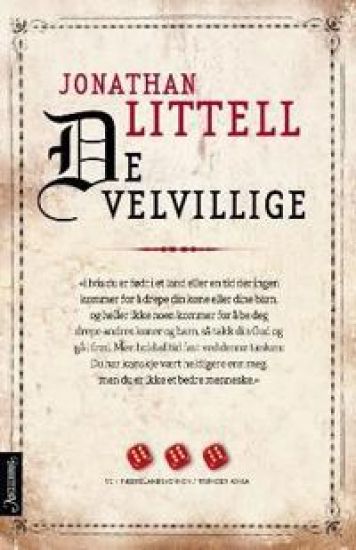
Maximilien Aue har fransk mor og tysk far. Faren forsvant mens han var liten, og han har aldri akseptert morens senere forhold til en franskmann. Etter endt utdannelse blir han i ren vanvare vervet til SS. Boka følger han gjennom alle krigens faser. Felttog i Ukraina og massakrene i Babij Jar er noe av det som skildres. Vi møter oppdiktede personer og kjente skikkelser som Hitler, Speer og Eichmann.
Die Weltkriegsmemoiren eines deutschen SS Mannes waren der Überraschungserfolg in Frankreich im Herbst 2006 und wurden schließlich mit dem Prix Goncourt gekrönt. Littell wagt eine neue ästhetische Dimension im Umgang mit der Barbarei. Sein Vertrauen in die Möglichkeiten des Erzählens bewahren seinen Roman vor der Banalisierung und Trivialisierung des Bösen durch die Literatur. Max Aue ist als Freiwilliger aus ideologischen Gründen der SS beigetreten. Er ist kultiviert, intelligent, studiert, homosexuell. Er überlebt Stalingrad, nimmt in der Ukraine an Judenermordungen teil, ist in Auschwitz. In Paris trifft er auf Ernst Jünger und ist später in Berlin bei Hitler im Führerbunker; seine Biographie ist eine Verdichtung vieler Lebensläufe. Selbstherrlich und offensiv erzählt der Täter von seinen Verbrechen. Seine Erinnerungen sind keine durch spätere Reue bedingte Lebensbeichte, sondern vielmehr eine Art Rechenschaftsbericht.