
Kirjojen hintavertailu – 12 903 725 kirjaa ja 27 kauppaa

Kirjailija

Jordi Vitrià

Kirjat ja teokset yhdessä paikassa: 3 kirjaa, julkaisuja vuosilta 2011–2015, suosituimpiin kuuluu Multimodal Interaction in Image and Video Applications. Vertaile teosten hintoja ja tarkista saatavuus suomalaisista kirjakaupoista.

3 kirjaa

Kirjojen julkaisuvuodet: 2011–2015.

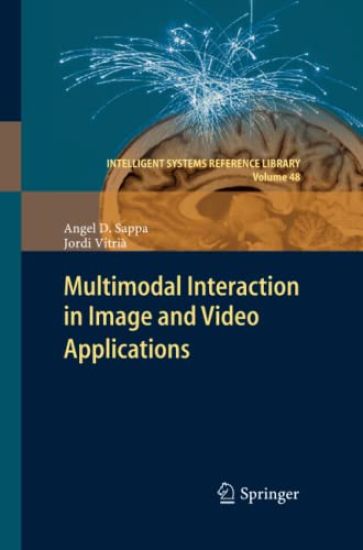
Multimodal Interaction in Image and Video Applications

Multimodal Interaction in Image and Video Applications

Angel D. Sappa; Jordi Vitrià

Springer-Verlag Berlin and Heidelberg GmbH Co. K
2015
nidottu
Traditional Pattern Recognition (PR) and Computer Vision (CV) technologies have mainly focused on full automation, even though full automation often proves elusive or unnatural in many applications, where the technology is expected to assist rather than replace the human agents. However, not all the problems can be automatically solved being the human interaction the only way to tackle those applications. Recently, multimodal human interaction has become an important field of increasing interest in the research community. Advanced man-machine interfaces with high cognitive capabilities are a hot research topic that aims at solving challenging problems in image and video applications. Actually, the idea of computer interactive systems was already proposed on the early stages of computer science. Nowadays, the ubiquity of image sensors together with the ever-increasing computing performance has open new and challenging opportunities for research in multimodal human interaction. This book aims to show how existing PR and CV technologies can naturally evolve using this new paradigm. The chapters of this book show different successful case studies of multimodal interactive technologies for both image and video applications. They cover a wide spectrum of applications, ranging from interactive handwriting transcriptions to human-robot interactions in real environments.
Multimodal Interaction in Image and Video Applications

Multimodal Interaction in Image and Video Applications

Angel D. Sappa; Jordi Vitrià

Springer-Verlag Berlin and Heidelberg GmbH Co. K
2013
sidottu
Traditional Pattern Recognition (PR) and Computer Vision (CV) technologies have mainly focused on full automation, even though full automation often proves elusive or unnatural in many applications, where the technology is expected to assist rather than replace the human agents. However, not all the problems can be automatically solved being the human interaction the only way to tackle those applications. Recently, multimodal human interaction has become an important field of increasing interest in the research community. Advanced man-machine interfaces with high cognitive capabilities are a hot research topic that aims at solving challenging problems in image and video applications. Actually, the idea of computer interactive systems was already proposed on the early stages of computer science. Nowadays, the ubiquity of image sensors together with the ever-increasing computing performance has open new and challenging opportunities for research in multimodal human interaction. This book aims to show how existing PR and CV technologies can naturally evolve using this new paradigm. The chapters of this book show different successful case studies of multimodal interactive technologies for both image and video applications. They cover a wide spectrum of applications, ranging from interactive handwriting transcriptions to human-robot interactions in real environments.
Traffic-Sign Recognition Systems

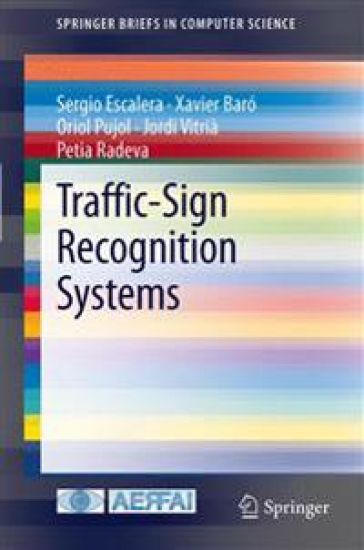
Traffic-Sign Recognition Systems

Sergio Escalera; Xavier Baró; Oriol Pujol; Jordi Vitrià; Petia Radeva

Springer London Ltd
2011
nidottu
This work presents a full generic approach to the detection and recognition of traffic signs. The approach is based on the latest computer vision methods for object detection, and on powerful methods for multiclass classification. The challenge was to robustly detect a set of different sign classes in real time, and to classify each detected sign into a large, extensible set of classes. To address this challenge, several state-of-the-art methods were developed that can be used for different recognition problems. Following an introduction to the problems of traffic sign detection and categorization, the text focuses on the problem of detection, and presents recent developments in this field. The text then surveys a specific methodology for the problem of traffic sign categorization – Error-Correcting Output Codes – and presents several algorithms, performing experimental validation on a mobile mapping application. The work ends with a discussion on future research and continuing challenges.