Kirjojen hintavertailu – 12 859 819 kirjaa ja 27 kauppaa

Kirjailija

Jörn Schönberger

Kirjat ja teokset yhdessä paikassa: 7 kirjaa, julkaisuja vuosilta 2005–2025, suosituimpiin kuuluu Global Supply Chain and Operations Management. Vertaile teosten hintoja ja tarkista saatavuus suomalaisista kirjakaupoista.

7 kirjaa

Kirjojen julkaisuvuodet: 2005–2025.

Global Supply Chain and Operations Management

Global Supply Chain and Operations Management

Dmitry Ivanov; Alexander Tsipoulanidis; Jörn Schönberger

Springer International Publishing AG
2025
sidottu
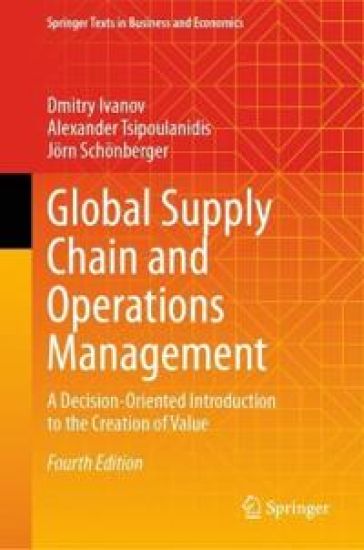
The fourth edition of this textbook offers a structured introduction to global supply chain and operations management (SCOM), combining value creation networks and operational processes. It explains quantitative and organizational methods for planning and control of material, information, and financial flows in supply chains. Each chapter begins with an introductory case study, while numerous examples from various industries and services help to illustrate the key concepts. The book explains how to design operations and supply networks and collaborate with suppliers and customers. It shows how to balance supply and demand, a core aspect of tactical planning, before turning to the allocation of resources to meet customer needs. In addition, the book covers some advanced topics in SCOM, such as supply chain resilience, sustainability, Industry 4.0, artificial intelligence, and digital twins. Providing readers with a working knowledge of global supply chain and operations management, with a focus on bridging the gap between theory and practice, this textbook can be used in core, specialized, and advanced classes alike. It is intended for a broad range of students and professionals in supply chain and operations management.
Global Supply Chain and Operations Management

Global Supply Chain and Operations Management

Dmitry Ivanov; Alexander Tsipoulanidis; Jörn Schönberger

Springer Nature Switzerland AG
2021
sidottu
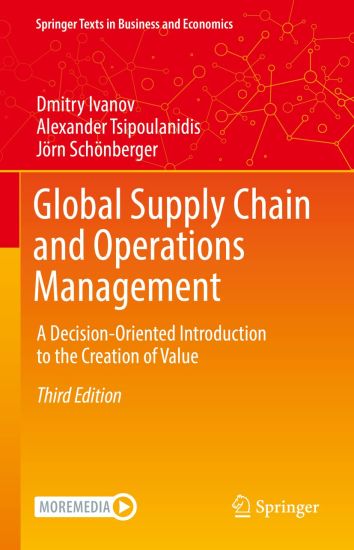
The third edition of this textbook comprehensively discusses global supply chain and operations management (SCOM), combining value creation networks and interacting processes. It focuses on operational roles within networks and presents the quantitative and organizational methods needed to plan and control the material, information, and financial flows in supply chains. Each chapter begins with an introductory case study, while numerous examples from various industries and services help to illustrate the key concepts. The book explains how to design operations and supply networks and how to incorporate suppliers and customers. It examines how to balance supply and demand, a core aspect of tactical planning, before turning to the allocation of resources to meet customer needs. In addition, the book presents state-of-the-art research reflecting the lessons learned from the COVID-19 pandemic, and emerging, fast-paced developments in the digitalization of supply chain and operations management. Providing readers with a working knowledge of global supply chain and operations management, with a focus on bridging the gap between theory and practice, this textbook can be used in core, specialized, and advanced classes alike. It is intended for a broad range of students and professionals in supply chain and operations management.
Global Supply Chain and Operations Management

Global Supply Chain and Operations Management

Dmitry Ivanov; Alexander Tsipoulanidis; Jörn Schönberger

Springer Nature Switzerland AG
2018
nidottu
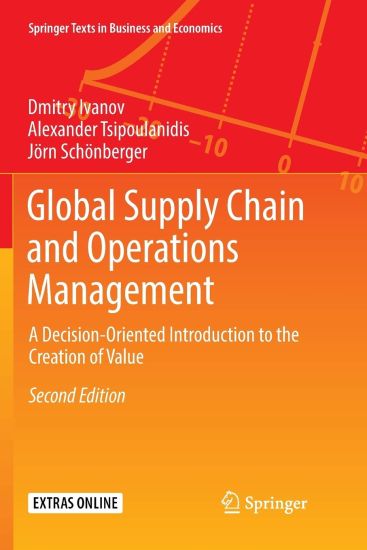
The second edition of this textbook comprehensively discusses global supply-chain and operations management, combining value creation networks and interacting processes. It focuses on the operational roles in the networks and presents the quantitative and organizational methods needed to plan and control the material, information and financial flows in the supply chain. Each chapter starts with an introductory case study, and numerous examples from various industries and services help to illustrate the key concepts. The book explains how to design operations and supply networks and how to incorporate suppliers and customers. It also examines matching supply and demand, which is a core aspect of tactical planning, before turning to the allocation of resources for fulfilling customer demands. This second edition features three new chapters: “Supply Chain Risk Management and Resilience”, “Digital Supply Chain, Smart Operations, and Industry 4.0”, and “Pricing and Revenue-Oriented Capacity Allocation”. These new chapters provide the structured knowledge on the principles, models, and technologies for managing the supply-chain risks and improving supply-chain and operations performance with the help of digital technologies such as Industry 4.0, additive manufacturing, Internet-of-Things, advanced optimization methods and predictive analytics. The existing chapters have been updated and new case studies have been included. In addition, the preface provides guidelines for instructors on how to use the material for different courses in supply-chain and operations management and at different educational levels, such as general undergraduate, specialized undergraduate, and graduate courses. The companion website www.global-supply-chain-management.de has also been updated accordingly. In addition, the book is now supported by e-manuals for supply-chain and operations simulation and optimization in AnyLogic and anyLogistix. Providing readers with a working knowledge of global supply-chain and operations management, with a focus on bridging the gap between theory and practice, this textbook can be used in core, special and advanced classes. It is intended for broad range of students and professionals involved in supply-chain and operations management.
Model-Based Control of Logistics Processes in Volatile Environments

Model-Based Control of Logistics Processes in Volatile Environments

Jörn Schönberger

Springer-Verlag New York Inc.
2013
nidottu
This monograph presents results originating from a research project investigating autonomous adaptation of vehicle schedules and systematically develops and evaluates innovative ideas for the management of transportation processes in volatile scenarios. Showing the progress made in the development of the methodological toolbox for decision support in dynamic process management is the major motivation behind this book. The result is a new integrated approach to dynamic decision making. Existing process planning approaches for volatile environments and their application boundaries are investigated in Part I. Part II introduces the concept of feedback-controlled adaptive decision models and proposes the required extensions of the online decision making framework and of multi-agent systems. A comprehensive evaluation of the proposed decision model adaptation framework based on computational simulation experiments is reported in Part III and demonstrates the predominance of the new approach. Distinguishing features of this book are:-It provides the first contribution to the operational management of processes in supply networks that explicitly addresses the two challenges of dynamics and distributed decision making simultaneously.-It systematically approaches the limits of model-based process planning but also proposes methods to extend the application boundaries. -Software prototypes are developed and a comprehensive evaluation within numerical simulation experiments is executed. -The observed results are discussed with an explicit focus on specific performance indicators (flexibility, stability and robustness).-The strict interdisciplinary approach merging the requirements and needs of management sciences, operations research and computer sciences is pursued throughout the book.
Model-Based Control of Logistics Processes in Volatile Environments

Model-Based Control of Logistics Processes in Volatile Environments

Jörn Schönberger

Springer-Verlag New York Inc.
2011
sidottu
This monograph presents results originating from a research project investigating autonomous adaptation of vehicle schedules and systematically develops and evaluates innovative ideas for the management of transportation processes in volatile scenarios. Showing the progress made in the development of the methodological toolbox for decision support in dynamic process management is the major motivation behind this book. The result is a new integrated approach to dynamic decision making. Existing process planning approaches for volatile environments and their application boundaries are investigated in Part I. Part II introduces the concept of feedback-controlled adaptive decision models and proposes the required extensions of the online decision making framework and of multi-agent systems. A comprehensive evaluation of the proposed decision model adaptation framework based on computational simulation experiments is reported in Part III and demonstrates the predominance of the new approach. Distinguishing features of this book are:-It provides the first contribution to the operational management of processes in supply networks that explicitly addresses the two challenges of dynamics and distributed decision making simultaneously.-It systematically approaches the limits of model-based process planning but also proposes methods to extend the application boundaries. -Software prototypes are developed and a comprehensive evaluation within numerical simulation experiments is executed. -The observed results are discussed with an explicit focus on specific performance indicators (flexibility, stability and robustness).-The strict interdisciplinary approach merging the requirements and needs of management sciences, operations research and computer sciences is pursued throughout the book.
Operational Freight Carrier Planning

Operational Freight Carrier Planning

Jörn Schönberger

Springer-Verlag Berlin and Heidelberg GmbH Co. K
2010
nidottu
This book represents the compilation of several research approaches on opera­ tional freight carrier planning carried out at the Chair of Logistics, University of Bremen. It took nearly three years from the first ideas to the final version, now in your hands. During this time, several persons helped me all the time to keep on going and to re-start when I got stuck in a dead end or when I could not see the wood for the trees. I am deeply indebted to them for their encouragement and comments. Prof. Dr. Herbert Kopfer, holder of the Chair of Logistics, introduced me into the field of operational transport planning. He motivated and supervised me. Furthermore, he supported me constantly and allowed me to be as free as possible in my research and encouraged me to be as creative as necessary. In addition, I have to thank Prof. Dr. Hans-Dietrich Haasis, Prof. Dr. Martin G. Mohrle and Prof. Dr. Thorsten Poddig. On behalf of all my colleagues, who supported me in numerous ways, I have to say thank you to Prof. Dr. Dirk C. Mattfeld, Prof. Dr. Christian Bierwirth, Henner Gratz, Prof. Dr. Elmar Erkens, Nadja Shigo and Katrin Dorow. They all helped me even with my most obscure and dubious problems. My family supported me all the time. They always showed me their trust and encouraged me continuously. Special thanks are dedicated to my parents Monika and Heinz-Jiirgen.
Operational Freight Carrier Planning

Operational Freight Carrier Planning

Jörn Schönberger

Springer-Verlag Berlin and Heidelberg GmbH Co. K
2005
sidottu
This book represents the compilation of several research approaches on opera­ tional freight carrier planning carried out at the Chair of Logistics, University of Bremen. It took nearly three years from the first ideas to the final version, now in your hands. During this time, several persons helped me all the time to keep on going and to re-start when I got stuck in a dead end or when I could not see the wood for the trees. I am deeply indebted to them for their encouragement and comments. Prof. Dr. Herbert Kopfer, holder of the Chair of Logistics, introduced me into the field of operational transport planning. He motivated and supervised me. Furthermore, he supported me constantly and allowed me to be as free as possible in my research and encouraged me to be as creative as necessary. In addition, I have to thank Prof. Dr. Hans-Dietrich Haasis, Prof. Dr. Martin G. Mohrle and Prof. Dr. Thorsten Poddig. On behalf of all my colleagues, who supported me in numerous ways, I have to say thank you to Prof. Dr. Dirk C. Mattfeld, Prof. Dr. Christian Bierwirth, Henner Gratz, Prof. Dr. Elmar Erkens, Nadja Shigo and Katrin Dorow. They all helped me even with my most obscure and dubious problems. My family supported me all the time. They always showed me their trust and encouraged me continuously. Special thanks are dedicated to my parents Monika and Heinz-Jiirgen.