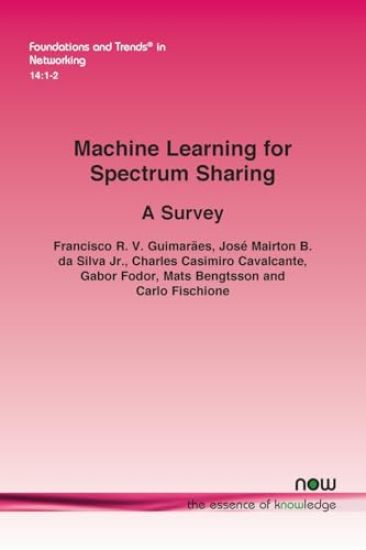
Machine Learning for Spectrum Sharing
Francisco R. V. Guimarães; José Mairton B. da Silva; Charles Casimiro Cavalcante; Gabor Fodor; Mats Bengtsson; Carlo Fischione
Now Publishers Inc
2024
nidottu
The 5th generation (5G) of wireless systems is being deployed with the aim to provide many sets of wireless communication services, such as low data rates for a massive amount of devices, broadband, low latency, and industrial wireless access. Such an aim is even more complex in the next generation wireless systems (6G) where wireless connectivity is expected to serve any connected intelligent unit, such as software robots and humans interacting in the metaverse, autonomous vehicles, drones, trains, or smart sensors monitoring cities, buildings, and the environment. As the wireless devices will be orders of magnitude denser than in 5G cellular systems, and due to the complex quality of service requirements, the access to the wireless spectrum will have to be appropriately shared to avoid congestion, poor quality of service, or unsatisfactory communication delays. Spectrum sharing methods have been the objective of intense study through model-based approaches, such as optimization or game theories. However, these methods may fail when facing the complexity of the communication environments in 5G, 6G, and beyond. Recently, there has been significant interest in the application and development of data-driven methods, namely machine learning methods, to handle the complex operation of spectrum sharing. In this monograph, a complete overview of the state-of-the-art of machine learning for spectrum sharing is provided. First, the authors map the most prominent methods that are encountered in spectrum sharing. Then, it is shown how these machine learning methods are applied to the numerous dimensions and sub-problems of spectrum sharing, such as spectrum sensing, spectrum allocation, spectrum access, and spectrum handoff. Finally, several open questions and future trends are highlighted.