
Kirjojen hintavertailu – 12 903 735 kirjaa ja 27 kauppaa

Kirjailija

Jose Matos

Kirjat ja teokset yhdessä paikassa: 2 kirjaa, julkaisuja vuosilta 2020–2023, suosituimpiin kuuluu War of Intervention in Angola, Volume 3. Vertaile teosten hintoja ja tarkista saatavuus suomalaisista kirjakaupoista.

Nimi esiintyy myös muodoissa: José Matos

2 kirjaa

Kirjojen julkaisuvuodet: 2020–2023.

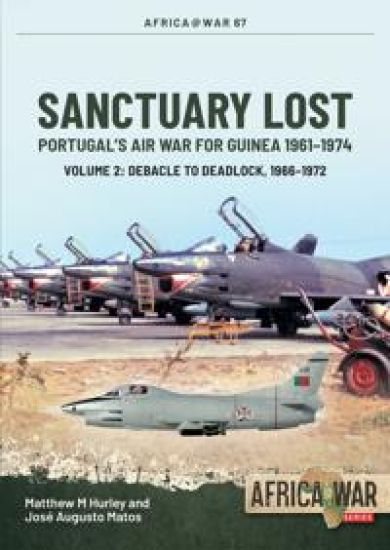
Sanctuary Lost: Portugal's Air War for Guinea, 1961-1974 Volume 2
From 1963 to 1974, Portugal and its nationalist enemies fought an increasingly intense war for the independence of "Portuguese" Guinea, then a colony but now the Republic of Guinea-Bissau. For most of the conflict Portugal enjoyed virtually unchallenged air supremacy, and increasingly based its military strategy and political pacification program on this singular advantage. The Portuguese Air Force (For a A rea Portuguesa, abbreviated FAP) consequently played a crucial role in the Guinean war. Indeed, throughout the conflict, the FAP - despite the many challenges it faced - proved to be the most effective and responsive military argument against the PAIGC rebels, which was fighting for the colony's independence from European rule. The air war for Guinea stands as a remarkable episode in air power history for several reasons. It was, for example, the first conflict in which a non-state irregular force deployed defensive missiles against an organized air force. Moreover, the degree to which Portugal relied on its air power was such that its effective neutralization doomed Lisbon's military strategy in the province. Ultimately, the FAP's unexpected combat losses initiated a cascade of effects that degraded, in turn, its own operational initiative; the battlefield effectiveness of increasingly air-dependent ground forces; Portuguese military morale and national resilience; and ultimately, Lisbon's tenability as an imperial power. The air war for Portuguese Guinea thus represents a compelling illustration of the value - and vulnerabilities - of air power in a counter-insurgency context, as well as the negative impacts of overreliance on air supremacy. This work is part of a three-volume history. This volume, the second, examines the evolution of Portuguese air power and guerrilla air defenses during the conflict's most active years, as both sides sought the means and methods required to counter the other's efforts to control Guinea's airspace.
War of Intervention in Angola, Volume 3

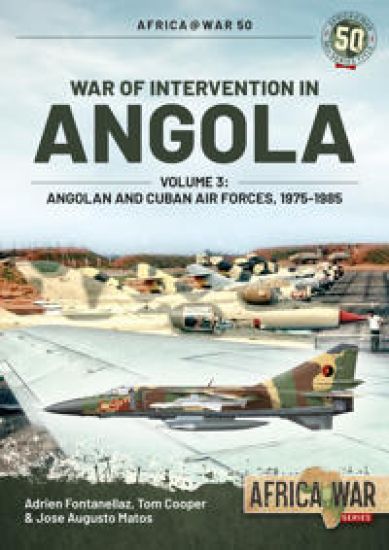
War of Intervention in Angola, Volume 3

Adrien Fontanellaz; José Matos; Tom Cooper

Helion Company
2020
nidottu

Halvin toimitettuna 28,40 €

War of Intervention in Angola, Volume 3 covers the air warfare during the II Angolan War – fought 1975-1992 – through narrating the emergence and operational history of the Angolan Air Force and Air Defence Force (FAPA/DAA) as told by Angolan and Cuban sources. Most accounts of this conflict – better known in the West as the ‘Border War’ or the ‘Bush War’, as named by its South African participants – tend to find the operations by the FAPA/DAA barely worth mentioning. A handful of published histories mention two of its MiG-21s claimed as shot down by Dassault Mirage F.1 interceptors of the South African Air Force (SAAF) in 1981 and 1982, and at least something about the activities of its MiG-23 interceptors during the battles of the 1987-1988 period. On the contrary, the story told by Angolan and Cuban sources not only reveals an entirely different image of the air war over Angola of the 1980s: indeed, it reveals to what degree this conflict was dictated by the availability – or the lack of – air power and shows that precisely this issue dictated the way that the commanders of the Cuban contingents deployed to the country – whether as advisors or as combat troops – planned and conducted their operations. It is thus little surprising that the first contingent of Cuban troops deployed to Angola during Operation Carlota, in late 1975, included a sizeable group of pilots and ground personnel who subsequently helped build-up the FAPA/DAA from virtually nothing. They continued that work over the following 14 years - sometimes in cooperation of Soviet advisors and others from East European countries – eventually establishing an air force that by 1988 maintained what South African military intelligence and the media subsequently described as the ‘most advanced air defence system in Africa’. Not only the air defence system in question, but also the aircraft serving as its extended arms, ultimately managed a unique feat in contemporary military history: they enabled an air force equipped with Soviet-made aircraft and trained along the Soviet doctrine to establish at least a semblance of aerial superiority over an air force equipped with Western-made aircraft and operating under a Western doctrine. Based on extensive research with help of Angolan and Cuban sources, the ‘War of Intervention in Angola, Volume 3’, traces the military build-up of the FAPA/DAA in the period 1975-1992, its capabilities and its intentions. Moreover, it provides a unique, blow-by-blow account of its combat operations and experiences. The volume is illustrated with 100 rare photographs, half a dozen maps and 15 colour profiles, thus providing a unique source of reference on this topic.