Kirjojen hintavertailu – 12 903 725 kirjaa ja 27 kauppaa

Kirjailija

Joseph A. Schumpeter

Kirjat ja teokset yhdessä paikassa: 33 kirjaa, julkaisuja vuosilta 1954–2024, suosituimpiin kuuluu Theory of Economic Development. Vertaile teosten hintoja ja tarkista saatavuus suomalaisista kirjakaupoista.

Nimi esiintyy myös muodoissa: Joseph A Schumpeter

33 kirjaa

Kirjojen julkaisuvuodet: 1954–2024.

And Democracy Capitalism, Socialism

And Democracy Capitalism, Socialism

Joseph A Schumpeter

WWW.Bnpublishing.com
2024
sidottu

Halvin toimitettuna 32,10 €

Joseph Schumpeter's classic *Capitalism, Socialism and Democracy* explains the process of capitalism's "creative destruction" - a key principle in understanding the logic of globalization." - Thomas L. Friedman, *Foreign Policy*In this definitive third and final edition of his prophetic masterwork, Joseph A. Schumpeter introduced the world to the concept of "creative destruction," which forever altered how global economics is approached and perceived. Now featuring a new introduction by Pulitzer Prize-winning Schumpeter biographer Thomas K. McCraw, *Capitalism, Socialism and Democracy* is essential reading for anyone who seeks to understand where the world economy is headed." If Keynes was the most important economist of the 20th century, then Schumpeter may well be the most important of the 21st. . . . His economic understanding was brilliant . . . He tried to set long-term economic growth-entrepreneurship and enterprise-at the top of the discipline's agenda. . . . *Capitalism, Socialism, and Democracy* is superb." This special edition features large fonts, making it accessible as a Large Print Edition.
The Theory of Economic Development

The Theory of Economic Development

Joseph A. Schumpeter

Routledge
2021
nidottu

Halvin toimitettuna 32,40 €

Joseph Schumpeter (1883–1950) is one of the most fascinating and influential economists of the twentieth century, renowned for his brilliant and unorthodox insights into the nature of capitalism. His students include leading economists such as Paul Samuelson, Robert Solow and the former chairman of the Federal Reserve, Alan Greenspan. The Theory of Economic Development is one of Schumpeter's most important books and the one that made him famous. He poses a fundamental question: why does economic development proceed cyclically rather than evenly? Turning prevailing economic theory, which approached economics as equilibrium, on its head, Schumpeter argues it is because economics is constantly transformed by its own internal forces. These forces are the 'circular flow' of economic life; economic development, characterised by disruption and innovation; and finally, the levers that push and pull capitalism including credit, profit and interest. These are all manifested in the ‘business cycle’, one of Schumpeter's major contributions to understanding economics and now a perennial feature of virtually all economics and business curricula. He is also the first economist to place the entrepreneur at the heart of capitalism, anticipating subsequent fascination with entrepreneurship in popular business and management writing. Schumpeter also lays the groundwork for his subsequent, highly influential idea of the 'creative destruction' characteristic of radical and rapid economic change. The Theory of Economic Development remains a vital, magisterial account of economics and the nature of capitalism whose many insights remain highly relevant today. This Routledge Classics edition includes a new Introduction by Richard Swedberg.
The Theory of Economic Development

The Theory of Economic Development

Joseph A. Schumpeter

Routledge
2021
sidottu

Halvin toimitettuna 216,80 €

Joseph Schumpeter (1883–1950) is one of the most fascinating and influential economists of the twentieth century, renowned for his brilliant and unorthodox insights into the nature of capitalism. His students include leading economists such as Paul Samuelson, Robert Solow and the former chairman of the Federal Reserve, Alan Greenspan. The Theory of Economic Development is one of Schumpeter's most important books and the one that made him famous. He poses a fundamental question: why does economic development proceed cyclically rather than evenly? Turning prevailing economic theory, which approached economics as equilibrium, on its head, Schumpeter argues it is because economics is constantly transformed by its own internal forces. These forces are the 'circular flow' of economic life; economic development, characterised by disruption and innovation; and finally, the levers that push and pull capitalism including credit, profit and interest. These are all manifested in the ‘business cycle’, one of Schumpeter's major contributions to understanding economics and now a perennial feature of virtually all economics and business curricula. He is also the first economist to place the entrepreneur at the heart of capitalism, anticipating subsequent fascination with entrepreneurship in popular business and management writing. Schumpeter also lays the groundwork for his subsequent, highly influential idea of the 'creative destruction' characteristic of radical and rapid economic change. The Theory of Economic Development remains a vital, magisterial account of economics and the nature of capitalism whose many insights remain highly relevant today. This Routledge Classics edition includes a new Introduction by Richard Swedberg.
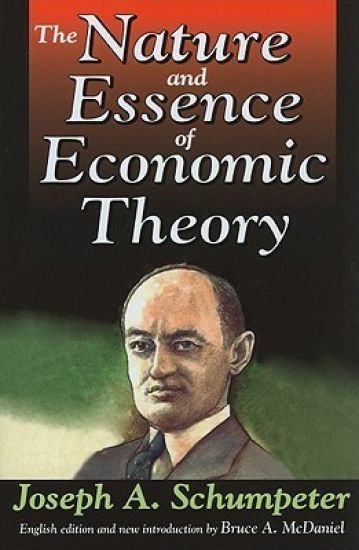
The Nature and Essence of Economic Theory

The Nature and Essence of Economic Theory

Joseph A. Schumpeter

AldineTransaction
2017
nidottu
Joseph A. Schumpeter was a monumental figure in the history and development of economics. This work brings together his brilliant lectures, delivered more than a century ago, in its first English-language paperback edition. Here, readers will discover Schumpeter's search for an economic science devoid of moral or political dogma. The Nature and Essence of Economic Theory works out what people should think of pure economics, what its nature is, what its methods and findings are, and where thought takes off from there. The book shows the limitations and weaknesses of nineteenth-century economics and how the field could be and was improved by establishing a fundamental differentiation between 'statistics' and 'dynamics'. To convey his arguments, Schumpeter uses certain axioms that form a consistent, self-contained system and show how sound economic science is based on facts and events rather than presuppositions or definitions. Schumpeter's larger aim, beyond a pedagogic tool, was to deduce changes in the market, trade, and exchange of goods and services. He defined the task of economy as the description of the system and its change tendencies. If that can be achieved unequivocally, without resorting to doctrine or dogma, then the field can be considered self-contained.
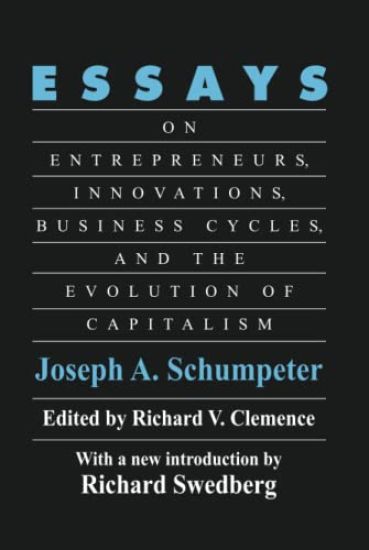
Essays

Essays

Joseph A. Schumpeter

Routledge
2017
sidottu
Ordinarily, the word essays is invoked at great risk by authors and publishers alike. But in the case of this special collection by Joseph A. Schumpeter, the great Austrian economist who finally settled at Harvard, the scholarly world knows this particular volume as his Essays. For a less pious younger generation, a subtitle has been added describing what these essays are about. In addition to the major themes of Schumpeter's life: the place of the entrepreneur in economic development, the risks and rewards of innovation, business cycles and why they occur, and the evolution of capitalism in Europe and America, the Essays contain statements on how Schumpeter viewed his own development; they discuss how he looked at Marxism, and how he feared that economics was in danger of becoming too ideological. Several of the Essays are classics. This is the case for "The Creative Response in Economic History" in which Schumpeter makes a plea for the close cooperation between economic theory and economic history. Another is "Science and Ideology," which constitutes Schumpeter's presidential address before the American Economic Association. Finally, there is the intriguing preface to the Japanese translation of Theory of Economic Development, in which Schumpeter names Walras and Marx as his two great predecessors. Even those who treasure the original publication were irritated by the remarkably poor quality of much of the book, which reproduced everything from typewriter script to nearly unreadable, reduced double columns. These lapses have been corrected in this new edition. Here Schumpeter's Essays can finally be read with the enjoyment, no lesS than enlightenment, they deserve. The volume is alive to the basic issues of our time. The reader can look forward to intellectual insight and stimuli of the highest order.
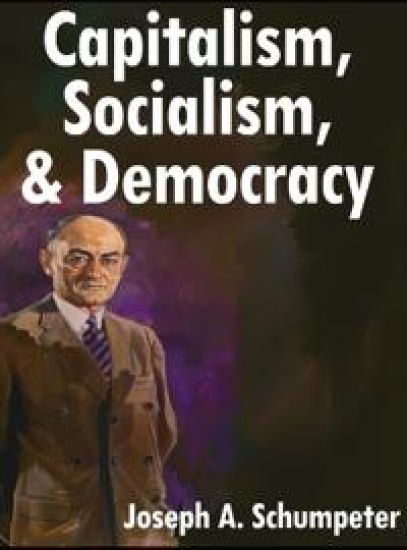
Capitalism, Socialism and Democracy

Capitalism, Socialism and Democracy

Joseph A. Schumpeter

Routledge
2015
sidottu
Capitalism, Socialism and Democracy remains one of the greatest works of social theory written this century. When it first appeared the New English Weekly predicted that `for the next five to ten years it will cetainly remain a work with which no one who professes any degree of information on sociology or economics can afford to be unacquainted.' Fifty years on, this prediction seems a little understated. Why has the work endured so well? Schumpeter's contention that the seeds of capitalism's decline were internal, and his equal and opposite hostility to centralist socialism have perplexed, engaged and infuriated readers since the book's publication. By refusing to become an advocate for either position Schumpeter was able both to make his own great and original contribution and to clear the way for a more balanced consideration of the most important social movements of his and our time.
Capitalism, Socialism and Democracy

Capitalism, Socialism and Democracy

Joseph A. Schumpeter

Routledge
2015
sidottu
Capitalism, Socialism and Democracy remains one of the greatest works of social theory written in the twentieth Century. Schumpeter's contention that the seeds of capitalism's decline were internal, and his equal and opposite hostility to centralist socialism have perplexed, engaged and infuriated readers since the book's first publication in 1943. By refusing to become an advocate for either position, Schumpeter was able both to make his own great and original contribution and to clear the way for a more balanced consideration of the most important social movements of his and our time. This Routledge Classics edition includes a new Introduction by one of the world’s leading economists, Joseph Stiglitz.
Imperialism and the Social Classes

Imperialism and the Social Classes

Joseph A. Schumpeter

Literary Licensing, LLC
2013
sidottu
Imperialism and the Social Classes is a book written by Joseph A. Schumpeter, a renowned economist and political scientist. The book explores the relationship between imperialism and social classes, and how this relationship has affected the development of capitalist economies. Schumpeter argues that imperialism is a product of the capitalist system, and that it is driven by the desire of capitalist elites to expand their economic and political power. He also contends that imperialism has led to the formation of a global economic system that is dominated by a small group of wealthy nations and corporations. The book examines the impact of imperialism on different social classes, including the working class, the middle class, and the ruling class. Schumpeter argues that imperialism has had a negative impact on the working class, as it has led to the exploitation of labor and the suppression of workers' rights. At the same time, he acknowledges that imperialism has also benefited certain segments of the middle class, particularly those involved in international trade and finance. The ruling class, he argues, has been the primary beneficiary of imperialism, as it has allowed them to accumulate wealth and power on a global scale. Overall, Imperialism and the Social Classes is a thought-provoking analysis of the relationship between imperialism and social classes, and the ways in which this relationship has shaped the development of modern capitalist economies. It is a must-read for anyone interested in economics, politics, and global history. This is a new release of the original 1951 edition. This scarce antiquarian book is a facsimile reprint of the old original and may contain some imperfections such as library marks and notations. Because we believe this work is culturally important, we have made it available as part of our commitment for protecting, preserving, and promoting the world's literature in affordable, high quality, modern editions, that are true to their original work.
The Analysis of Economic Change

The Analysis of Economic Change

Joseph A. Schumpeter

Literary Licensing, LLC
2013
sidottu

Halvin toimitettuna 37,10 €

The Analysis of Economic Change is a book written by Joseph A. Schumpeter, a renowned economist of the 20th century. The book is a comprehensive analysis of the various factors that contribute to economic change and growth. Schumpeter presents a unique perspective on the evolution of economic systems, arguing that innovation and entrepreneurship are the driving forces behind economic progress. The book is divided into several sections, each of which explores a different aspect of economic change. The first section focuses on the role of innovation in economic growth, examining how new technologies and ideas can transform entire industries. Schumpeter argues that entrepreneurs are the key to innovation, as they are the ones who take risks and develop new products and services. The second section of the book looks at the impact of economic change on society. Schumpeter argues that economic growth can have both positive and negative effects on society, and that policymakers need to be aware of these effects when making decisions about economic policy. The final section of the book explores the future of economic change, examining how technological advancements and globalization will continue to shape the global economy in the coming decades. Overall, The Analysis of Economic Change is a seminal work in the field of economics, offering a unique perspective on the role of innovation and entrepreneurship in economic growth. It is a must-read for anyone interested in understanding the forces that drive economic change and progress. This is a new release of the original 1935 edition. This scarce antiquarian book is a facsimile reprint of the old original and may contain some imperfections such as library marks and notations. Because we believe this work is culturally important, we have made it available as part of our commitment for protecting, preserving, and promoting the world's literature in affordable, high quality, modern editions, that are true to their original work.
The Nature and Essence of Economic Theory

The Nature and Essence of Economic Theory

Joseph A. Schumpeter

AldineTransaction
2010
sidottu
Joseph A. Schumpeter was a monumental figure in the history and development of economics. This work brings together his brilliant lectures, delivered more than a century ago, in its first English-language paperback edition. Here, readers will discover Schumpeter's search for an economic science devoid of moral or political dogma. The Nature and Essence of Economic Theory works out what people should think of pure economics, what its nature is, what its methods and findings are, and where thought takes off from there. The book shows the limitations and weaknesses of nineteenth-century economics and how the field could be and was improved by establishing a fundamental differentiation between 'statistics' and 'dynamics'. To convey his arguments, Schumpeter uses certain axioms that form a consistent, self-contained system and show how sound economic science is based on facts and events rather than presuppositions or definitions. Schumpeter's larger aim, beyond a pedagogic tool, was to deduce changes in the market, trade, and exchange of goods and services. He defined the task of economy as the description of the system and its change tendencies. If that can be achieved unequivocally, without resorting to doctrine or dogma, then the field can be considered self-contained.