Kirjailija
Joseph Conrad
Kirjat ja teokset yhdessä paikassa: 2 285 kirjaa, julkaisuja vuosilta 1895–2026, suosituimpiin kuuluu Lord Jim. Vertaile teosten hintoja ja tarkista saatavuus suomalaisista kirjakaupoista.
Nimi esiintyy myös muodoissa: Joseph. Conrad
2 285 kirjaa
Kirjojen julkaisuvuodet: 1895–2026.
Several of us, all more or less connected with the sea, were dining in a small river-hostelry not more than thirty miles from London, and less than twenty from that shallow and dangerous puddle to which our coasting men give the grandiose name of "German Ocean." And through the wide windows we had a view of the Thames; an enfilading view down the Lower Hope Reach. But the dinner was execrable, and all the feast was for the eyes. That flavour of salt-water which for so many of us had been the very water of life permeated our talk. He who hath known the bitterness of the Ocean shall have its taste forever in his mouth. But one or two of us, pampered by the life of the land, complained of hunger. It was impossible to swallow any of that stuff. And indeed there was a strange mustiness in everything. The wooden dining-room stuck out over the mud of the shore like a lacustrine dwelling; the planks of the floor seemed rotten; a decrepit old waiter tottered pathetically to and fro before an antediluvian and worm-eaten sideboard; the chipped plates might have been disinterred from some kitchen midden near an inhabited lake; and the chops recalled times more ancient still. They brought forcibly to one's mind the night of ages when the primeval man, evolving the first rudiments of cookery from his dim consciousness, scorched lumps of flesh at a fire of sticks in the company of other good fellows; then, gorged and happy, sat him back among the gnawed bones to tell his artless tales of experience-the tales of hunger and hunt-and of women, perhaps
The Secret Agent: A Simple Tale
Joseph Conrad
Createspace Independent Publishing Platform
2017
nidottu
he novel is set in London in 1886 and follows the life of Mr. Verloc, a secret agent. Verloc is also a businessman who owns a shop which sells pornographic material, contraceptives, and bric-a-brac. He lives with his wife Winnie, his mother-in-law, and his brother-in-law, Stevie. Stevie has a mental disability, possibly autism, which causes him to be very excitable; his sister, Verloc's wife, attends to him, treating him more as a son than as a brother. Verloc's friends are a group of anarchists of which Comrade Ossipon, Michaelis, and "The Professor" are the most prominent. Although largely ineffectual as terrorists, their actions are known to the police. The group produce anarchist literature in the form of pamphlets entitled F. P., an acronym for The Future of the Proletariat. The novel begins in Verloc's home, as he and his wife discuss the trivialities of everyday life, which introduces the reader to Verloc's family. Soon after, Verloc leaves to meet Mr. Vladimir, the new First Secretary in the embassy of a foreign country. Although a member of an anarchist cell, Verloc is also secretly employed by the Embassy as an agent provocateur. Vladimir informs Verloc that from reviewing his service history he is far from an exemplary model of a secret agent and, to redeem himself, must carry out an operation - the destruction of Greenwich Observatory by a bomb explosion. Vladimir explains that Britain's lax attitude to anarchism endangers his own country, and he reasons that an attack on 'science', which he claims is the current vogue amongst the public, will provide the necessary outrage for suppression. Verloc later meets with his friends, who discuss politics and law, and the notion of a communist revolution. Unbeknownst to the group, Stevie, Verloc's brother-in-law, overhears the conversation, which greatly disturbs him.
Chance is a novel by Joseph Conrad, published in 1913 following serial publication the previous year. Although the novel was not one upon which Conrad's later critical reputation was to depend, it was his greatest commercial success upon initial publication. Chance is narrated by Conrad's regular narrator, Charles Marlow, but is characterised by a complex, nested narrative in which different narrators take up the story at different points. The novel is also unusual among its author's works for its focus on a female character: the heroine, Flora de Barral. The narrators describe and attempt to interpret various episodes in the life of Miss de Barral, the daughter of a convicted swindler named Smith de Barral (though this character is famous in the world of the novel as a criminal, he may, at least at first, have been merely an incompetent banker). Miss de Barral leads a sheltered life while her father is prosperous, then must rely on the generosity of others, who resent her or have agendas for her, before she escapes by marrying one Captain Anthony. Chance opened a path to commercial success for Conrad after years of slow progress and obscurity. This success could be measured by the record sale of the book in 1914, which outsold all his previous publications and shot him to fame. This classic title has been published by RADLEY BOOKS. Each RADLEY CLASSIC is a meticulously restored, luxurious and faithful reproduction of a classic book; produced with elegant text layout, clarity of presentation, and stylistic features that make reading a true pleasure. Special attention is given to legible fonts and adequate letter sizing, correct line length for readability, generous margins and triple lead (lavish line separation); plus we do not allow any mistakes/changes/additions to creep into the author's words. Visit RADLEY BOOKS at www.radleybooks.com (or search RADLEY CLASSIC on Amazon) to see more classic book titles in this series.
Typhoon
Joseph Conrad
Createspace Independent Publishing Platform
2017
nidottu
Halvin toimitettuna 12,60 €
I believe he had seen us out of the window coming off to dine in the dinghy of a fourteen-ton yawl belonging to Marlow my host and skipper. We helped the boy we had with us to haul the boat up on the landing-stage before we went up to the riverside inn, where we found our new acquaintance eating his dinner in dignified loneliness at the head of a long table, white and inhospitable like a snow bank. The red tint of his clear-cut face with trim short black whiskers under a cap of curly iron-grey hair was the only warm spot in the dinginess of that room cooled by the cheerless tablecloth. We knew him already by sight as the owner of a little five-ton cutter, which he sailed alone apparently, a fellow yachtsman in the unpretending band of fanatics who cruise at the mouth of the Thames. But the first time he addressed the waiter sharply as 'steward' we knew him at once for a sailor as well as a yachtsman. Presently he had occasion to reprove that same waiter for the slovenly manner in which the dinner was served. He did it with considerable energy and then turned to us. "If we at sea," he declared, "went about our work as people ashore high and low go about theirs we should never make a living. No one would employ us. And moreover no ship navigated and sailed in the happy-go-lucky manner people conduct their business on shore would ever arrive into port."
Mr Verloc, the secret agent, keeps a shop in London's Soho where he lives with his wife Winnie, her infirm mother, and her idiot brother, Stevie. When Verloc is reluctantly involved in an anarchist plot to blow up the Greenwich Observatory things go disastrously wrong, and what appears to be 'a simple tale' proves to involve politicians, policemen, foreign diplomats and London's fashionable society in the darkest and most surprising interrelations.
The Secret Agent: A Simple Tale is a novel by Joseph Conrad, published in 1907. The story is set in London in 1886 and deals with Mr. Adolf Verloc and his work as a spy for an unnamed country (presumably Russia). The novel deals broadly with anarchism, espionage and terrorism. It also deals with exploitation of the vulnerable in Verloc's relationship with his brother-in-law Stevie, who has a learning difficulty. Because of its terrorism theme, it was noted as "one of the three works of literature most cited in the American media" two weeks after the September 11 attacks. The novel was published to favourable reviews, with most agreeing with the view of The Times Literary Supplement, that the novel "increase d] Mr. Conrad's reputation, already of the highest." More recently, The Secret Agent is considered to be one of Conrad's finest novels. The Independent calls it " o]ne of Conrad's great city novels whilst The New York Times insists that it is "the most brilliant novelistic study of terrorism". It is considered to be a "prescient" view of the 20th century, foretelling the rise of terrorism, anarchism, and the growth of spy agencies, such as MI5. This classic title has been published by RADLEY BOOKS. Each RADLEY CLASSIC is a meticulously restored, luxurious and faithful reproduction of a classic book; produced with elegant text layout, clarity of presentation, and stylistic features that make reading a true pleasure. Special attention is given to legible fonts and adequate letter sizing, correct line length for readability, generous margins and triple lead (lavish line separation); plus we do not allow any mistakes/changes/additions to creep into the author's words. Visit RADLEY BOOKS at www.radleybooks.com (or search RADLEY CLASSIC on Amazon) to see more classic book titles in this series.
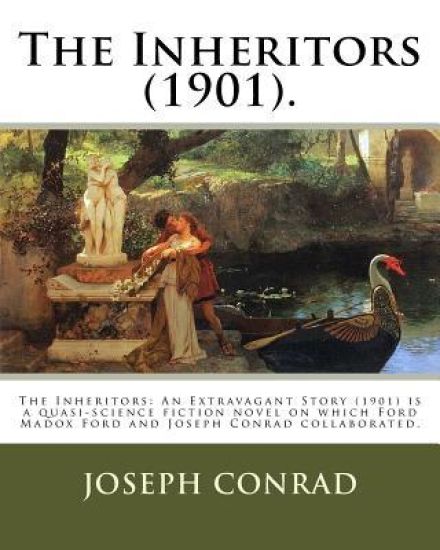
The Inheritors (1901). By: Joseph Conrad and Ford Hermann Hueffer (Ford Madox Ford): The Inheritors: An Extravagant Story (1901) is a quasi-scien
Ford Hermann Hueffer; Joseph Conrad
Createspace Independent Publishing Platform
2017
nidottu
The Inheritors: An Extravagant Story (1901) is a quasi-science fiction novel on which Ford Madox Ford and Joseph Conrad collaborated. It looks at society's mental evolution and what is gained and lost in the process. Written before the first World War, its themes of corruption and the effect of the 20th Century on British aristocracy appeared to predict history. Plot: The inheritors are a breed of cold materialists, calling themselves Fourth Dimensionists, whose task is to occupy the earth. An unsuccessful English writer meets a fascinating woman by chance, who seems to talk in metaphors. She claims to be from the Fourth Dimension and a major player in a plan to "inherit the earth". They go their separate ways with her pledge they will meet again and again. At their next meeting, the woman freely reveals her "identity" and two others in their circle, one a cabinet minister (Charles Gurnard) and Fox, the editor of a new paper - all of them competing with each other. She has taken on his name and pretends to be his sister, invading firstly his down-on-their-luck aristocratic family by financing improvements to their estate, until she moves with his aunt, to Paris. Each time she turns up, she is in greater connection with prominent political people and appears more dazzlingly beautiful and more desirable to Arthur.... Joseph Conrad (Polish pronunciation: born J zef Teodor Konrad Korzeniowski; 3 December 1857 - 3 August 1924) was a Polish-British writer regarded as one of the greatest novelists to write in the English language. He joined the British merchant marine in 1878, and was granted British nationality in 1886. Though he did not speak English fluently until his twenties, he was a master prose stylist who brought a non-English sensibility into English literature. He wrote stories and novels, many with a nautical setting, that depict trials of the human spirit in the midst of an impassive, inscrutable universe. Conrad is considered an early modernist, though his works still contain elements of 19th-century realism. His narrative style and anti-heroic characters have influenced many authors, including F. Scott Fitzgerald, William Faulkner, Ernest Hemingway, Andr Malraux, 6] George Orwell: 254 Graham Greene, Gabriel Garc a M rquez, John le Carr , V. S. Naipaul, Philip Roth, J. M. Coetzee, and Salman Rushdie. Many films have been adapted from, or inspired by, Conrad's works... Ford Madox Ford (born Ford Hermann Hueffer (17 December 1873 - 26 June 1939) was an English novelist, poet, critic and editor whose journals, The English Review and The Transatlantic Review, were instrumental in the development of early 20th-century English literature.
Lord Jim (1900) NOVEL by: Joseph Conrad
Joseph Conrad
Createspace Independent Publishing Platform
2017
nidottu