Kirjailija
Joseph Ginat
Kirjat ja teokset yhdessä paikassa: 11 kirjaa, julkaisuja vuosilta 1994–2013, suosituimpiin kuuluu From War to Peace. Vertaile teosten hintoja ja tarkista saatavuus suomalaisista kirjakaupoista.
11 kirjaa
Kirjojen julkaisuvuodet: 1994–2013.
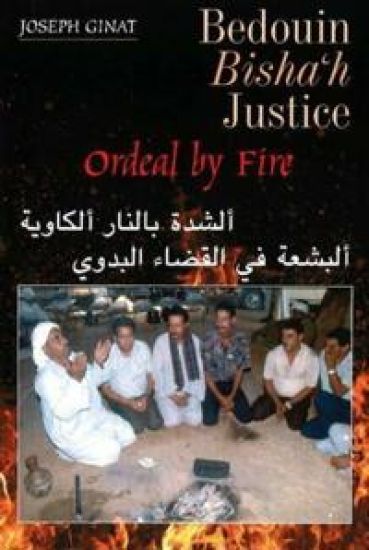
A book about blood homicide in Bedouin and rural Arab society in Israel.
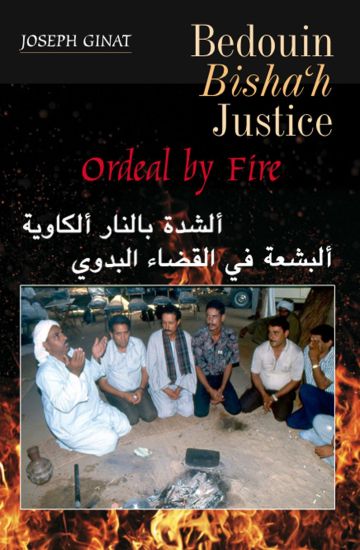
Trials by ordeal, a judicial practice in which the guilt or innocence of the accused is determined by subjecting them to a painful task, have taken place from ancient Mesopotamia until the present day. This volume focuses on a special type of ordeal by fire called the bishah ceremony, which originated in Bedouin societies and continues to be practiced in Egypt today. In Bedouin and Arab rural societies, when somebody suspects another person of theft, property damage, murder, manslaughter, illicit sexual relations, rape, or witchcraft, and there are no witness to the crime, this individual can request the suspect or suspects to accompany him to the mubasha', a Bedouin notable who conducts the ordeal by fire. The bisha'h ceremony was previously performed in Jordan and in Saudi Arabia as well as in Egypt. In Jordan, the late King Hussein banned the ordeal by fire in 1976. In Saudi Arabia, the mubasha' died in the late 1980s, without leaving a successor. Today, in Egypt, near Ismaliyya, a mubasha' continues to practice the ceremonial ordeal in which the suspect licks a ladle that is heated to between 600-900 degrees Celsius. If the suspect's tongue blisters, they are deemed guilty. If the tongue is clear, they are declared innocent. The author observed 169 of such ordeals, many of which are documented and illustrated in this volume. People who take part in the bisha'h ceremony not only come from various regions in Egypt, but also from other North African countries, and from several Middle Eastern countries, including the Gulf States. Most of the cases involve rural peasants rather than Bedouin, but there are also instances where city dwellers take part in the ordeal.
Water in the Middle East
K. David Hambright; F. Jamil Ragep; Joseph Ginat
Sussex Academic Press
2005
sidottu
"Water in the Middle East" presents historical and cross-cultural perspectives on water and conflict, prospects for future cooperation in the water arena among Middle Eastern countries, the political economy of water and technical solutions to water shortages in the Jordan Valley, and the relationships among water, agriculture, and environmental sustainability. Through case studies and essays, natural and social scientific water experts from Israel, Palestine, Jordan, and the United States examine: The role of water in Middle East conflicts and the possibility of regional solutions to water scarcity requiring cooperation among states; Long-term prospects of various aquifers and other fresh-water sources, including desalination; current and future environmental deterioration of water resources; Breakthroughs and developments increasing regional agricultural productivity, depending less on high-quality waters while turning to lower quality resources, such as recycled and brackish waters; alternatives to current water-usage patterns, particularly with regard to agriculture and the possibility of redirecting water to tourism and other economic sectors. While this book highlights the complexities pertaining to regional water scarcity and inequitable distribution, the contributors offer no definitive conclusions or facile solutions; yet there is a broad consensus that regional solutions to maximize water resources must be pursued even as desalination becomes more viable both from technical/economic standpoints. The continuing deterioration of existing water supplies in terms of quantity and quality mandate that any solution must be achieved within a political/social framework of peace, enlightened economic policies, and the application of technical solutions that take due account of environmental concerns.
The Middle East Peace Process
Joseph Ginat; Edward J. Perkins; Edwin G. Corr; HRH Prince El Hassan bin Talal of Jordan
University of Oklahoma Press
2003
sidottu
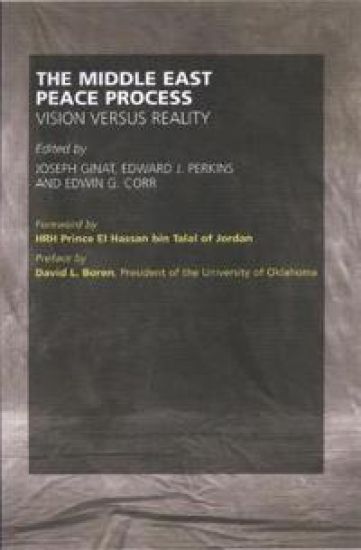
Political stability is a crucial precondition for peace in the Middle East. In The Middle East Peace Process: Vision versus Reality, Joseph Ginat, Edward J. Perkins, and Edwin G. Corr have assembled a comprehensive overview of the complex peace negotiations taking place among Middle Eastern nations to resolve the Israeli-Palestinian conflict and forge normal relations between Arab nations and Israel. More than thirty academics and practitioners probe, discuss, and engage themselves with issues concerning the peace process. The volume focuses first on the Oslo Agreement and the Palestinian Track; then addresses Israeli relations with Egypt, Jordan, Lebanon, Syria, and Iraq; and concludes with an examination of relations between Israelis and Palestinians in Jerusalem. The Middle East Peace Process is the result of the Center for Peace Studies conference ""The Peace Process in the Middle East,"" cosponsored by the International Program Center at the University of Oklahoma and the University of Haifa in Israel. The volume features a foreword by HRH Prince El Hassan bin Talal of Jordan and a preface by David L. Boren, President of the University of Oklahoma.
The Palestinian Refugees
Edward J. Perkins; Joseph Ginat; HRH Prince El Hassan bin Talal of Jordan
University of Oklahoma Press
2002
sidottu
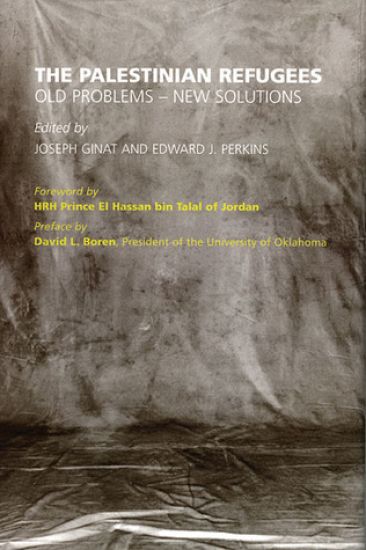
As violence escalates in the Middle East, a peace agreement between Israel and Palestine seems more elusive than ever. Yet one thing remains clear: without constructive dialogue such an agreement cannot occur. This timely volume presents just such a dialogue. It brings together opinions, perspectives, and research focused on one of the region's most complex and volatile problems: the Palestinian refugee situation. Based on a 1999 conference at the University of Oklahoma International Program Center, Palestinian Refugees combines contributions from Israelis, Palestinians, Jordanians, Egyptians, Americans, and Europeans. In addition to focusing on the Palestinian refugees, the essays present various proposals for solving the Palestinian problem. Organized in two parts, the volume presents both scholarly essays and position papers. The scholarly essays place current issues in historical context and explore the Palestinian belief in the ""right of return"" and questions of appropriate compensation. The position papers focus on policy and offer a variety of perspectives. Concluding the volume is a special essay on public polls that gauge how Palestinians and Israelis view the circumstances of Palestinian refugees and what they feel about possible solutions.
There has been little progress on the refugee problem because of official Palestinian public positions, other Arab countries' approach to the 'right of return' of all Palestinian refugees, and the contrasting Israeli public policy of not allowing any refugees to return to Israel. Such polar-opposite approaches can never resolve this difficult and longstanding humanitarian problem. By working collectively, the world's leading experts from Arab countries, the Palestinian Authority, Israel, Europe and the United States have developed a chessboard of proposed solutions. The volume in part reflects the polarization that exists on the issue, and in part moves away from the political slogans of both sides, toward concrete proposals for negotiating a comprehensive agreement.
A book about blood homicide in Bedouin and rural Arab society in Israel.
Polygamous Families in Contemporary Society
Irwin Altman; Joseph Ginat; Sterling M. McMurrin
Cambridge University Press
1996
sidottu
In this intriguing book, social psychologist Irwin Altman and anthropologist Joseph Ginat examine husband-wife and wife-wife relationships in contemporary Mormon polygamous families. They describe how husbands and wives in plural families cope with their complex lifestyle in various facets of everyday life, including courtship, weddings, honeymoons, adjustments to a new life, living arrangements, and the husband's rotation among his wives. Other important topics include budget and resource management, psychological attachments to homes, and the social-emotional relationships between family members. This pioneering, comprehensive analysis of life in modern day Mormon polygamous families uses first-hand interviews and observations to describe this unusual family lifestyle. It adds to our understanding of close relationships and complements knowledge on other modern relationship forms, such as single-parent families, blended families, and cohabiting partners.
Polygamous Families in Contemporary Society
Irwin Altman; Joseph Ginat; Sterling M. McMurrin
Cambridge University Press
1996
pokkari
In this intriguing book, social psychologist Irwin Altman and anthropologist Joseph Ginat examine husband-wife and wife-wife relationships in contemporary Mormon polygamous families. They describe how husbands and wives in plural families cope with their complex lifestyle in various facets of everyday life, including courtship, weddings, honeymoons, adjustments to a new life, living arrangements, and the husband’s rotation among his wives. Other important topics include budget and resource management, psychological attachments to homes, and the social-emotional relationships between family members. This pioneering, comprehensive analysis of life in modern day Mormon polygamous families uses first-hand interviews and observations to describe this unusual family lifestyle. It adds to our understanding of close relationships and complements knowledge on other modern relationship forms, such as single-parent families, blended families, and cohabiting partners.
A survey of Arab-Israeli relations from the Yom Kippur War to the present day. This book reveals new first-hand material based on personal involvement at a high political level, and analysis by top Middle East experts. The volume deals with two pivotal events, in 1973 and 1993, leading the Middle East from War to Peace, as well as the dramatic changes connecting these years and events over time, incorporating Israeli, Palestinian and American scholars and participants in the fighting, diplomacy and secret contacts which moved towards resolving the world's longest ongoing conflict.