

Kirjailija
Joseph Ledoux
Kirjat ja teokset yhdessä paikassa: 11 kirjaa, julkaisuja vuosilta 1999–2021, suosituimpiin kuuluu Le Cerveau des émotions. Vertaile teosten hintoja ja tarkista saatavuus suomalaisista kirjakaupoista.
11 kirjaa
Kirjojen julkaisuvuodet: 1999–2021.

Rock Music and Psychoanalysis: Frenis Zero Press
Joseph LeDoux; Lewis Aron; Rod Tweedy
Frenis Zero
2020
nidottu
Longlisted for the PEN/E. O. Wilson Literary Science Writing Award A leading neuroscientist offers a history of the evolution of the brain from unicellular organisms to the complexity of animals and human beings today Renowned neuroscientist Joseph LeDoux digs into the natural history of life on earth to provide a new perspective on the similarities between us and our ancestors in deep time. This page-turning survey of the whole of terrestrial evolution sheds new light on how nervous systems evolved in animals, how the brain developed, and what it means to be human. In The Deep History of Ourselves, LeDoux argues that the key to understanding human behavior lies in viewing evolution through the prism of the first living organisms. By tracking the chain of the evolutionary timeline he shows how even the earliest single-cell organisms had to solve the same problems we and our cells have to solve each day. Along the way, LeDoux explores our place in nature, how the evolution of nervous systems enhanced the ability of organisms to survive and thrive, and how the emergence of what we humans understand as consciousness made our greatest and most horrendous achievements as a species possible.
The Deep History Of Ourselves
Joseph LeDoux
Prentice Hall Press
2019
sidottu
Halvin toimitettuna 33,80 €
A leading neuroscientist offers a history of the evolution of the brain from unicellular organisms to the complexity of animals and human beings today Renowned neuroscientist Joseph LeDoux digs into the natural history of life on earth to provide a new perspective on the similarities between us and our ancestors in deep time. This page-turning survey of the whole of terrestrial evolution sheds new light on how nervous systems evolved in animals, how the brain developed, and what it means to be human. In The Deep History of Ourselves, LeDoux argues that the key to understanding all human behavior lies in viewing evolution through the prism of the first living organisms. By tracking the chain of the evolutionary timeline he shows how even the earliest single-cell organisms had to solve the same problems we and our cells have to solve each day. Along the way, LeDoux explores our place in nature, how the evolution of nervous systems enhanced the ability of organisms to survive and thrive, and how the emergence of what we humans understand as consciousness made our greatest and most horrendous achievements as a species possible.
Anxious: Using the Brain to Understand and Treat Fear and Anxiety
Joseph LeDoux
PENGUIN BOOKS
2016
nidottu
"A rigorous, in-depth guide to the history, philosophy, and scientific exploration of this widespread emotional state . . . LeDoux] offers a magisterial review of the role of mind and brain in the generation of unconscious defense responses and consciously expressed anxiety. . . . His] charming personal asides give an impression of having a conversation with a world expert." --Nature A comprehensive and accessible exploration of anxiety, from a leading neuroscientist and the author of Synaptic Self Collectively, anxiety disorders are our most prevalent psychiatric problem, affecting about forty million adults in the United States. In Anxious, Joseph LeDoux, whose NYU lab has been at the forefront of research efforts to understand and treat fear and anxiety, explains the range of these disorders, their origins, and discoveries that can restore sufferers to normalcy. LeDoux's groundbreaking premise is that we've been thinking about fear and anxiety in the wrong way. These are not innate states waiting to be unleashed from the brain, but experiences that we assemble cognitively. Treatment of these problems must address both their conscious manifestations and underlying non-conscious processes. While knowledge about how the brain works will help us discover new drugs, LeDoux argues that the greatest breakthroughs may come from using brain research to help reshape psychotherapy. A major work on one of our most pressing mental health issues, Anxious explains the science behind fear and anxiety disorders. Praise for Anxious " Anxious] helps to explain and prevent the kinds of debilitating anxieties all of us face in this increasingly stressful world." --Daniel J. Levitin, author of The Organized Mind and This Is Your Brain on Music "A careful tour through the current neuroscience of fear and anxiety . . . Anxious] will reward the informed reader." --The Wall Street Journal "An extraordinarily ambitious, provocative, challenging, and important book. Drawing on the latest research in neuroscience (including work in his own laboratory), LeDoux provides explanations of the origins, nature, and impact of fear and anxiety disorders." --Psychology Today
Anxiety is the most prevalent psychiatric problem of our time. Decades of research have gone into probing its mysteries and developing treatments. But what if we’ve been thinking about fear and anxiety in the wrong way for all these years? This is the groundbreaking premise behind a wave of new research, led by the lab of renowned neuroscientist Joseph LeDoux. He believes that fear and anxiety are not innate states, simply waiting to be unleashed in the brain. Rather they are assembled experiences, and that has huge implications for patients. By mapping brain circuits, LeDoux explains the origins of anxiety disorders and reveals discoveries that can restore sufferers to normality. As impressive as it is timely, Anxious is a comprehensive survey of cutting-edge research revolutionising the way we treat our most pressing mental health issue.
Synaptic Self: How Our Brains Become Who We Are / Neurobiologie de la personnalité
Joseph LeDoux
Odile Jacob
2003
nidottu
In The Emotional Brain, Joseph LeDoux revealed the neural circuit of pain, and then used it as a model to study the neural foundations of the emotions. In The Synaptic Brain, he carries on his study and delves into the cellular interconnections of the emotional circuits, i.e. the synapses, the areas between neurons that chemical and electric signals travel across. This fundamental search leads Stern to ask a profound question: How are our personalities constituted? What maintains their endurance through time, in spite of all the life changes that we choose or are subjected to? We think, act, memorise and feel through our synapses, and they in turn determine our preferences and beliefs, thus defining our most intimate selves and enabling us to act as unique, differentiated iedividuals. LeDoux shows how neurons shape experience and how experience, through the learning process, determines the neuron network. Fear, for example, is both innate and learned. A rat will freeze at the sight of its very first rat ? but it can also be taught to freeze when there's no rat in sight. The synaptic interconnections are established by our personal experiences and, in this sense, we fashion our own brains, we create our own personalities. Joseph LeDoux is a professor at the Center for Neural Science, New York University. He is regarded as one of the world's foremost specialists in the neurosciences. His 1996 book, The Emotional Brain, has already become a classic in its field.
Synaptic Self: How Our Brains Become Who We Are
Joseph LeDoux
PENGUIN BOOKS
2003
nidottu
Halvin toimitettuna 21,50 €
In 1996 Joseph LeDoux's The Emotional Brain presented a revelatory examination of the biological bases of our emotions and memories. Now, the world-renowned expert on the brain has produced with a groundbreaking work that tells a more profound story: how the little spaces between the neurons--the brain's synapses--are the channels through which we think, act, imagine, feel, and remember. Synapses encode the essence of personality, enabling each of us to function as a distinctive, integrated individual from moment to moment. Exploring the functioning of memory, the synaptic basis of mental illness and drug addiction, and the mechanism of self-awareness, Synaptic Self is a provocative and mind-expanding work that is destined to become a classic.
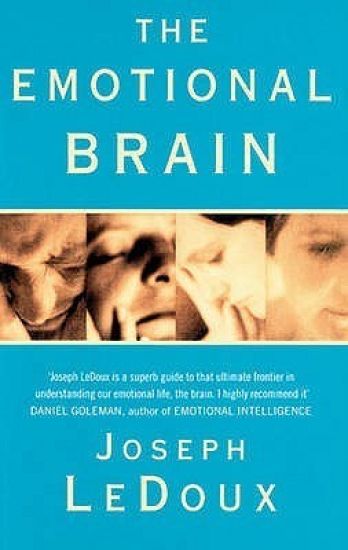
The science behind David Goleman's Emotional Intelligence.