Kirjojen hintavertailu – 12 903 725 kirjaa ja 27 kauppaa

Kirjailija

Joseph M. Siracusa

Kirjat ja teokset yhdessä paikassa: 29 kirjaa, julkaisuja vuosilta 2002–2026, suosituimpiin kuuluu Reagan, Bush, Gorbachev. Vertaile teosten hintoja ja tarkista saatavuus suomalaisista kirjakaupoista.

29 kirjaa

Kirjojen julkaisuvuodet: 2002–2026.

A History of U.S. Nuclear Testing and Its Influence on Nuclear Thought, 1945–1963
The story of U. S. nuclear testing between 1945 and 1963 is a vivid and exciting one, but also one of profound importance. It is a story of trailblazing scientific progress, weapons of mass destruction, superpower rivalry, accidents, radiological contamination, politics, and diplomacy. The testing of weapons that defined the course and consequences of the Cold War was itself a crucial dimension to the narrative of that conflict. Further, the central question - Why conduct nuclear tests? - was fully debated among American politicians, generals, civilians, and scientists, and ultimately it was victory for those who argued in favor of national security over diplomatic and environmental costs that normalized nuclear weapons tests. A History of U. S. Nuclear Testing and Its Influence on Nuclear Thought, 1945–1963 is an examination of this question, beginning with the road to normalization and, later, de-normalization of nuclear testing, leading to the Nuclear Test Ban Treaty in 1963. As states continue to pursue nuclear weaponry, nuclear testing remains an important political issue in the twenty-first century.
The Death Penalty and U.S. Diplomacy

The Death Penalty and U.S. Diplomacy

Wesley Kendall; Joseph M. Siracusa

Rowman Littlefield
2013
sidottu
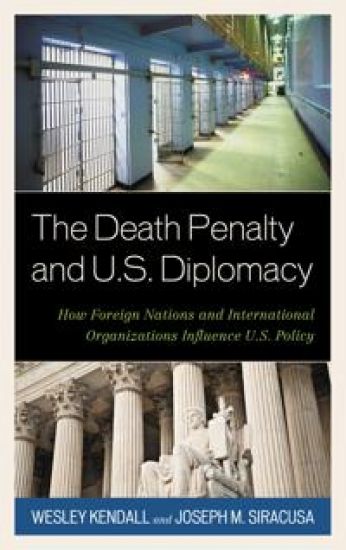
This unique book examines how U. S. domestic policy regarding the death penalty has been influenced by international pressures, in particular, by foreign nations and international organizations. International pressure has mounted against America’s use of the death penalty, straining diplomatic ties. U. S. policies that endorse the execution of juveniles, the mentally handicapped, and disadvantaged foreign nationals have been recognized by allied nations and international organizations as human rights abuses and violation of international law. Further, organizations such as the United Nations and Amnesty International have issued scathing reports revealing racial bias and fundamental procedural flaws in almost every phase of the judicial process in capital cases. International pressures directed at governmental entities, in particular specific states such as Texas, can have a profound impact on governmental operational efficiency and public opinion and effectively render capital punishment cost-prohibitive from a public policy standpoint. The Death Penalty and U. S. Diplomacy analyzes the institutional response to specific forms of foreign intervention and influence such as consular intervention, international litigation, and extradition negotiation. This is documented through case studies such as how a judge in Texas v. Green turned to a comparative Delaware case that relied on the Vienna Convention to remove the death penalty as possible punishment, and how Mexico pressured the White House in two separate cases. By demonstrating that foreign actors have done much to constrain the United States to abandon its policies of executing foreigners, as well as its own citizens, the book explores the foreign dimensions of the U. S. death penalty while advancing the debate surrounding the viability of this controversial policy.
Foreign Affairs and the Founding Fathers

Foreign Affairs and the Founding Fathers

Norman A. Graebner; Richard Dean Burns; Joseph M. Siracusa

Praeger Publishers Inc
2011
sidottu
This concise diplomatic history of the Confederation era is the first new work on the topic in a generation. In its pages, three distinguished diplomatic historians offer a realist interpretation of the way in which the Founding Fathers conducted foreign affairs, refreshing our collective memory about their priorities and their values. When three of the nation's leading historians come together to fashion a fresh study of American history, the resulting work cannot help but be a monumental addition to the field. Foreign Affairs and the Founding Fathers: From Confederation to Constitution, 1776–1787 is such a work. These eminent scholars provide a thoughtful, realist interpretation of the Founders' view of America's place in the world, delivering a timely reassessment of their aspirations, thoughts, and actions during the seminal decades of the American nation. This book takes readers backstage where they can eavesdrop on the Founders to better understand their motives and intentions and see how they responded to threats and problems associated with America's place in the world. Arguing that the Founding Fathers essentially thought and acted in terms of power—ranking matters of national interest and security over ideology and moral concerns—the book sheds new light on the foreign policy opportunities and challenges of the day, as the Founders weighed and determined them. In so doing, it offers important guideposts for our own time.
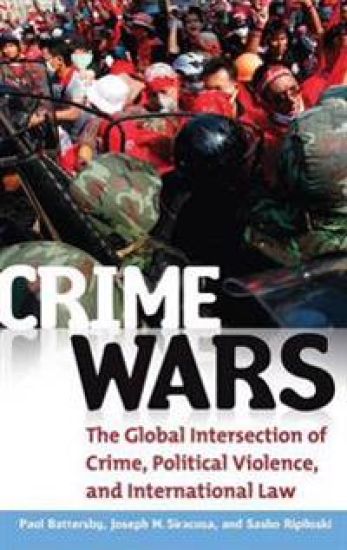
Crime Wars

Crime Wars

Paul Battersby; Joseph M. Siracusa; Sasho Ripiloski

Praeger Publishers Inc
2011
sidottu
This expert analysis addresses the many interconnections between political violence and crime, including the transnational crimes of non-state actors and the international crimes of states. How crime is defined goes to the heart of the boundaries drawn between legitimate and illegitimate use of force; between violence and non-violence; between legality and criminality. Crime Wars: The Global Intersection of Crime, Political Violence, and International Law presents a well-balanced, introductory analysis of this critically important subject, addressing the many points of intersection between political legitimacy, law, political violence, and criminal activity. This thought-provoking work examines the criminalization of the developing world, opening up debate about the nature and cause of acts that transgress laws, rules, and social norms. Acknowledging the subjective nature of crime, it nevertheless urges readers to ask difficult questions about why law-abiding persons and states sanction rule infringement, law breaking, and amoral policy. Perhaps most importantly, the authors assess structures of global and regional governance, including legal regimes and major international non-governmental agencies, to offer unique, historically grounded insights into security challenges and the ways in which global crimes and wars can be addressed in the 21st century.
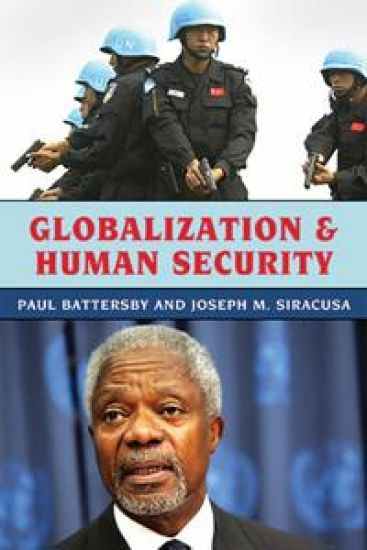
Globalization and Human Security

Globalization and Human Security

Paul Battersby; Joseph M. Siracusa

Rowman Littlefield Publishers
2009
sidottu
This concise text presents a focused, well-rounded, and clear-eyed introduction to the concept of human security. Questioning the utility of traditional national-security frameworks in the post–Cold War era, Paul Battersby and Joseph M. Siracusa argue that we must urgently reconsider the principle of state sovereignty in a global world where threats to humanity are beyond the capacity of any one nation to address through unilateral action. The authors highlight circumstances, actors, and influences beyond the traditional focus on state security, especially the role of international organizations and nongovernmental organizations. They also emphasize the importance of human rights, arguing for the development of an effective intervention capacity to protect individuals from state action as well as other security threats arising from conflict, poverty, disease, and environmental degradation. A welcome alternative to state-centric approaches to security, this balanced book will be a valuable supplement for courses in international and national security.
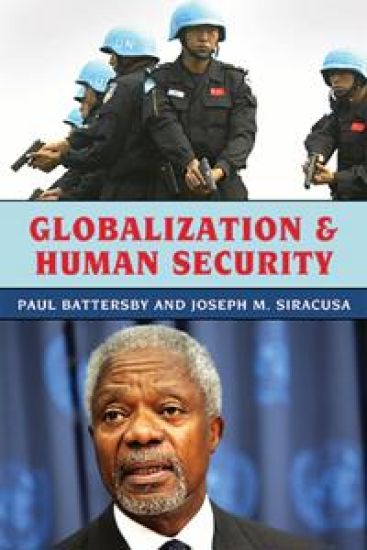
Globalization and Human Security

Globalization and Human Security

Paul Battersby; Joseph M. Siracusa

Rowman Littlefield Publishers
2009
nidottu
This concise text presents a focused, well-rounded, and clear-eyed introduction to the concept of human security. Questioning the utility of traditional national-security frameworks in the post–Cold War era, Paul Battersby and Joseph M. Siracusa argue that we must urgently reconsider the principle of state sovereignty in a global world where threats to humanity are beyond the capacity of any one nation to address through unilateral action. The authors highlight circumstances, actors, and influences beyond the traditional focus on state security, especially the role of international organizations and nongovernmental organizations. They also emphasize the importance of human rights, arguing for the development of an effective intervention capacity to protect individuals from state action as well as other security threats arising from conflict, poverty, disease, and environmental degradation. A welcome alternative to state-centric approaches to security, this balanced book will be a valuable supplement for courses in international and national security.
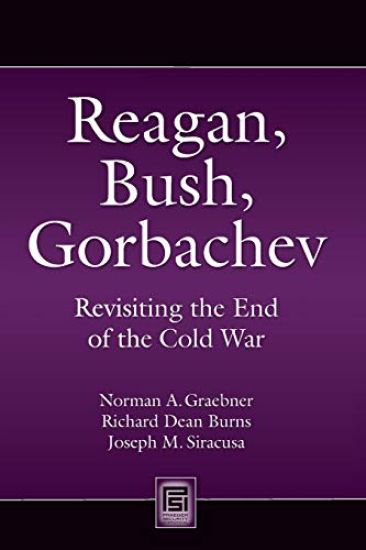
Reagan, Bush, Gorbachev

Reagan, Bush, Gorbachev

Norman A. Graebner; Richard Dean Burns; Joseph M. Siracusa

Praeger Publishers Inc
2008
nidottu
This work is a contemporary chronicle of the Cold War and offers an analysis of policy and rhetoric of the United States and Soviet Union during the 1980s. The authors examine the assumptions that drove political decisions and the rhetoric that defined the relationship as the Soviet Union began to implode. This work demonstrates that while the subsequent unraveling of the Soviet empire was an unintended side effect of Mikhail Gorbachev's reforms, termination of the Cold War was not. Ronald Reagan deserves full credit for recognizing Gorbachev's sincerity and his determination to change the direction of Soviet policies. For this, Reagan felt the full wrath of anticommunist hawks for doing business with a communist leader. But it was Gorbachev who concluded the superpowers had become mesmerized by ideological myths which ruled out any meaningful discussions of a possible accommodation of political issues for more than four decades. The evidence is compelling that Gorbachev himself broke the Cold War's ideological straight jacket that had paralyzed Moscow and Washington's ability to resolve their differences. Though politically weakened, Gorbachev conceded nothing to U. S. military superiority. Never did he negotiate from a position of weakness. In doing so, the last Soviet leader faced even greater political and physical risk. Without Gorbachev the end of the Cold War could have played out very differently and perhaps with great danger.
Real-World Nuclear Deterrence

Real-World Nuclear Deterrence

David G. Coleman; Joseph M. Siracusa

Praeger Publishers Inc
2006
sidottu
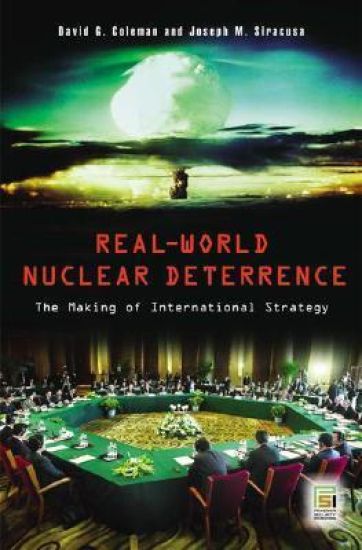
The threat of nuclear weapons did not fade away with the collapse of the Soviet Union. Rather, the geopolitical disorders of the post-Cold War era and the rise of global terrorism have ensured that they remain conspicuously present on the world stage as a serious international concern. With the eight or nine nuclear powers maintaining about 27,000 nuclear weapons in their arsenals to this day, it is clear that they are here to stay for the foreseeable future. The primary mission of these nuclear forces has been and remains deterrence. Using plain language rather than policy jargon, this historically focused book shows how nuclear deterrence has worked rather than how it should. It then shows how the growing threat of nuclear proliferation threatens to create a far more complicated international situation largely because of the attendant proliferation of state nuclear deterrents. By drawing on a wide array of new sources from international archives and the latest in international scholarship, Coleman and Siracusa put some of the most important and enduring problems of nuclear deterrence over the past sixty years into global context. Nuclear deterrence in the real world often operates very differently from how it should according to the prevailing theories, and Coleman and Siracusa take a fresh look at how nuclear weapons policy has been made, finding that it often has had surprisingly little to do with what works and what does not. By studying in depth how governments here and abroad have confronted and dealt with some of the most important issues in nuclear weapons policy, for example, How many nuclear weapons are enough? and What is it that will deter? they find that the making of nuclear weapons policy is a complex, fluid bargaining process subject to the tides of politics, budgets, threat perception, ideology, technology, parochial service rivalries, flawed information, and sometimes just plain wishful thinking.
Depression to Cold War

Depression to Cold War

Joseph M. Siracusa; David G. Coleman

Praeger Publishers Inc
2002
sidottu
Organized around the office of the president, this study focuses on American behavior at home and abroad from the Great Depression to the onset of the end of the Cold War, two key points during which America sought a re-definition of its proper relationship to the world. Domestically, American society continued the process of industrialization and urbanization that had begun in the 19th century. Urban growth accompanied industrialism, and more and more Americans lived in cities. Because of industrial growth and the consequent interest in foreign markets, the United States became a major world power. American actions as a nation, whether as positive attempts to mold events abroad or as negative efforts to enjoy material abundance in relative political isolation, could not help but affect the course of world history. Under President Hoover, the federal government was still a comparatively small enterprise; challenges of the next six decades would transform it almost beyond belief, touching in one way or another almost every facet of American life. Before the New Deal, few Americans expected the government to do anything for them. By the end of the Second World War and in the aftermath of the Great Depression, however, Americans had turned to Washington for help. Even the popular Reagan presidency of the 1980s, the most conservative since Hoover, would fail to undo the basic New Deal commitment to assist struggling Americans. There would be no turning back the clock, at home or abroad.