Kirjojen hintavertailu – 12 903 735 kirjaa ja 27 kauppaa

Kirjailija

Joseph McDonald

Kirjat ja teokset yhdessä paikassa: 11 kirjaa, julkaisuja vuosilta 1994–2026, suosituimpiin kuuluu Duncan McDonald. Vertaile teosten hintoja ja tarkista saatavuus suomalaisista kirjakaupoista.

11 kirjaa

Kirjojen julkaisuvuodet: 1994–2026.

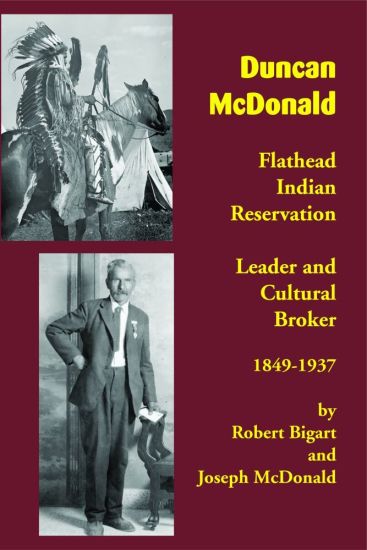
Duncan McDonald

Duncan McDonald

Robert J. Bigart; Joseph McDonald

Salish Kootenai College
2016
pokkari
Duncan McDonald (1849–1937) led a remarkable life as an entrepreneur, tribal leader, historian, and cultural broker on the Flathead Indian Reservation in western Montana. The mixed-blood son of a Hudson’s Bay Company fur trader and a Nez Perce Indian woman, Duncan accompanied the Pend d’Oreille Indians on a buffalo hunt and horse-stealing expedition to the Montana plains during the early 1870s. During the late nineteenth century he was put in charge of Fort Connah, the Hudson’s Bay Company post on the Flathead Indian Reservation, and worked as an independent trader across the northern Rocky Mountains. Duncan established a hotel and restaurant, among other businesses, on the Flathead Reservation. In 1878 and 1879 he wrote a history of the 1877 Nez Perce Indian War, which was published in a Deer Lodge, Montana, newspaper. Long a thorn in the side of Flathead Indian agents, Duncan was chairman of the Flathead Business Committee between 1909 and 1924 and for many years represented the interests and views of tribal members to the Montana white community.

Developing a Security Training Program

Developing a Security Training Program

Joseph McDonald

TAYLOR FRANCIS LTD
2024
sidottu
Developing a Security Training Program focuses on how to establish a comprehensive training program for a security department from the ground up. This book highlights formal curriculum development, consistent and continual training, and the organizational benefits including how such security training will be a value-add. It’s long overdue for the industry to revisit old security training models from the past — to both general staff as well as to the dedicated security staff and professionals within organizations — and examine and revamp such with a fresh perspective. Given the current, dynamic environment for businesses — and the threats businesses face — it is important that any such training consider all procedures and policies, and be fully integrated into the company culture. This includes maintaining an eye on budgetary and financial costs while recognizing the need to budget for more training resources to maintain resilience and adaptability to current challenges and future changes to the environment. There is only one way to prepare your staff and that is through comprehensive and consistent training. Developing a Security Training Program provides the blueprint and tools for professionals to provide ongoing, targeted, and comprehensive security training at a low, budget-friendly cost.
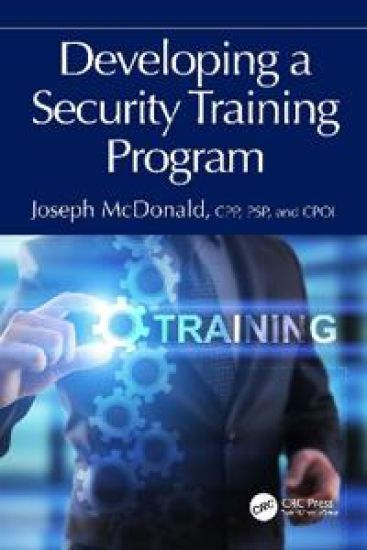
Developing a Security Training Program

Developing a Security Training Program

Joseph McDonald

TAYLOR FRANCIS LTD
2024
nidottu
Developing a Security Training Program focuses on how to establish a comprehensive training program for a security department from the ground up. This book highlights formal curriculum development, consistent and continual training, and the organizational benefits including how such security training will be a value-add. It’s long overdue for the industry to revisit old security training models from the past — to both general staff as well as to the dedicated security staff and professionals within organizations — and examine and revamp such with a fresh perspective. Given the current, dynamic environment for businesses — and the threats businesses face — it is important that any such training consider all procedures and policies, and be fully integrated into the company culture. This includes maintaining an eye on budgetary and financial costs while recognizing the need to budget for more training resources to maintain resilience and adaptability to current challenges and future changes to the environment. There is only one way to prepare your staff and that is through comprehensive and consistent training. Developing a Security Training Program provides the blueprint and tools for professionals to provide ongoing, targeted, and comprehensive security training at a low, budget-friendly cost.
Warrior Athletes

Warrior Athletes

Robert J. Bigart; Joseph McDonald

SALISH KOOTENAI COLLEGE
2023
pokkari
Warrior Athletes tells the story of ten prominent twentieth-century Salish and Kootenai Indian athletes from the Flathead Indian Reservation in western Montana: Charles Allard Jr. was a University of Montana football star and the 1901 captain of the Grizzly football team. Two Feathers, William Matt, and Henry Matt wrestled professionally in Montana and the Pacific Northwest from 1903 to 1905. Nick Lassa played on the Carlisle Indian School football team in Carlisle, Pennsylvania, from 1914 to 1918. Between 1918 and 1921 he played football for the Haskell Indian Institute in Lawrence, Kansas, and was a member of the only all-Indian National Football League team from 1922 to 1923. Jimmy Dupuis fought regular boxing matches in western Montana from 1930 to 1940. Frenchy Roullier and Sam Clairmont were basketball stars at Ronan High School, Mount Saint Charles College, and western Montana independent basketball teams from 1925 to 1940. Archie McDonald played football for the Haskell Indian Institute in Kansas and the Montana State University Grizzlies at Missoula from 1930 to 1939. Marvin Camel was the only Native American two-time world boxing champion and boxed professionally from 1973 to 1990.
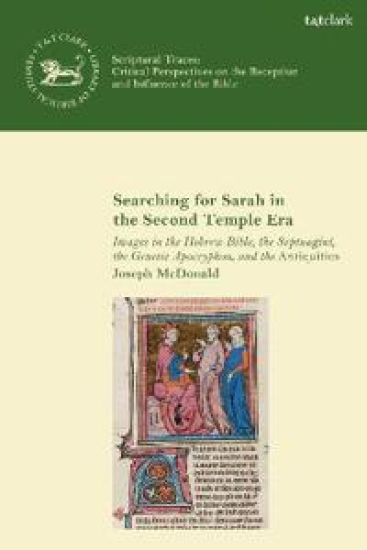
Searching for Sarah in the Second Temple Era

Searching for Sarah in the Second Temple Era

Joseph McDonald

T. T.Clark Ltd
2021
nidottu
Seeking to build upon recent scholarship based on Biblical women, Joseph McDonald uses a character-centered literary approach to read the story of Sarah as it was told and retold in the Second Temple period. McDonald offers an alternative to the usual approaches to “rewritten Bible” narratives, which often emphasize near-context, synoptic comparison of retold stories and their scriptural precursors, arguing that examination of retold narratives as narratives reveals important aspects of their internal literary effects, that may otherwise go unnoticed. Taken together, McDonald suggests that such readings reveal one of Sarah’s trans-narrative or “deep traits,” as a curious, multi-faceted resemblance to the character of Abraham. The richness of her images, however, shows that this resemblance is not the ultimate distillation of Sarah, but a symptom of the kind of restriction that she consistently faces in this literature. McDonald concludes that creative readings of the narratives featuring Sarah in the Hebrew Bible, the Septuagint, the Genesis Apocryphon, and the Jewish Antiquities of Josephus illuminate Sarah as a complex and sometimes contradictory figure, whose individuality and agency often struggle to escape limitations placed upon her – both by other characters, such as Abraham and God, and by the narrators of her tales.
Searching for Sarah in the Second Temple Era

Searching for Sarah in the Second Temple Era

Joseph McDonald

T. T.Clark Ltd
2020
sidottu
Seeking to build upon recent scholarship based on Biblical women, Joseph McDonald uses a character-centered literary approach to read the story of Sarah as it was told and retold in the Second Temple period. McDonald offers an alternative to the usual approaches to “rewritten Bible” narratives, which often emphasize near-context, synoptic comparison of retold stories and their scriptural precursors, arguing that examination of retold narratives as narratives reveals important aspects of their internal literary effects, that may otherwise go unnoticed. Taken together, McDonald suggests that such readings reveal one of Sarah’s trans-narrative or “deep traits,” as a curious, multi-faceted resemblance to the character of Abraham. The richness of her images, however, shows that this resemblance is not the ultimate distillation of Sarah, but a symptom of the kind of restriction that she consistently faces in this literature. McDonald concludes that creative readings of the narratives featuring Sarah in the Hebrew Bible, the Septuagint, the Genesis Apocryphon, and the Jewish Antiquities of Josephus illuminate Sarah as a complex and sometimes contradictory figure, whose individuality and agency often struggle to escape limitations placed upon her – both by other characters, such as Abraham and God, and by the narrators of her tales.
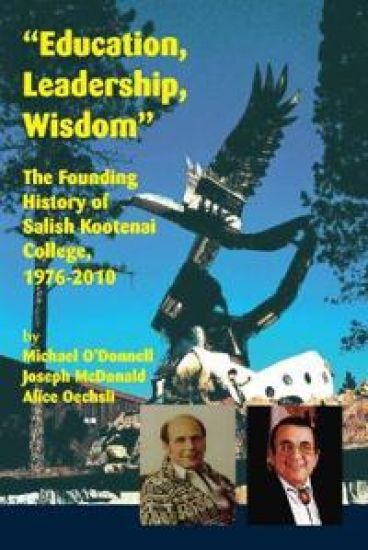
"Education, Leadership, Wisdom"

"Education, Leadership, Wisdom"

Michael O'Donnell; Joseph McDonald; Alice Oechsli

Salish Kootenai College
2018
pokkari
“Education, Leadership, Wisdom” is an institutional history of one of the leading Native American tribal colleges. Salish Kootenai College began in 1976 as a response from the Confederated Salish and Kootenai Tribes to the failure of higher education to recruit, educate, and graduate Native American students from the Flathead Indian Reservation in western Montana. The college opened its borrowed doors to students in winter term 1977 as a newly formed tribal college and as a branch campus of Flathead Valley Community College of Kalispell, Montana. By 2010 the college offered eleven bachelor’s degrees, fifteen associate degrees, and five vocational certificate programs of study to 877 full-time equivalent students. Instructional and student support services were provided by 68 full-time faculty, 53 part-time faculty, and 120 staff members. From 1980 to 2010 the college conferred 1,461 associate and bachelor’s degrees on Indian students, more than the total Indian graduates of all Montana public and private colleges and universities in the last 125 years.
Academic Libraries

Academic Libraries

Joseph McDonald; Lynda B Micikas

Praeger Publishers Inc
1994
sidottu
This book offers a completely new approach to the measurement of academic library effectiveness. Based on a significant empirical investigation, it contradicts established practices such as the measurement of outputs as indicators of effectiveness and the tendency to focus the evaluation of library effectiveness on the success of isolated activities. The book also explores in detail the fundamental inadequacy of library-based bibliographic instruction and information-seeking skills development. It argues that a student learns in order to become information literate and does not become information literate in order to learn. In so doing, it challenges much of the accepted wisdom in libraries and information technology.