Kirjojen hintavertailu – 12 903 725 kirjaa ja 27 kauppaa

Kirjailija

Joseph W. Goodman

Kirjat ja teokset yhdessä paikassa: 11 kirjaa, julkaisuja vuosilta 1995–2026, suosituimpiin kuuluu Exponential Explosions of Technology. Vertaile teosten hintoja ja tarkista saatavuus suomalaisista kirjakaupoista.

Nimi esiintyy myös muodoissa: Joseph W Goodman

11 kirjaa

Kirjojen julkaisuvuodet: 1995–2026.

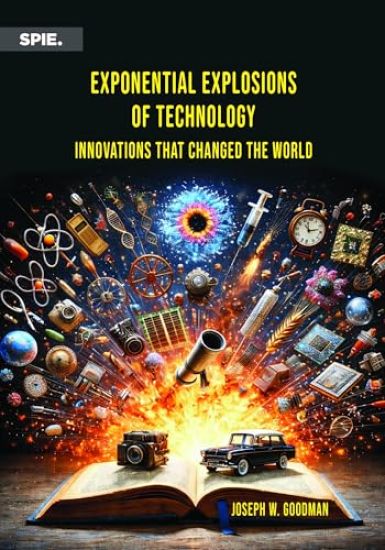
Exponential Explosions of Technology

Exponential Explosions of Technology

Joseph W. Goodman

SPIE PRESS
2026
nidottu
Exponential Explosions of Technology: Innovations That Changed the World by Joseph W. Goodman explores how technological progress across diverse fields has followed—and often still follows—exponential trajectories. It begins by explaining the mathematics and meaning of exponential growth, then traces the phenomenon through more than twenty major domains of science and engineering. The book weaves together advances in electronics, energy, communications, biotechnology, food production, and land transportation, revealing how compounding innovation has transformed human capability. It highlights the accelerating improvements in computing power, data storage, imaging, energy production, medical discovery, and artificial intelligence, alongside real-world consequences such as cheaper renewable energy, more powerful neural networks, and the rise of electric vehicles. In its later chapters, it investigates why exponential growth is so pervasive, and what natural, physical, and economic limits might eventually constrain it. Through quantitative data and historical analysis, the book offers a panoramic view of how exponential technological change continues to reshape civilization.
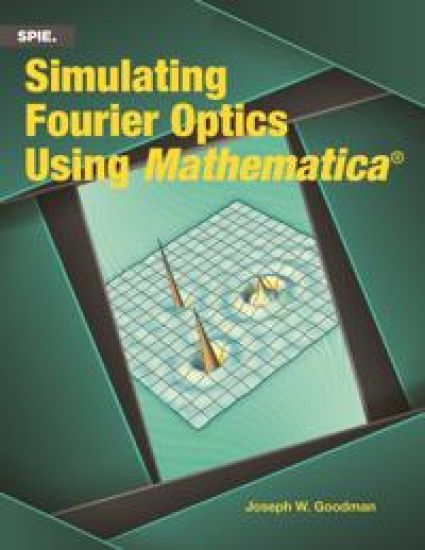
Simulating Fourier Optics Using Mathematica®
This book introduces the reader to many aspects of Fourier optics, using Mathematica as a simulation tool. A brief discussion of Mathematica's symbolic and numerical computation capabilities is introduced. Starting from the wave equation, several simulations of Fresnel and Fraunhofer diffraction problems are treated symbolically. Diffraction by an arbitrary linear optical system using ABCD matrices includes several symbolic examples. Recognizing that many diffraction problems cannot be solved symbolically, the discrete Fourier transform (DFT) is introduced and used to calculate many diffraction problems numerically. Three different numerical methods are used: numerical convolution, the Fresnel transform, and the Fresnel transfer function, with examples for each. Simulations of imaging with both coherent and incoherent light are covered both symbolically and numerically. Simulations of Gabor holography, Leith–Upatnieks holography, and phase-stepping holography are treated numerically. Finally, simulations of spatial filtering by manipulating the Fourier spectrum of an object are presented.
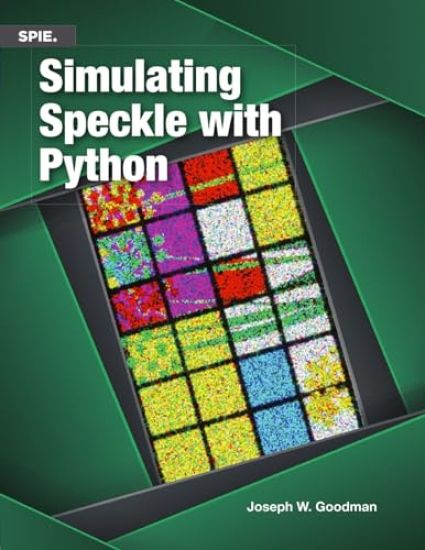
Simulating Speckle with Python

Simulating Speckle with Python

Joseph W. Goodman

SPIE PRESS
2024
nidottu
The speckle phenomenon is ubiquitous, occurring in all regions of the electromagnetic spectrum, as well as in both ultrasound and synthetic-aperture-radar imaging. Speckle occurs whenever radiation is reflected from a surface that is rough on the scale of a wavelength or is passed through a diffusing surface that introduces random path-length delays on the scale of a wavelength. This book is devoted to simulation of speckle phenomena using the software package Python. Various techniques for simulating speckle are discussed. Simulation topics include first-order amplitude and intensity statistics, speckle phenomena in both imaging and free-space propagation, speckle at low light levels, polarization speckle, phase vortices in speckle, and speckle metrology methods.
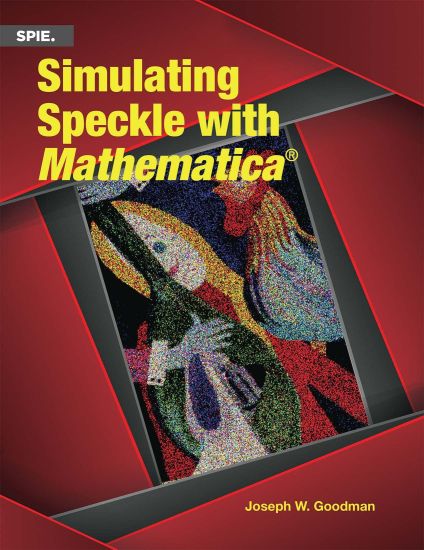
Simulating Speckle with Mathematica®

Simulating Speckle with Mathematica®

Joseph W. Goodman

SPIE PRESS
2022
nidottu
The speckle phenomenon is ubiquitous, occurring in all regions of the electromagnetic spectrum, as well as in both ultrasound and synthetic-aperture-radar imaging. Speckle occurs whenever radiation is reflected from a surface that is rough on the scale of a wavelength, or is passed through a diffusing surface that introduces random path-length delays on the scale of a wavelength. This book is devoted to simulation of speckle phenomena using the software package Mathematica®. Various techniques for simulating speckle are discussed. Simulation topics include first-order amplitude and intensity statistics, speckle phenomena in both imaging and free-space propagation, speckle at low light levels, polarization speckle, phase vortices in speckle, and speckle metrology methods.
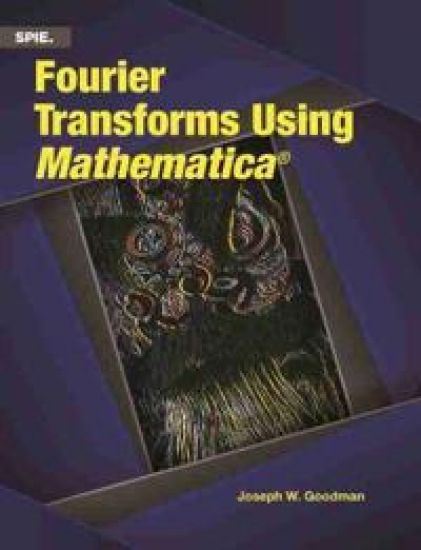
Fourier Transforms Using Mathematica

Fourier Transforms Using Mathematica

Joseph W. Goodman

SPIE Press
2021
nidottu
The Fourier transform is a ubiquitous tool used in most areas of engineering and physical sciences. The purpose of this book is two-fold: (1) to introduce the reader to the properties of Fourier transforms and their uses, and (2) to introduce the reader to the program Mathematica® and demonstrate its use in Fourier analysis. Unlike many other introductory treatments of the Fourier transform, this treatment will focus from the start on both one-dimensional and two-dimensional transforms, the latter of which play an important role in optics and digital image processing, as well as in many other applications. It is hoped that by the time readers have completed this book, they will have a basic understanding of Fourier analysis and Mathematica.
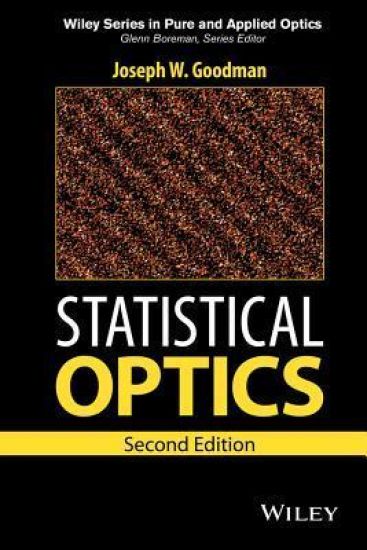
Statistical Optics

Statistical Optics

Joseph W. Goodman

Wiley-Blackwell
2015
sidottu
This book discusses statistical methods that are useful for treating problems in modern optics, and the application of these methods to solving a variety of such problems This book covers a variety of statistical problems in optics, including both theory and applications. The text covers the necessary background in statistics, statistical properties of light waves of various types, the theory of partial coherence and its applications, imaging with partially coherent light, atmospheric degradations of images, and noise limitations in the detection of light. New topics have been introduced in the second edition, including: Analysis of the Vander Pol oscillator model of laser lightCoverage on coherence tomography and coherence multiplexing of fiber sensorsAn expansion of the chapter on imaging with partially coherent light, including several new examplesAn expanded section on speckle and its propertiesNew sections on the cross-spectrum and bispectrum techniques for obtaining images free from atmospheric distortionsA new section on imaging through atmospheric turbulence using coherent lightThe addition of the effects of “read noise” to the discussions of limitations encountered in detecting very weak optical signalsA number of new problems and many new references have been added Statistical Optics, Second Edition is written for researchers and engineering students interested in optics, physicists and chemists, as well as graduate level courses in a University Engineering or Physics Department.
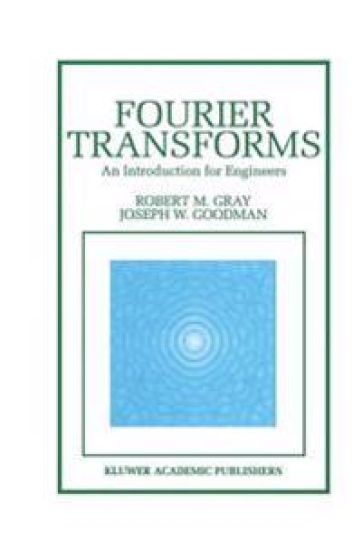
Fourier Transforms

Fourier Transforms

Robert M. Gray; Joseph W. Goodman

Springer-Verlag New York Inc.
2012
nidottu
The Fourier transform is one of the most important mathematical tools in a wide variety of fields in science and engineering. In the abstract it can be viewed as the transformation of a signal in one domain (typically time or space) into another domain, the frequency domain. Applications of Fourier transforms, often called Fourier analysis or harmonic analysis, provide useful decompositions of signals into fundamental or "primitive" components, provide shortcuts to the computation of complicated sums and integrals, and often reveal hidden structure in data. Fourier analysis lies at the base of many theories of science and plays a fundamental role in practical engineering design. The origins of Fourier analysis in science can be found in Ptolemy's decomposing celestial orbits into cycles and epicycles and Pythagorus' de­ composing music into consonances. Its modern history began with the eighteenth century work of Bernoulli, Euler, and Gauss on what later came to be known as Fourier series. J. Fourier in his 1822 Theorie analytique de la Chaleur [16] (still available as a Dover reprint) was the first to claim that arbitrary periodic functions could be expanded in a trigonometric (later called a Fourier) series, a claim that was eventually shown to be incorrect, although not too far from the truth. It is an amusing historical sidelight that this work won a prize from the French Academy, in spite of serious concerns expressed by the judges (Laplace, Lagrange, and Legendre) re­ garding Fourier's lack of rigor.
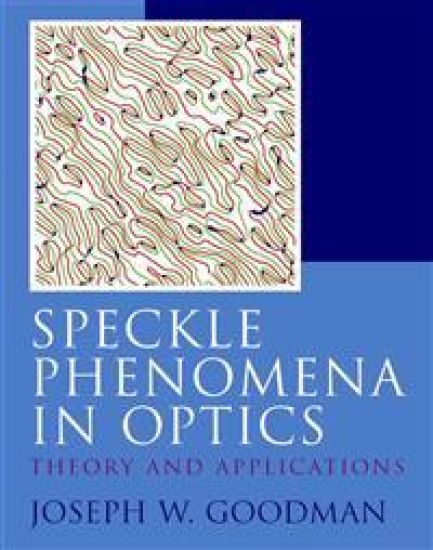
Speckle Phenomena in Optics

Speckle Phenomena in Optics

Joseph W Goodman

W. H. Freeman
2010
pokkari
Speckle Phenomena in Optics provides a comprehensive discussion of the statistical properties of speckle, as well as detailed coverage of its role in applications. Some of the applications discussed include speckle in astronomy, speckle in the eye, speckle in projection displays, speckle in coherence tomography, speckle in lithography, speckle in waveguides (modal noise), speckle in optical radar detection, and speckle in metrology. This book was written for graduate students and professionals working in a wide variety of fields.
Telecommunications Policy-Making in the European Union

Telecommunications Policy-Making in the European Union

Joseph W. Goodman

Edward Elgar Publishing Ltd
2006
sidottu
Examining the emergence of a European Union telecommunications policy, Joseph Goodman explains how and why the policy developed as it did and why certain reforms in the sector were easier to achieve than others. He provides a history of the key actors in the policy-making process from the first attempts by the national postal, telegraph, and telecommunication administrations to coordinate their telecommunications policies in the 1950s, to the implementation of a comprehensive EU telecommunications regulatory structure in 1998 and the development of a new regulatory structure in 2003. The analytical framework employed by the author draws upon new institutionalism and actor-based approaches, providing an opportunity to evaluate the utility of a synthetic approach for examining and explaining EU policy-making. The focus of his analysis is on the European Commission's two-pronged strategy of liberalisation and harmonisation, which began in the late 1980s and culminated in an important milestone on January 1st 1998, when the EU Member States fully opened their telecommunications markets to competition. He concludes that a synthetic approach, which enables the researcher to apply a number of approaches to multiple settings and various levels of analysis, is useful - even necessary - in understanding and explaining the many dimensions of EU policy-making. This authoritative study will be of interest to all those in the telecommunications industry - including attorneys, consultants, and lobbyists - who would like to know how the EU's policy developed. It will appeal, more generally, to political scientists and scholars of European history and politics.
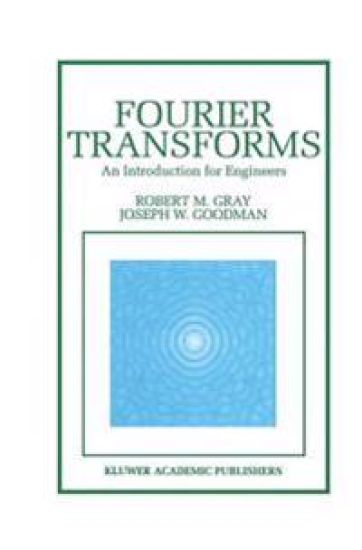
Fourier Transforms

Fourier Transforms

Robert M. Gray; Joseph W. Goodman

Springer
1995
sidottu
The Fourier transform is one of the most important mathematical tools in a wide variety of fields in science and engineering. In the abstract it can be viewed as the transformation of a signal in one domain (typically time or space) into another domain, the frequency domain. Applications of Fourier transforms, often called Fourier analysis or harmonic analysis, provide useful decompositions of signals into fundamental or "primitive" components, provide shortcuts to the computation of complicated sums and integrals, and often reveal hidden structure in data. Fourier analysis lies at the base of many theories of science and plays a fundamental role in practical engineering design. The origins of Fourier analysis in science can be found in Ptolemy's decomposing celestial orbits into cycles and epicycles and Pythagorus' de­ composing music into consonances. Its modern history began with the eighteenth century work of Bernoulli, Euler, and Gauss on what later came to be known as Fourier series. J. Fourier in his 1822 Theorie analytique de la Chaleur [16] (still available as a Dover reprint) was the first to claim that arbitrary periodic functions could be expanded in a trigonometric (later called a Fourier) series, a claim that was eventually shown to be incorrect, although not too far from the truth. It is an amusing historical sidelight that this work won a prize from the French Academy, in spite of serious concerns expressed by the judges (Laplace, Lagrange, and Legendre) re­ garding Fourier's lack of rigor.