Kirjojen hintavertailu – 12 903 724 kirjaa ja 27 kauppaa
Kirjailija
Joshua A. Fishman
Kirjat ja teokset yhdessä paikassa: 11 kirjaa, julkaisuja vuosilta 1985–2010, suosituimpiin kuuluu Introduction to Test Construction in the Social and Behavioral Sciences. Vertaile teosten hintoja ja tarkista saatavuus suomalaisista kirjakaupoista.
In this major new text, Joshua Fishman charts the rise of vernacular literacy in Europe, and the major social, economic, religious, political, demographic, educational and philosophical changes that attended it. Following the story up until the present day, the book examines the people who became leaders of the growth of vernacular literacy in Europe, and looks at how European colonizers viewed vernacular literacy efforts in their current and former colonies. Looking forward, Fishman discusses how new technology affects vernacular literacy both now and in the present, and whether developments in voice and visual media mean that vernacular literacy will be less important to future generations than it is to us. ‘European Vernacular Literacy’ is not only a review of well-known facts and theories of the rise of vernacular literacy in Europe, but an attempt to reintegrate and rethink them along new and provocative lines, meaning that the book will be of interest not only to students of literacy and history but also to scholars interested in Fishman’s latest contribution to sociolinguistics.
In this major new text, Joshua Fishman charts the rise of vernacular literacy in Europe, and the major social, economic, religious, political, demographic, educational and philosophical changes that attended it. Following the story up until the present day, the book examines the people who became leaders of the growth of vernacular literacy in Europe, and looks at how European colonizers viewed vernacular literacy efforts in their current and former colonies. Looking forward, Fishman discusses how new technology affects vernacular literacy both now and in the present, and whether developments in voice and visual media mean that vernacular literacy will be less important to future generations than it is to us. ‘European Vernacular Literacy’ is not only a review of well-known facts and theories of the rise of vernacular literacy in Europe, but an attempt to reintegrate and rethink them along new and provocative lines, meaning that the book will be of interest not only to students of literacy and history but also to scholars interested in Fishman’s latest contribution to sociolinguistics.
This book documents ongoing language shift to English among Latino professionals in California 67% of which studied Spanish formally in high school and 54% of which studied Spanish in college. Taking into account the recommendations about the teaching of Spanish as a heritage language made by these professionals, the book then describes current instructional practices used in the teaching of Spanish as an academic subject at the high school and university levels to “heritage” language students who, although educated entirely in English, acquired Spanish at home as their first language. The suggestions made by the Professionals concentrated almost exclusively on Spanish language maintenance (e.g., making cultural/historical connections; showing relevance and significance of language to students’ lives, teaching other subjects in Spanish, teaching legal, medical, business terms in Spanish). The study of goals currently guiding instruction for heritage speakers of Spanish at both the high school and the college levels, on the other hand, raise questions about the potential contribution of educational institutions to the maintenance and retention of Spanish among the current Spanish-speaking population of California.
This book, focused on corpus planning in language policy, provides a broad, integrative framework and also discusses multiple languages in detail. It provides readers with great familiarity with a wide range of language cases and at the same time gives them the theoretical tools and analysis to see how they inter-relate. The novelty of this volume is twofold: First, it deals with corpus planning alone (modernizing a language per se), and second, it does so in terms of a systematization of the often unconscious language status aspirations that both guide language planners themselves and motivate the lay public (the target population of all language planning). Corpus planning is going on all over the world today and inevitably becomes an expression of the societal goals, ideologies, and aspirations of the societies and cultures that support it. The implication is that the distinction between corpus and status planning, which has a long tradition in language planning research, must be critically re-examined. DO NOT Leave Your Language Alone: The Hidden Status Agendas Within Corpus Planning in Language Policy begins with a brief introduction to language planning as a whole, to corpus planning in particular, and to the unavoidability of a status component in the execution of all corpus planning past, present, and future. Topics of the central chapters include:*corpus planning and status planning: separates, opposites, or Siamese twins?;*the directions and dimensions of corpus planning;*does "folksiness" come before or after "cleanliness"?;*the bi-polar dimension of uniqueness vs. Westernization;*the classicization vs. "panification" bi-polar dimension;*the Ausbau vs. Einbau bi-polar dimension;*the interdependence and independence of dimensional clusters; and*can opposites and incommensurables be combined? Written at an introductory level assuming no prior knowledge of the field, this book is intended as a text for higher undergraduate and lower graduate level courses in language planning and policy. It is equally valuable for researchers in the field of language planning, policy, and politics, as well as those in sociolinguistics, political science, and communication studies more generally--that is, for all who are interested in fostering or limiting human intervention in the language change processes that are ongoing worldwide. Finally, an introduction to corpus planning that is full of historical vignettes, good humor, visual illustrations, and cutting-edge thought!
This book, focused on corpus planning in language policy, provides a broad, integrative framework and also discusses multiple languages in detail. It provides readers with great familiarity with a wide range of language cases and at the same time gives them the theoretical tools and analysis to see how they inter-relate. The novelty of this volume is twofold: First, it deals with corpus planning alone (modernizing a language per se), and second, it does so in terms of a systematization of the often unconscious language status aspirations that both guide language planners themselves and motivate the lay public (the target population of all language planning). Corpus planning is going on all over the world today and inevitably becomes an expression of the societal goals, ideologies, and aspirations of the societies and cultures that support it. The implication is that the distinction between corpus and status planning, which has a long tradition in language planning research, must be critically re-examined. DO NOT Leave Your Language Alone: The Hidden Status Agendas Within Corpus Planning in Language Policy begins with a brief introduction to language planning as a whole, to corpus planning in particular, and to the unavoidability of a status component in the execution of all corpus planning past, present, and future. Topics of the central chapters include:*corpus planning and status planning: separates, opposites, or Siamese twins?;*the directions and dimensions of corpus planning;*does "folksiness" come before or after "cleanliness"?;*the bi-polar dimension of uniqueness vs. Westernization;*the classicization vs. "panification" bi-polar dimension;*the Ausbau vs. Einbau bi-polar dimension;*the interdependence and independence of dimensional clusters; and*can opposites and incommensurables be combined? Written at an introductory level assuming no prior knowledge of the field, this book is intended as a text for higher undergraduate and lower graduate level courses in language planning and policy. It is equally valuable for researchers in the field of language planning, policy, and politics, as well as those in sociolinguistics, political science, and communication studies more generally--that is, for all who are interested in fostering or limiting human intervention in the language change processes that are ongoing worldwide. Finally, an introduction to corpus planning that is full of historical vignettes, good humor, visual illustrations, and cutting-edge thought!
This book offers beginning researchers in psychology and education with limited statistics backgrounds a practical, hands-on guide to the preparation, assessment, and development of quantitative research instruments. With the explicit goal in mind of making the text accessible to readers with only a beginning level of statistical expertise, the authors include numerous examples and figures to illustrate necessary concepts and procedures, while minimizing jargon. The book includes an appendix with directions for the required statistical analyses for readers with access to SPSS. The organization of the book into two sections, theoretical and practical, with complementary chapters in each section, results in a practical and versatile resource to have in a variety of contexts. Because of its versatility, the book may be used either as a textbook for courses on test construction and instrument design or quantitative research methods in psychology and education, as a reference for researchers using and constructing quantitative instruments, or as background reading for professionals in related fields.
This text presents an analysis and interpretation of the thematic content of statements of praise and committment pertaining to a sample of vernacular languages from all over the world. It attempts to describe, classify, interpret and make comparisons in connection with the positive content of ethnolinguistic consciousness. Among the questions asked are: what are the positive views about the vernaculars that have been expressed by peoples all over the world?; are there any regularities to these views, across time and across space?; and are there common and less common themes, and, if so, which are which?
This superbly organised presentation consists of four introductory theoretical chapters dealing with the why, what and how of RLS, six chapters devoted to 13 separate cases from various parts of the world and four concluding chapters that both restate the underlying theory as well as apply it more broadly, beyond the mother tongue transmission nexus, to second language for which intergenerational continuity is pursued precisely as second languages.
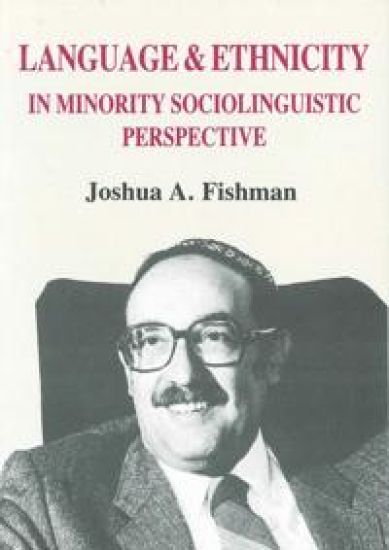
A selection of Professor Fishman's writings, during the past two decades, on language and ethnicity in minority perspective, this volume concentrates on six major topics: • What is ethnicity and how is it linked to language? • Language maintenance and language shift in ethnocultural perspective • The ethnic dimension in language planning • Language and ethnicity in education: the bilingual minority focus • Elites and rank-and-file: contrasts and contexts • Ethnolinguistic homogeneity and heterogeneity: national and international causes and consequences. Each major topic is prefaced by a specially written introduction, as is the volume as a whole, thereby integrating the material and focusing it on minority group concerns. Joshua Fishman's well-known dedication to worldwide cultural democracy and cultural pluralism, not only as moral imperatives but as empirical assets, shines through all of these selections and unifies them philosophically as well as scientifically.
The Contributions to the Sociology of Language series features publications dealing with sociolinguistic theory, methods, findings and applications. It addresses the study of language in society in its broadest sense, as a truly international and interdisciplinary field in which various approaches – theoretical and empirical – supplement and complement each other. The series invites the attention of scholars interested in language in society from a broad range of disciplines – anthropology, education, history, linguistics, political science, and sociology. To discuss your book idea or submit a proposal, please contact Natalie Fecher.