

Kirjojen hintavertailu – 12 859 818 kirjaa ja 27 kauppaa

Kirjailija

Joshua Decter

Kirjat ja teokset yhdessä paikassa: 2 kirjaa, julkaisuja vuosilta 2013–2020, suosituimpiin kuuluu What about Activism?. Vertaile teosten hintoja ja tarkista saatavuus suomalaisista kirjakaupoista.

2 kirjaa

Kirjojen julkaisuvuodet: 2013–2020.

What about Activism?

What about Activism?

Steven Henry Madoff; Carolyn Christov–bakarg; Joshua Decter; Mick Wilson; Nato Thompson

Sternberg Press
2020
nidottu
Curators and thinkers about contemporary art consider how to engage audiences in creative forms of protest and advocacy. With the global rise of a politics of shock, driven by nationalist and authoritarian regimes, what paths to resistance and sites of sanctuary can cultural institutions offer? In this book, more than twenty of the world's leading curators and thinkers about contemporary art offer powerful case studies from their own work, along with historical and theoretical perspectives, that point the way for cultural producers everywhere to engage audiences in creative forms of protest and advocacy capable of confronting the fierce political challenges of today and tomorrow. ContributorsDefne Ayas, Ute Meta Bauer, Nicolas Bourriaud, Carolyn Christov-Bakargiev, Joshua Decter, Cl mentine Deliss, Irmgard Emmelhainz, Boris Groys, Hou Hanru, Pi Li, Maria Lind, Steven Henry Madoff, Antonia Majaca, Gabi Ngcobo, Hans Ulricht Obrist, Jack Persekian with Alison Ramer, Mar a Bel n Sa z de Ibarra, Terry Smith, Nato Thompson, Mick Wilson, Brian Kuan Wood, Tirdad Zolghadr
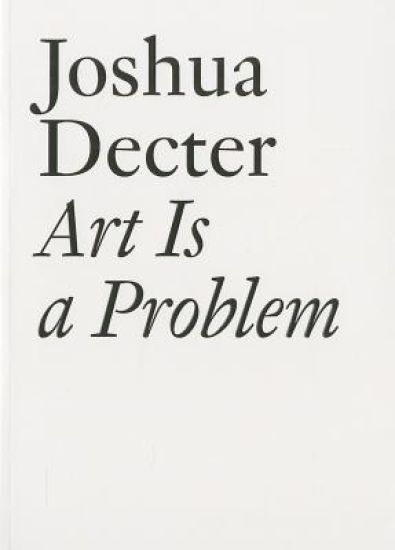
Joshua Decter

Joshua Decter

Joshua Decter

JRP Ringier
2013
nidottu
This volume of selected essays, interviews, reviews and curatorial texts, spanning the 1986-2011 period, represents a significant part of Joshua Decter's ongoing work as a critic, curator and educator. In fact, the writings presented here--as edited by John Miller--form a discourse that engages the interrelationship of these vocations. Decter rejects the conventional form-content dichotomy; rather, he views the artwork from a public perspective and consistently probes its placement in a cultural continuum, and the social relations organized around it. Among the topics Decter addresses in "Art Is a Problem" are: institutional critique, the relationship between art and politics, the privatization of the public sphere and curatorial practices. "If art is a problem," he says, "this book does not claim to be the solution a more difficult question to consider is whether art ever did pose any problems--and what criteria would we use to measure this?"